







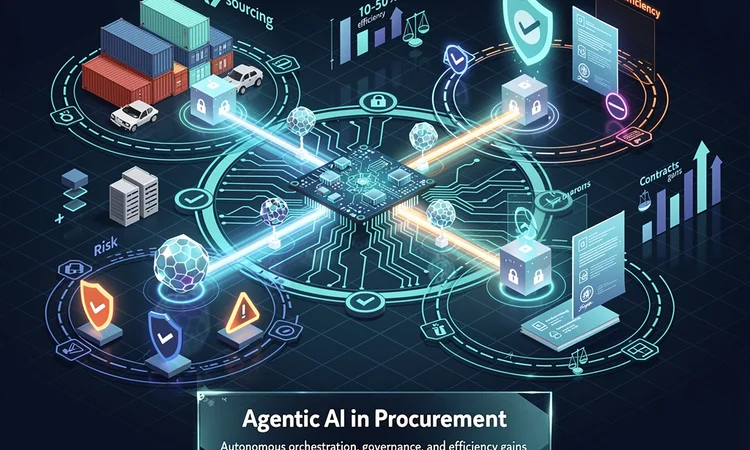
In the high-stakes arena of global procurement, agentic AI is emerging as the decisive force, transforming fragmented workflows into autonomous, intelligent operations. Unlike traditional automation tools that merely execute predefined scripts, agentic AI operates independently within defined boundaries, incorporating real-time feedback loops and dynamic data analysis to adapt actions amid volatility. This shift promises procurement leaders unprecedented control, clarity, and collaboration in managing complex supply networks.
Sonali Bhavsar, head of data and AI at GEP, emphasizes the foundational role of quality data: “It’s important that your foundation is very strong.” Without robust data governance, agentic systems falter, leading to flawed supplier vetting or compliance oversights, as detailed in a Supply Chain Brain analysis.
Recent advancements underscore this evolution. Zip introduced agentic procurement orchestration, projecting that by 2026, 30% of its 58 million request approvals will be handled autonomously by AI agents, automating intake-to-pay cycles with precision.
From Reactive Tools to Proactive Orchestrators
Agentic AI redefines procurement orchestration by shifting from retrospective dashboards to proactive risk mitigation. Systems now analyze contract performance, market signals, and supply disruptions in real time, flagging anomalies like compliance breaches before escalation. Bhavsar notes, “If you come with proactive risk mitigation, you’re going to be in a much better space to really look forward.”
In practice, GEP’s platforms set entry and exit criteria for workflows, suggesting optimal suppliers and monitoring compliance while escalating ethical or financial decisions to humans. Oracle’s Fusion Cloud SCM integrates Model Context Protocol for seamless data pulls from multi-vendor ecosystems, enabling agents to automate planning and fulfillment, as reported by Forbes .
Deloitte forecasts that improved agent orchestration could boost the autonomous AI market by 15% to 30%, reaching $45 billion by 2030, driven by multi-agent systems coordinating across languages and protocols.
Real-World Deployments Drive Tangible Gains
Zip’s AI Summit unveiled agents for purchase-to-pay, supplier onboarding, and risk orchestration, handling 14 million requests in 2024 with scalability to 58 million by 2026. Zycus reported a Fortune 500 manufacturer achieving 2% savings on 3,000+ tail-spend negotiations via autonomous agents, projecting $1 trillion in enterprise value by 2026 per industry estimates.
C.H. Robinson’s Agentic Supply Chain deploys 30+ connected agents for logistics planning, executing millions of tasks from procurement to replenishment, leveraging Lean AI for continuous improvement, according to FT.com .
GEP highlights agents scanning supplier databases in real time for optimal matches, while Hackett Group’s 2025 study shows early adopters gaining 10-25% productivity boosts in effectiveness and cost efficiency, as covered by Spend Matters .
Multi-Agent Systems Scale Complexity
2026 marks the rise of orchestrated multi-agent teams, replacing single agents with specialized collaborators for end-to-end tasks. Gartner’s 1,445% surge in multi-agent inquiries signals this trend, with protocols like Anthropic’s MCP and Google’s A2A enabling interoperability, per MachineLearningMastery.com .
In procurement, agents triage intake, detect risks, coordinate sourcing, and trigger reviews autonomously. BCG notes agents auto-resolving tickets, rerouting supplies, and initiating procurement flows, accelerating processes by 30-50% while cutting low-value work by 25-40%.
Lyzr AI’s Procurement Agents reduce vendor discovery from days to minutes, achieving 99.2% OCR accuracy and 40-60% TCO reductions across strategy, compliance, and management.
Governance and Risks in the Autonomous Era
Autonomy demands rigorous oversight. Singapore’s Model AI Governance Framework for Agentic AI addresses amplified risks like hallucinations and prompt injections through agent components, urging dynamic frameworks. Deloitte warns of agent sprawl across frameworks, advocating human-on-the-loop models with telemetry dashboards.
Bhavsar cautions that non-adopters risk losing savings and insights: “It is absolutely a must in today’s world.” Procurement leaders must collaborate with AI officers on data reliability, defining boundaries for fairness and regulations.
Forrester highlights breach risks without orchestration, while 92% of CPOs plan GenAI investments exceeding $1 million annually, per Deloitte, prioritizing operationalization over tools.
Vendor Innovations Fuel Adoption
SAP previews agentic assistants for supply chains, analyzing data for cost cuts. Coupa’s agents handle supplier queries and sourcing via natural language, per Forbes . Veeva Systems rolls out industry-specific agents for Vault Platform by 2026.
John Galt Solutions integrates agentic AI in Atlas for context-aware planning. Freight Technologies’ Zayren Pro shifts to actionable procurement, as noted in recent X discussions.
Gartner predicts 40% of enterprise apps embedding agents by 2026, up from 5%, with federal sectors demanding operationalization, according to Nextgov/FCW .
Strategic Imperatives for CPOs
ProcureCon’s 2025 CPO Report reveals 90% considering AI agents, with 40% eyeing enterprise value beyond savings. Infosys BPM urges C-suites to invest in governance and skills for adaptive functions.
Bhavsar advises: “Get familiar with agentic AI in your world.” Leaders blending human judgment with AI orchestration will elevate procurement, as GEP asserts, driving outcomes in sourcing and contracting.
As 2026 unfolds, agility defines winners, with agentic AI turning procurement into a resilient, value-creating powerhouse.






Leave a Reply
Your email address will not be published.