
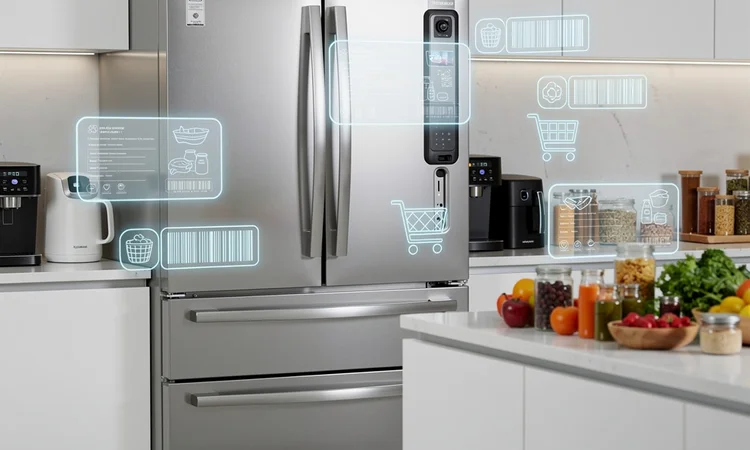
In the bustling world of home appliances, where innovation often promises to simplify daily chores, General Electric has unveiled a refrigerator that could redefine how households manage their groceries. Announced just ahead of the Consumer Electronics Show in 2026, the GE Profile Smart 4-Door French-Door Refrigerator integrates a built-in barcode scanner, a camera system, and seamless connectivity with Instacart, aiming to automate the tedious task of inventory tracking and shopping list creation. This isn’t just another smart fridge with a touchscreen; it’s a device that actively scans items as they’re placed inside, recognizes when supplies are low, and populates a digital shopping cart without user intervention.
The core feature revolves around the patented barcode scanner, embedded in the fridge’s interior. Users simply wave an item’s barcode in front of the scanner upon restocking, and the system logs it into an inventory database. As items are depleted—detected via internal cameras that monitor shelves—the fridge automatically adds them to a grocery list accessible through a companion app or an integrated 8-inch tablet on the door. This integration with Instacart allows for one-tap ordering, potentially turning the refrigerator into a proactive household manager. According to details from Engadget , the technology draws on AI to predict needs based on usage patterns, such as suggesting milk refills if the scanner notes frequent scans of cereal boxes.
Industry observers note that this launch comes at a time when consumers are increasingly seeking ways to reduce mental load in the kitchen. GE’s press release highlights how the Kitchen Assistant feature—essentially the fridge’s AI brain—can even scan perishables for freshness, alerting users to impending expirations via notifications. Priced at around $3,500, the 27.9 cubic foot model positions itself as a premium offering, blending French-door aesthetics with cutting-edge tech that could appeal to busy families and tech-savvy professionals alike.
Unpacking the Technology Behind the Scan
Delving deeper into the mechanics, the barcode scanner isn’t a mere gimmick; it’s powered by advanced optical recognition software that interfaces with a vast database of product UPC codes. This allows the fridge to identify not just the item but also its typical shelf life and nutritional data, which can feed into meal planning suggestions. The internal cameras, meanwhile, use computer vision algorithms to estimate quantities—say, how many eggs are left in a carton—without requiring manual input. GE claims this reduces food waste by up to 20%, a statistic echoed in early reviews from tech sites.
Integration with Instacart is particularly noteworthy, as it leverages the delivery service’s API for real-time pricing and availability checks. Users can customize preferences, like opting for organic alternatives or specific brands, and the system learns from past orders to refine suggestions. As reported by The Verge , this fridge builds on previous smart kitchen experiments but introduces a level of automation that feels genuinely hands-off, distinguishing it from competitors like Samsung’s Family Hub, which relies more on manual list-building.
For industry insiders, the real intrigue lies in the data ecosystem. GE’s appliance connects to the company’s broader smart home platform, potentially sharing insights with other devices like ovens or pantries. This could enable scenarios where the fridge communicates with a smart oven to suggest recipes based on available ingredients, further embedding AI into everyday cooking routines.
Market Positioning and Competitive Edges
Positioned against a backdrop of evolving consumer behaviors, GE’s fridge taps into the growing demand for connected kitchens. Recent posts on X highlight user excitement, with many praising the potential for seamless grocery automation amid rising food costs and time constraints. One viral thread discussed how such tech could alleviate the “mental load” of meal planning, drawing parallels to earlier innovations like Amazon’s Dash buttons.
Comparisons to rivals are inevitable. LG and Samsung have long dominated the smart fridge segment with features like door-in-door access and integrated screens, but GE’s barcode focus addresses a specific pain point: forgetting what’s inside. Mashable notes in its CES coverage that while Samsung’s models offer recipe apps and family calendars, they lack this inventory-scanning precision, which could give GE an edge in efficiency-driven markets.
From a business perspective, this launch aligns with GE Appliances’ strategy under Haier ownership to innovate in the premium segment. Sales data from recent years show smart appliances growing at a 15% annual rate, per industry reports, and GE aims to capture a slice by emphasizing practicality over flashy gimmicks. Insiders speculate that partnerships like Instacart could expand to other services, such as Amazon Fresh or local grocers, broadening appeal.
Challenges in Adoption and Privacy Concerns
Yet, no innovation is without hurdles. Early adopters might face compatibility issues, as the scanner relies on standard barcodes; unpackaged produce or bulk items could require manual entry via the app. Moreover, the always-on cameras raise privacy questions—GE assures users that footage is processed locally and not stored in the cloud, but skeptics point to past data breaches in smart home devices.
Cost remains a barrier; at $3,500, it’s a significant investment compared to basic models under $1,000. Tom’s Guide highlights in its review that while the tech justifies the price for high-income households, broader adoption might hinge on scaled-down versions or subsidies through energy-efficient incentives.
On the regulatory front, as smart devices proliferate, there’s increasing scrutiny over energy consumption and e-waste. GE’s model boasts Energy Star certification, but insiders worry about the environmental impact of embedded electronics that could shorten appliance lifespans.
Broader Implications for Kitchen Innovation
Looking ahead, this fridge exemplifies a shift toward predictive appliances that anticipate needs rather than merely respond. Drawing from X discussions, enthusiasts envision ecosystems where fridges integrate with robotic kitchens, like the CA-1 system in Germany that automates cooking, potentially creating fully autonomous home food management.
GE’s approach could influence supply chains, too. By aggregating user data (anonymized, per the company), manufacturers might gain insights into consumption trends, aiding inventory for retailers. GE Appliances’ press room emphasizes how this reduces the “grocery guesswork,” a sentiment echoed in business analyses predicting a $50 billion market for smart kitchen tech by 2030.
For developers and engineers, the open APIs hinted at in the launch could spur third-party apps, from dietary trackers to sustainability monitors, fostering an innovation ecosystem around the device.
Evolving Consumer Expectations and Future Horizons
Consumers today expect appliances to do more than preserve food—they want them to enhance lifestyles. GE’s fridge meets this by blending hardware with software, much like how smartphones evolved from calls to life hubs. Posts on X from tech influencers underscore this, with some comparing it to Amazon Go’s cashierless stores, where sensors automate transactions seamlessly.
Potential expansions include voice control via integrations with Alexa or Google Assistant, allowing verbal queries about inventory while cooking. BusinessWire details how the Kitchen Assistant evolves with over-the-air updates, ensuring the fridge improves post-purchase.
Ultimately, success will depend on user feedback. Pilot programs in select markets could refine features, addressing any glitches in barcode recognition or app usability.
Industry Ripple Effects and Strategic Insights
The ripple effects extend to competitors, who may accelerate their own scanner integrations. Samsung, for instance, has experimented with AI cameras, but GE’s patent could provide a temporary moat. Analysts predict this could boost GE’s market share in North America, where smart home adoption lags behind Asia.
From an investment standpoint, Haier’s backing positions GE to leverage global manufacturing for cost efficiencies. CNET explores how this tech might “change grocery shopping forever,” by making lists dynamic and context-aware.
In supply chain terms, automated reordering could stabilize demand for staples, benefiting producers and reducing waste across the board.
Pushing Boundaries in Home Automation
As kitchens become smarter, ethical considerations emerge. Who owns the data from your fridge? GE pledges transparency, but industry watchers call for stronger standards. X threads debate this, with some users excited about personalized nutrition advice, others wary of surveillance.
Future iterations might include scent sensors for spoilage detection or AR overlays via the tablet for virtual meal prep. Yahoo Finance reports on the launch’s stock impact, noting a bump in investor confidence.
For insiders, this fridge signals a maturation of IoT in homes, where devices don’t just connect—they collaborate to streamline life.
Refining the Vision for Tomorrow’s Kitchens
Refinement will come from real-world use. Beta testers report high accuracy in scanning, but edge cases like faded barcodes pose challenges. GE’s roadmap includes machine learning updates to handle such variances.
Broader adoption could influence urban planning, with smart fridges in apartments reducing trips to stores and easing traffic. Posts on X from urban dwellers highlight this appeal in dense cities.
In essence, GE’s innovation bridges the gap between convenience and intelligence, setting a new benchmark for what a refrigerator can achieve in the modern home.






Leave a Reply
Your email address will not be published.