


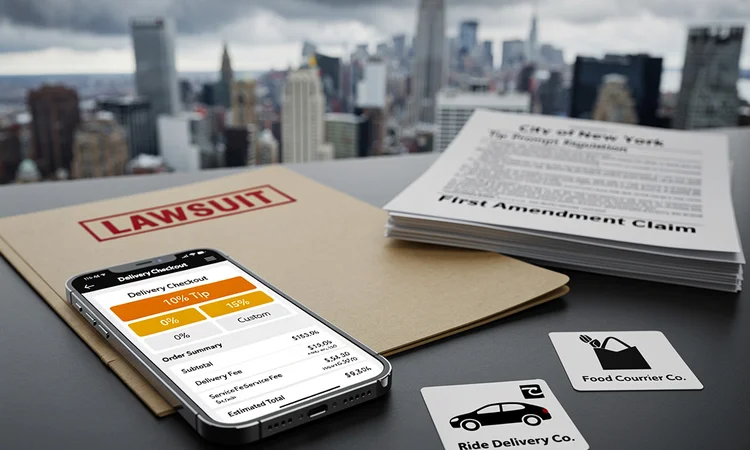
In a bold challenge to New York City’s regulatory reach into app interfaces, Uber Technologies Inc. and DoorDash Inc. have filed a joint federal lawsuit seeking to block a new rule that mandates tipping prompts appear before checkout with a default 10% gratuity option. The litigation, lodged in Manhattan federal court, accuses the city of trampling First Amendment rights by compelling the companies to convey a government-drafted message on their digital platforms. Set to take effect January 26, the regulation stems from Local Law 202, which aims to boost delivery workers’ earnings amid rising operational costs.
The companies argue the mandate forces them to alter their proprietary software in ways that infringe on free speech protections. ‘This law compels apps to speak a government-mandated message,’ the complaint states, echoing broader tensions between tech platforms and local governments over user interface control. DoorDash and Uber, which dominate the $40 billion U.S. food delivery market, previously shifted tip prompts post-checkout in 2023 to mitigate ‘sticker shock’ after NYC enacted a $21.44 hourly minimum wage for drivers, a move that spurred fee hikes and prompted this latest countermeasure.
New York’s Push to Frontload Tips
City officials defend the rule as essential for transparency and worker pay. A New York Times report details how the law requires apps to display tip options at order finalization, pre-set to 10%, 15%, or 20%, with users able to adjust or opt out. This reverses the apps’ post-2023 strategy of delaying prompts until after delivery or even during rating screens, a change implemented after the wage law drove up base fees by up to 46%, per a city-commissioned study.
That study, released last year by the NYC Department of Consumer and Worker Protection, found tips plummeted 68% year-over-year following the wage hike and prompt shift, even as driver earnings rose overall due to mandated minimums. Critics like Uber and DoorDash contend the new rule exacerbates ‘tipping fatigue’ among consumers battered by inflation, potentially curbing order volumes in a sector already squeezed by labor costs and restaurant fees.
Free Speech at the Checkout Counter
The lawsuit invokes landmark Supreme Court precedents like Reed v. Town of Gilbert , positioning app interfaces as protected expressive conduct. ‘The city cannot commandeer private companies’ platforms to push its preferred messaging,’ lawyers for the firms wrote in filings reviewed by Restaurant Dive . This marks the latest salvo in a years-long war: Uber and DoorDash lost a prior suit against the 2023 wage law but succeeded in delaying its full enforcement through appeals.
DoorDash’s public affairs head, Adrian Lappert, framed the stakes in a statement: ‘NYC’s policies are driving up prices and hurting Dashers, restaurants, and customers.’ Meanwhile, labor advocates hail the tip rule as a win for gig workers, who rely on gratuities for up to 70% of income, according to data from the Independent Drivers Guild, a union-backed group.
Fee Spiral and Driver Earnings Data
Post-wage law, average order fees ballooned from $4.50 to $6.60, per the city’s analysis, while tips averaged just 5% of order values down from 12%. A Gothamist investigation notes restaurants have absorbed some costs via lower commissions, but many report 10-15% order drops. Uber’s head of U.S. policy, Chris Nakamoto, told analysts on a recent earnings call that such regulations threaten platform viability in high-cost markets like NYC, where drivers log over 100 million miles annually.
Defendants, represented by the city law department, have yet to respond formally, but Mayor Eric Adams’ administration views the suit as industry pushback against fair pay reforms. ‘Delivery workers deserve every dollar,’ said a spokesperson, citing $500 million in added wages since 2023.
Broader Industry Ripples
The case could set precedents beyond food delivery, testing municipal authority over private app designs in rideshare, e-commerce, and fintech. Similar battles brew in California, where Prop 22’s gig classification faces challenges, and Chicago mulls tip transparency rules. Bloomberg reports investor eyes are on potential impacts: DoorDash shares dipped 2% post-filing, while Uber held steady, buoyed by diversified revenue.
Legal experts predict a drawn-out fight, possibly reaching the Second Circuit or Supreme Court. ‘This pits consumer protection against corporate speech rights,’ said Fordham Law professor Carl Tobias. For insiders, the real wager is on demand elasticity: Will upfront tips deter orders, or stabilize driver retention in a market with 15% annual churn?
Stakeholder Voices and Market Dynamics
Delivery unions like Real Food Workers United back the city, sharing rider testimonials of $2-3 average tips post-shift. Restaurant groups, caught in the crossfire, lobby for exemptions; the New York State Restaurant Association warns of further menu price hikes. On X, sentiment splits: Driver accounts celebrate potential pay bumps, while users decry ‘guilt-trip interfaces’ amid 7% food inflation.
As hearings loom in early 2026, the suit underscores gig economy fault lines—balancing worker protections with platform innovation. With NYC accounting for 10% of U.S. delivery volume, a ruling could reshape fee structures nationwide.






Leave a Reply
Your email address will not be published.