





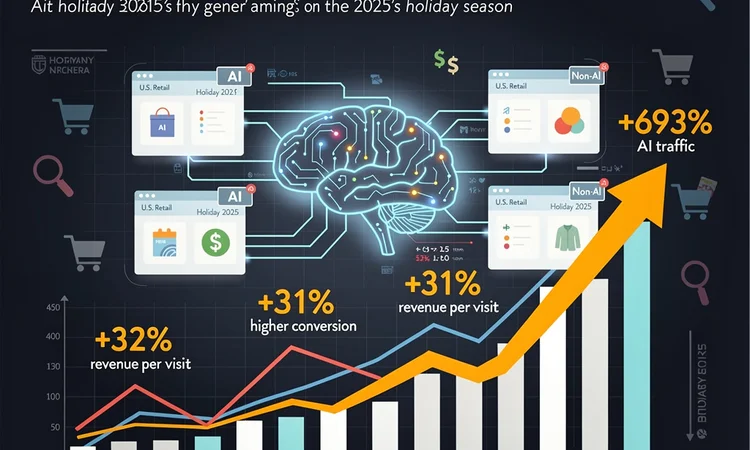
Generative AI tools like ChatGPT, Gemini and Perplexity propelled a staggering 693% year-over-year surge in traffic to U.S. retail sites during the 2025 holiday season from November 1 to December 31, according to Adobe’s Quarterly AI Traffic Report. Analyzing over one trillion visits to retail sites and more than 100 million stock-keeping units, the data reveals AI referrals not only flooded sites but delivered superior performance, converting 31% higher than non-AI sources overall—54% more on Thanksgiving and 38% more on Black Friday.
This shift marks a reversal from 2024, when non-AI traffic outperformed AI by 51% in revenue per visit. In 2025, AI-sourced visitors drove 32% more revenue per visit, alongside 14% higher engagement, 45% longer session times and 13% more pages viewed per session. “AI-driven traffic surged across industries. This means for marketers and retailers alike, we saw deeper engagement is translating directly into higher conversion during the 2025 holiday season,” said Vivek Pandya, director of Adobe Digital Insights, in remarks to Marketing Dive .
The retail boom extended beyond holidays, with triple-digit AI referral growth in travel (539%), financial services (266%) and tech/software sectors. Total U.S. online holiday sales hit a record $257.8 billion, up 6.8% from $241.4 billion in 2024, fueled by 25 days exceeding $4 billion in daily spend—up from 18 days the prior year—as reported by Adobe .
From Novelty to Revenue Engine
AI’s evolution from experimental tool to commerce powerhouse accelerated post-2024’s 1,300% holiday traffic spike. By mid-2025, AI revenue per visit had climbed 84% from January to July versus non-AI sources, narrowing the value gap to 27%. Holiday data confirms consumers trust these channels: 47% expressed confidence in AI results per Adobe’s survey of over 1,000 shoppers. “Traffic from tools like ChatGPT, Gemini and Perplexity is growing rapidly. More importantly, it’s high-quality traffic that converts,” Pandya told Marketing Dive .
Retailers felt the impact acutely. On Black Friday, AI traffic rose 805% year-over-year, per Retail Dive . Mobile dominated, claiming 56.4% of transactions—peaking at 66.5% on Christmas—while buy-now-pay-later hit $20 billion, up 9.8%. Salesforce data echoed the trend, with AI influencing 20% of U.S. holiday retail sales, or $262 billion globally, as shoppers from AI search converted nine times more than social referrals ( Retail TouchPoints ).
Demographics sharpened the picture. High-income states like Virginia, Washington, New York, California and Massachusetts generated twice the national AI engagement average, accounting for 52% of U.S. AI traffic. Urban consumers showed 80% awareness of AI assistants, 48% usage in shopping and 63% planning increased 2026 adoption; rural figures lagged at 67%, 27% and 42%.
Geographic and Economic Divides Emerge
Adoption hinged on exposure over access—Mississippi boasted high online activity but low AI engagement. Nationwide, just 2% of consumers remain unaware of AI assistants, with 46% having used them for shopping and 58% intending to in 2026. High-income areas led, while South and Appalachia trailed, highlighting a digital divide in AI commerce uptake ( Marketing Dive ).
Broader surveys reinforced consumer embrace. Talkdesk’s post-holiday poll found 88% used AI during 2025 holidays, with 56% happier for it and 69% more likely to adopt AI shopping in future seasons. Deloitte noted 33% planned generative AI use—double 2024’s rate—with 26% reporting heightened trust. Salesforce’s Caila Schwartz described it as a “definitive shift to a new era of ‘agentic’ shopping,” powering $1.29 trillion global online holiday sales, up 7% year-over-year ( WWD ).
Tools like Perplexity and Claude gained traction for research, deal-hunting and gift ideas. Adobe observed prompts for phones peaking 40% above 2024 averages pre-Thanksgiving, toys surging 50% in Christmas week. Retailers adapted: Target launched conversational AI gift finders; Amazon enhanced agentic tools for sellers ( Retail Dive ).
Marketers Race to Optimize for AI Discovery
“For retailers and brands, this signals a lasting shift in how consumers discover and evaluate products. Generative AI’s role in commerce isn’t a passing trend. It’s becoming a core part of the digital shopping journey,” Pandya emphasized to Adobe . Marketers must pivot: 75% plan AI for deals per Talkdesk, up from 66% in 2024. Zeta Global saw 25x AI agent growth in holiday campaigns.
X discussions amplified urgency. @KobeissiLetter highlighted the $257.8 billion spend and 693% AI surge, while @NVIDIAAI noted 89% of retail leaders reporting revenue gains from AI. @dsteinberg10000 of Zeta Global touted 153% platform usage jump and 87% time savings via AI agents. Practical Ecommerce cautioned that while percentages dazzle off small bases, AI’s direct visits remain tiny—but influence looms large ( Practical Ecommerce ).
Challenges persist: High returns at 28% pressured margins, per Salesforce, amid tariffs and price sensitivity. Yet AI’s momentum—projected 520% pre-holiday growth—positions it as retail’s next battleground. Winners will embed AI in sites, optimize for LLMs and bridge divides to capture this high-intent traffic.
Charting AI’s Enduring Retail Path
Adobe’s data, drawn from 215 top retailers, signals optimization imperatives. Bounce rates fell as relevance rose; desktop still led AI traffic at 86% early 2025, but mobile share climbed toward one-third. Forrester predicted AI aiding one in five for gifts; Visa and Zeta found 40-83% planning AI use. Global sales hit $1.29 trillion, with U.S. at $294 billion per Salesforce ( Yahoo Finance ).
As 2026 unfolds, 58% of consumers eye more AI shopping. Retailers ignoring this risk obsolescence; adapters like those leveraging NVIDIA’s AI—95% cost reductions—stand to gain. Pandya’s final word: “Marketers should continue to adapt as more consumers turn to large language models to research products, compare options, and make decisions.” The commerce era of AI assistants has arrived.






Leave a Reply
Your email address will not be published.