







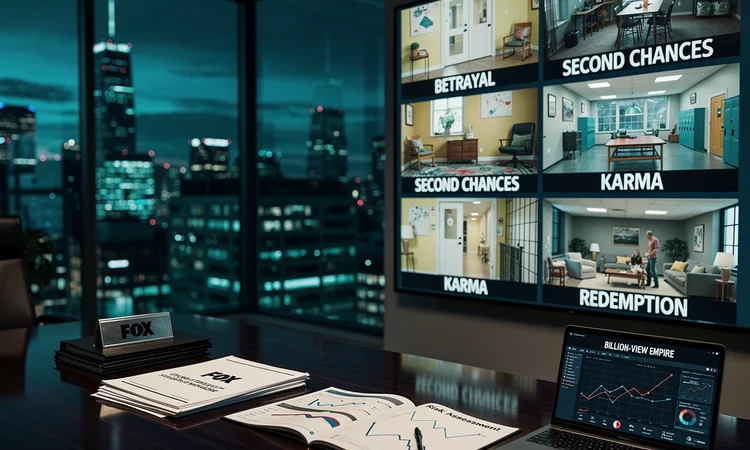
NEW YORK – In the hushed boardrooms of legacy media conglomerates, a new kind of calculus is being run. The spreadsheets and presentations are no longer just about box office returns or Nielsen ratings, but about view counts in the billions and algorithms that crown new kings of content overnight. It is within this disruptive new reality that a name once confined to YouTube and Facebook feeds is increasingly being weighed as a strategic imperative: Dhar Mann.
Mr. Mann, a 39-year-old entrepreneur and filmmaker, has built a digital content empire on a deceptively simple formula: short, moralistic videos where good behavior is rewarded and bad behavior is swiftly punished. His eponymous studio produces a torrent of these “micro-dramas,” which have garnered a staggering 100 billion-plus views across social media platforms. For an industry titan like Fox Corporation, whose success with the ad-supported streamer Tubi hinges on a massive volume of content, the sheer scale of Mr. Mann’s audience represents an unignorable opportunity to capture a demographic that has largely abandoned traditional television.
The appeal is rooted in a production model that is the antithesis of old Hollywood. Dhar Mann Studios operates less like a motion picture studio and more like a high-velocity manufacturing plant for viral narratives. The videos, typically 5 to 10 minutes long, are scripted with predictable emotional arcs, use a recurring troupe of actors, and are optimized for shareability. This content machine has proven so effective that it has made Mr. Mann one of the most-watched content creators on the planet, a distinction that carries immense weight in an era of audience fragmentation.
The Unignorable Economics of Viral Fables
The financial underpinnings of Mr. Mann’s operation reveal a sophisticated understanding of the creator economy. While initial revenue was driven by the standard YouTube and Facebook monetization of ad revenue sharing, the studio’s strategy has evolved significantly. This has culminated in a direct-to-consumer play that should give any potential media partner pause: the 2023 launch of his own free, ad-supported streaming app. As detailed by Forbes , the app not only allows Mr. Mann to consolidate his vast library of content but also to control distribution, advertising, and, most critically, first-party audience data.
This move into a proprietary ecosystem mirrors a broader ambition to build a self-sustaining media brand. By creating his own platform, Mr. Mann bypasses the very distributors, like a Fox-owned Tubi, that might seek to acquire his content. It’s a bold declaration of independence, signaling that he views his operation not merely as a production house for hire, but as a burgeoning network in its own right. Any partnership would therefore be less of an acquisition of talent and more of a negotiation between two distinct, if vastly different-sized, media entities.
For a legacy player, the value proposition extends beyond just licensing Mr. Mann’s back catalog. The true prize is his proven ability to create content that reliably engages a massive audience at a fraction of the cost of a traditional scripted television show. Integrating this low-cost, high-volume production methodology could provide a significant competitive advantage in the brutal streaming wars, where content budgets are under intense scrutiny from Wall Street and the demand for new material is insatiable.
A Content Engine Built for the Algorithm, Not the A-List
The efficiency of the Dhar Mann Studios production model, however, has also become its greatest source of controversy and a significant liability for any potential corporate suitor. The studio’s relentless focus on output has led to public disputes with the very actors who populate its viral videos. In early 2023, a group of these actors began protesting outside the studio’s facilities, alleging they were being paid unsustainable wages that made it impossible to earn a living, as reported by NBC News . The protests highlighted a fundamental disconnect between the billions of views the content was generating and the compensation for the on-screen talent.
These labor disputes cast a shadow over the wholesome, feel-good brand Mr. Mann has meticulously cultivated. One actor described the studio as a “content factory” where performers were treated as interchangeable parts in a system designed for mass production. These allegations, which gained significant traction online, were further detailed by Rolling Stone , creating a public relations challenge that a publicly-traded company like Fox would have to carefully vet. The risk of brand association with these labor issues is not insignificant.
Furthermore, the creative formula itself, while effective for social media, presents integration challenges. Mr. Mann’s videos are built on a rigid narrative structure that, while comforting to his core audience, may not translate well to longer formats or different platforms without significant creative evolution. The question for a partner is whether the “secret sauce” of his success is the moralistic storytelling or the algorithm-friendly format—and whether one can exist without the other.
Navigating the Perils of a Creator-Led Kingdom
The strategic calculus for a media giant considering a partnership with a creator of Mr. Mann’s stature is therefore fraught with complexity. The upside is clear: immediate access to a colossal, digitally native audience and a proven content-generation engine. The downside, however, is a tangled web of reputational risk, creative control issues, and the challenge of integrating a fiercely independent digital-first brand into a corporate hierarchy. Mr. Mann is not simply talent to be managed; he is the founder, CEO, and creative visionary of his own kingdom.
This dynamic is a defining feature of the modern media environment. Creators with massive followings are no longer just waiting for a call from Hollywood; they are building their own Hollywoods. This shift in power can be seen in deals across the industry, such as the one between Jimmy Donaldson, better known as MrBeast, and Amazon’s Prime Video for a reality competition series. As noted by Variety , that deal involves a record-breaking prize but also cedes a degree of control to a creator with a very specific and demanding vision for his content. Any deal with Mr. Mann would require similar, if not greater, concessions.
The central question for an executive at Fox or any other major studio is one of control versus scale. Is it worth absorbing the potential brand damage from labor disputes and ceding creative authority to Mr. Mann in exchange for his audience? For a platform like Tubi, which thrives on volume and niche content, the answer may be a qualified yes. His content is brand-safe in its messaging, and his production model could be scaled further with a significant capital injection. The challenge would lie in structuring a deal that insulates the parent company from operational controversies while capitalizing on the content’s proven appeal.
From Social Feeds to Streaming Services: A Bridge Too Far?
Ultimately, the conversation around a potential Dhar Mann partnership is a microcosm of the fundamental transformation underway in media. The monolithic gatekeepers of content are being forced to reckon with decentralized, creator-led networks that command as much, if not more, attention than their own cable channels and streaming services. The path forward is not about simply acquiring these creators, but about forging new kinds of partnerships that respect their autonomy and audience relationship.
The success of such a venture would depend on finding a middle ground. Mr. Mann would gain access to a global distribution and advertising sales infrastructure far beyond his current capabilities, potentially turning his moral fables into a global television phenomenon. The media partner would gain a turnkey content solution and a direct line to a younger generation of viewers. Yet the cultural clash between a nimble, controversial, and personality-driven digital studio and a legacy media corporation remains the single greatest obstacle.
As the industry continues to grapple with shifting viewer habits and economic pressures, the allure of proven digital successes will only grow stronger. Whether Dhar Mann ultimately chooses to build his empire independently with his own app or joins forces with a traditional media giant remains to be seen. But the fact that the possibility is being seriously weighed in executive suites is a clear sign that the viral, feel-good videos dominating social media feeds are now a serious business with which the entire industry must contend.






Leave a Reply
Your email address will not be published.