



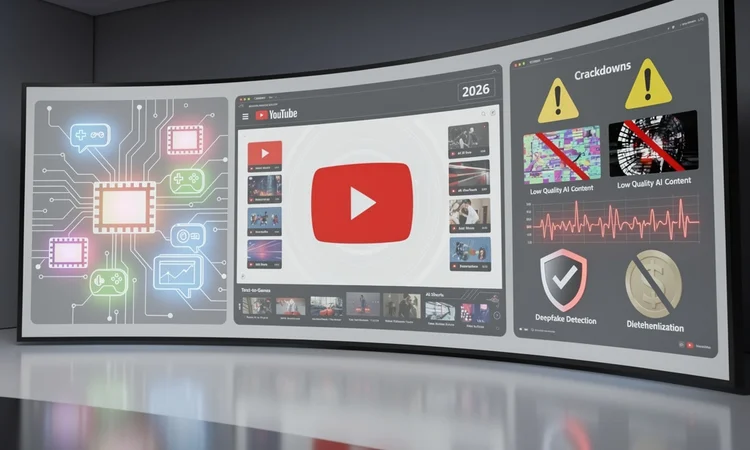
YouTube, the world’s largest video platform, faces a pivotal challenge in 2026: harnessing artificial intelligence to fuel creator innovation while eradicating low-quality “AI slop” that threatens user trust and engagement. CEO Neal Mohan laid out this dual strategy in his January 21 annual letter, promising new AI tools even as the company vows to intensify moderation against repetitive, machine-generated drivel. “The rise of AI has raised concerns about low-quality content, aka ‘AI slop,’” Mohan wrote on the YouTube Blog . This tension underscores a broader industry struggle, where platforms promote generative tech but grapple with its excesses.
Merriam-Webster crowned “slop” its 2025 Word of the Year, defining it as low-quality digital content mass-produced by AI, a phenomenon now flooding feeds. Studies indicate over 20% of videos recommended to new users qualify as such, including mindless clips aimed at infants. YouTube’s response builds on mid-2025 monetization overhauls targeting “inauthentic” and repetitious uploads, with permanent demonetization for undisclosed realistic AI content under new transparency rules, as detailed by Falkon Digital .
The platform’s algorithm now favors E-E-A-T—Experience, Expertise, Authoritativeness, Trustworthiness—penalizing purely automated videos lacking a “human in the loop.” Low-effort AI fare sees up to 5.44 times less traffic, often plateauing below 1,000 views.
Embracing the New Creative Frontier
Contrasting its crackdown, YouTube is rolling out creator-centric AI features. In December 2025, over 1 million channels used on-platform tools daily, with 20 million queries via the Ask feature for video insights like song lyrics or recipes. Upcoming: AI-generated Shorts using creators’ likenesses, text-to-game prompts on the no-code Playables platform, and experimental music tools. “AI will act as a bridge between curiosity and understanding,” Mohan stated, emphasizing it as “a tool for expression, not a replacement.” Over 6 million daily viewers watched 10+ minutes of auto-dubbed content that month.
These initiatives position AI as a booster for high-value output. Google DeepMind’s Veo 3 powers some tools, tested with Shorts creators. Yet, all in-house AI content gets automatic labels, and creators must disclose external alterations, per policies since 2023 but tightened in 2025.
Mohan’s letter highlights creators as “the new stars & studios,” citing examples like Jesser for Super Bowl coverage and Ms. Rachel’s Emmy nods. YouTube claims #1 U.S. streaming watchtime for nearly three years, per Nielsen.
Fortifying Against Deepfakes and Misuse
Transparency is central: Labels for synthetic media, removal of harmful deepfakes violating guidelines, and expanded likeness detection for Partner Program members to block unauthorized face use. YouTube backs the NO FAKES Act for copyright safeguards. “It’s becoming harder to detect what’s real and what’s AI-generated. This is particularly critical when it comes to deepfakes,” Mohan noted, as covered by CNBC .
Enforcement examples abound. In December 2025, channels like Screen Culture and KH Studio—pumping fake movie trailers mixing official clips with AI—were terminated after re-monetizing post-suspension, breaching spam policies, per Ars Technica . Mid-2025 saw demonetization of networks spreading AI fake news on celebrities using deepfakes and robotic narration.
July 15, 2025, Partner Program updates mandated “significantly original and authentic” content, demonetizing mass-produced AI like text-to-video clips, stock footage with voiceovers, or batch uploads, as reported by Mashable and CineD .
Creator Economy Under the Microscope
YouTube has paid $100 billion to creators since 2021, contributing $55 billion to U.S. GDP in 2024. Yet slop dilution risks this. Features like voice replies—10-second audio comment responses—promote human connection. Marketers applaud the cleanup for elevating CPMs, while some creators fear overreach, with false flags reinstated after outcry, noted Forbes .
The Los Angeles Times highlighted parental concerns over AI kids’ content designed for endless viewing, prompting stronger controls like Shorts timers. Los Angeles Times quoted Mohan: “As an open platform, we allow for a broad range of free expression while ensuring YouTube remains a place where people feel good spending their time.”
Joe Green captured the contradiction in Marketing Tech News : YouTube invests in AI while reducing low-quality derivations, leaving uncertainty on algorithmic favoritism toward in-house tools.
Balancing Openness and Quality
YouTube’s playbook evolves from 20 years combating spam, now AI-augmented. Engadget notes wariness of slop matches viewer sentiment, with platform AI content explicitly “in no way slop.” Critics worry automation errors could hit legit creators, echoing past over-censorship.
Ultimately, success hinges on execution: Will viewers reject flagged external AI while embracing endorsed tools? As Mohan bets on undiscovered talents, YouTube’s 2026 hinges on distinguishing genuine expression from automated filler, preserving its role as culture’s epicenter.



Leave a Reply
Your email address will not be published.