



Apple Inc. reported blockbuster fiscal first-quarter results on January 29, 2026, with iPhone revenue surging amid renewed demand in China and elsewhere, yet executives warned of mounting supply hurdles that could cap the company’s growth trajectory. CEO Tim Cook disclosed that constraints on advanced-node system-on-chips from Taiwan Semiconductor Manufacturing Co. are limiting iPhone production, even as orders pour in. Finance chief Kevan Parekh forecasted second-quarter revenue growth of 13% to 16% year-over-year, a figure that already factors in these bottlenecks. CNBC highlighted Cook’s candid assessment: “The constraints that we have are driven by the availability of the advanced nodes that our SoCs are produced on, and at this time, we’re seeing less flexibility in supply chain than normal, partly because of our increased demand.”
This admission underscores a pivotal shift in the semiconductor arena, where Apple’s longstanding dominance as TSMC’s premier client is eroding under pressure from artificial intelligence workloads. Nvidia Corp. has reportedly eclipsed Apple as TSMC’s top revenue generator in recent quarters, commanding priority for high-performance computing chips that consume vast fab capacity. Reports indicate Apple must now “fight” for allocation at TSMC’s facilities, facing price hikes of 8% to 10% on sub-5-nanometer processes starting in 2026, including the forthcoming A20 chip for iPhone 18 models. 9to5Mac detailed how AI-driven GPUs from Nvidia and Advanced Micro Devices Inc. occupy larger wafer footprints, squeezing space for Apple’s mobile silicon.
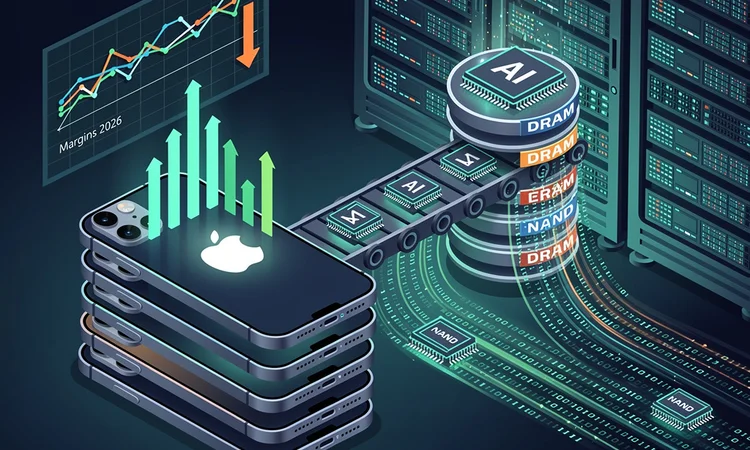
The plot thickens with skyrocketing memory costs, as producers like Samsung Electronics Co. and SK Hynix redirect capacity toward high-bandwidth memory for AI data centers, starving smartphone DRAM and NAND supplies. Samsung reported DRAM prices jumping over 30% quarter-over-quarter, with NAND up 20%, trends expected to persist through 2026. Apple, despite long-term contracts buffering it through early 2026, anticipates sharper impacts post-Q1, prompting quarterly negotiations instead of biannual ones. Los Angeles Times quoted IDC analyst Francisco Jeronimo: “This is not just a cyclical shortage… but a potentially permanent, strategic reallocation of the world’s silicon wafer capacity.”
AI’s Relentless Capacity Grab
TSMC’s advanced nodes, critical for Apple’s A-series and M-series processors, are under siege from AI demand. The foundry dominates over 90% of leading-edge production, but high-performance computing now accounts for 58% of its sales, up from smartphone-centric eras. Nvidia’s ascent to TSMC’s largest customer—potentially surpassing Apple’s 16-20% share—has flipped pricing dynamics, with Apple hit by its steepest hikes ever on A20 chips. Supply-chain whispers suggest expedited “hot runs” command 50-100% premiums, a tactic some clients employ to leapfrog queues. Financial Content noted this hierarchy upheaval as of January 15, 2026.
Apple’s response includes diversification overtures, with rumors of renewed Intel Corp. ties for base-model chips on 18A and 14A nodes by 2027-2028, leveraging U.S. fabs under CHIPS Act funding. Yet TSMC remains irreplaceable for premium silicon, as Samsung’s yields falter. Meanwhile, ancillary shortages compound woes: Japanese firm Nitto Boseki’s glass cloth monopoly for circuit boards is strained, pitting Apple against Nvidia and Qualcomm Inc. X posts from analysts like @utsavtechie amplified this, warning of device price ripple effects.
Gross margins offer a silver lining, projected at 48-49% for Q2, buoyed by services growth and U.S. manufacturing pushes. Apple sourced 20 billion domestic chips in 2025, exceeding targets via a $600 billion five-year commitment, including TSMC’s Arizona plants ramping 2nm output in 2026. Cook emphasized: “As always, we’ll look at a range of options to deal with that,” regarding memory. Still, analysts like those at Morgan Stanley foresee 50%+ DRAM hikes in Q1 2026 contracts. iDrop News pegged TSMC 2nm wafers at $30,000, up from $20,000 for 3nm.
Memory Market’s AI Overhaul
The 2024-2026 memory crisis, chronicled on Wikipedia , stems from HBM prioritization, leaving legacy chips for devices like iPhones in limbo. Counterpoint Research predicts global smartphone shipments dropping 2.1% in 2026 due to chip costs, with IDC forecasting a 0.9% dip tied to Apple’s base model delays. HP Inc. slashed 2026 earnings guidance by 30 cents per share from memory alone, per executives. Samsung’s profits tripled on these surges, signaling prolonged pain.
Apple’s scale provides leverage—analyst Ming-Chi Kuo expects iPhone 18 base prices to hold steady at $799, absorbing hits via services revenue. Yet X chatter from @jukan05 reveals clients paying double for TSMC priority, and @BenBajarin charted Nvidia’s priority ascent. Cook noted iPhone market-share gains over Android, hinting at procurement edge amid peers’ struggles. Reuters reported Q2 forecasts baking in constraints, with no visibility beyond March.
U.S. policy adds layers: tariffs and export curbs prompted Apple to source India-bound iPhones stateside, while TSMC’s $56 billion 2026 capex signals AI confidence over consumer recovery. Foxconn, once iPhone-centric, now derives more from AI servers. Business Insider framed Apple’s grip loosening as partners pivot.
Strategic Maneuvers Amid Bottlenecks
Apple boosted A19 orders by 4-5 million units post-iPhone 17 launch, per Digitimes , prompting TSMC reallocations. Yet 2nm shortages loom despite Apple securing nearly half initial capacity for A20 Pro. Reports of Cupertino executives embedding in Korean hotels underscore desperation for oversight. Emarketer’s Jacob Bourne warned: “Manufacturers might absorb some costs but… it is certainly going to show up as higher prices for consumers.”
For insiders, the calculus is clear: Apple’s $144 billion Q1 revenue masks execution risks. iPhone 17’s China rebound—share above 20% in late 2025—fuels optimism, but Mac and wearables softness tempers it. TSMC’s optimism persists, claiming memory fluctuations have “limited impact” on high-end demand. As Parekh put it, Q2 growth “comprehends our best estimates of constrained iPhone supply.” X analyst @StackAlphaIO cautioned on 3nm risks persisting.
The endgame? Apple wields $261 billion iPhone revenue power in 2025, per IDC, to navigate this squeeze. Diversification, inventory stockpiles, and services insulation position it better than rivals like HP or Lenovo. Yet as AI reallocates silicon globally, Cupertino’s supply chain mastery faces its sternest test, with iPhone 18 pricing and volumes hanging in balance.






Leave a Reply
Your email address will not be published.