








The Pentagon’s Chief Technology Officer has assembled a team of six seasoned defense technology veterans to lead the department’s most critical technology domains, marking a significant reorganization of how the Defense Department approaches innovation and technological superiority. The appointments, which span expertise from cloud computing to marine biology, represent the military’s evolving understanding that future conflicts will be won or lost based on technological advantage rather than traditional military might alone.
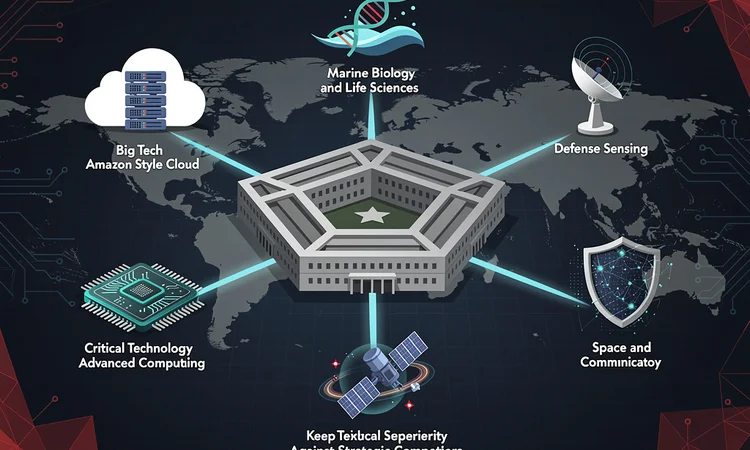
According to Breaking Defense , the newly appointed leaders bring diverse backgrounds ranging from Silicon Valley executives to specialized scientists who have spent years solving unique military challenges. Among them is a former Amazon executive whose experience scaling cloud infrastructure will now be applied to military systems, and a marine biologist whose research into jellyfish stings affecting Navy divers demonstrates the unconventional expertise the Pentagon now values. Each appointee will oversee a Critical Technology Area (CTA), domains identified as essential for maintaining American military dominance in an era of great power competition.
The selection of these six individuals reflects a broader transformation within the Department of Defense, one that acknowledges the inadequacy of traditional procurement processes and organizational structures in keeping pace with rapidly evolving technologies. The Pentagon has increasingly recognized that adversaries, particularly China, have made significant investments in emerging technologies, forcing the United States to fundamentally rethink how it develops, acquires, and deploys military capabilities.
Bridging Silicon Valley and the Pentagon’s Five-Sided Fortress
The appointment of a former Amazon executive to lead one of the CTAs signals the Pentagon’s continued effort to import private sector expertise and methodologies into military technology development. This individual’s background in managing massive-scale cloud infrastructure and data systems addresses one of the Defense Department’s most pressing challenges: modernizing its antiquated IT systems while ensuring security and interoperability across all branches of service. The military’s increasing reliance on data-driven decision-making, artificial intelligence, and distributed computing makes this expertise particularly valuable.
Silicon Valley’s relationship with the Pentagon has been fraught with tension in recent years, as tech companies have faced internal employee resistance to defense contracts while simultaneously pursuing lucrative commercial opportunities in China. The hiring of executives with Big Tech credentials represents an attempt to rebuild bridges between the defense establishment and the innovation hubs that drive technological advancement. These appointments suggest that the Pentagon is willing to adapt its culture and processes to attract talent that might otherwise remain in the commercial sector, where compensation and working conditions typically far exceed government standards.
Unconventional Expertise for Asymmetric Challenges
Perhaps most intriguing among the appointments is the marine biologist who studied jellyfish stings affecting Navy divers. This selection exemplifies the Pentagon’s recognition that military challenges often require specialized scientific knowledge that falls outside traditional engineering or computer science disciplines. Naval operations in tropical waters have long been complicated by jellyfish populations, with stings causing mission delays, medical emergencies, and reduced operational effectiveness. By elevating someone with this specific expertise to lead a CTA, the Defense Department acknowledges that seemingly niche problems can have strategic implications.
The inclusion of such specialized scientific expertise alongside more conventional technology leaders suggests a sophisticated understanding of modern military requirements. Future conflicts will not be won solely through superior weapons systems or communications networks, but through the integration of knowledge across multiple domains—biological, chemical, physical, and digital. The ability to protect personnel from environmental hazards, enhance human performance, or develop biomimetic technologies could prove as decisive as advances in hypersonic missiles or quantum computing.
Critical Technology Areas as Strategic Organizing Principles
The CTA framework itself represents a departure from traditional military organizational structures, which typically align along service branches or functional capabilities. By organizing leadership around technology domains rather than organizational hierarchies, the Pentagon aims to break down silos that have historically impeded innovation and slowed the integration of new capabilities. Each CTA leader will presumably have authority that cuts across service branches, enabling more rapid decision-making and resource allocation.
This approach mirrors organizational strategies employed by leading technology companies, where cross-functional teams focused on specific products or capabilities often outperform traditional hierarchical structures. The challenge for the Pentagon will be ensuring these CTA leaders have sufficient authority and resources to drive change within an institution famous for bureaucratic inertia and inter-service rivalries. Success will require not just technical expertise but political acumen and the ability to navigate complex stakeholder relationships.
The Talent War Between Public and Private Sectors
The appointments highlight an intensifying competition for technical talent between the Defense Department and private industry. While the Pentagon can offer the opportunity to work on problems of national significance and access to resources unavailable in the commercial sector, it struggles to match private sector compensation and often burdens employees with security clearance requirements and bureaucratic processes. The selection of individuals with extensive defense experience suggests the Pentagon is drawing from a pool of professionals who have already demonstrated commitment to national security missions despite these challenges.
These six leaders will face the difficult task of recruiting and retaining talented teams beneath them, a challenge that has bedeviled defense technology initiatives for years. The success of initiatives like the Defense Innovation Unit and the establishment of software factories across the military services has shown that talented technologists will work on defense problems when given autonomy, modern tools, and mission clarity. The CTA leaders must create similar environments within their domains while operating within the constraints of a massive bureaucracy.
Implications for Defense Industrial Base and Innovation Ecosystem
The reorganization around CTAs and the appointment of these leaders will likely have significant implications for defense contractors and the broader innovation ecosystem. Traditional prime contractors accustomed to lengthy development cycles and cost-plus contracts may find themselves competing with more agile companies led by executives who understand modern software development, rapid prototyping, and iterative improvement. The former Amazon executive’s experience with cloud services and platform thinking could accelerate the Pentagon’s shift toward enterprise-level solutions and away from bespoke systems.
Small and medium-sized defense technology companies, along with venture-backed startups, may find new opportunities as CTA leaders seek innovative solutions unconstrained by existing contractor relationships. However, these companies will still need to navigate complex procurement regulations, security requirements, and the challenge of scaling solutions across the massive Defense Department enterprise. The success of these appointments may ultimately be measured not just by the technologies they develop but by their ability to transform how the Pentagon works with its industrial partners.
Measuring Success in an Era of Strategic Competition
The true test of this reorganization will come not in peacetime announcements but in whether the United States maintains technological superiority over strategic competitors. China’s military modernization, Russia’s investments in asymmetric capabilities, and the proliferation of advanced technologies to state and non-state actors create an environment where the margin for error has diminished considerably. The CTA leaders must deliver not just innovative technologies but capabilities that can be rapidly fielded, sustained in contested environments, and integrated with existing systems.
Each of the six appointees brings unique strengths, but they will need to function as a coordinated team to address challenges that span multiple technology domains. Artificial intelligence systems require advanced computing infrastructure; autonomous systems need robust communications networks; and all military capabilities depend on personnel who can operate effectively in demanding environments. The interconnected nature of modern military technology means that success in one CTA often depends on progress in others, requiring unprecedented coordination and collaboration.
As these leaders assume their roles, they inherit both opportunity and obligation. The opportunity lies in shaping technologies that will define military capability for decades to come, with resources and authority that few technologists ever receive. The obligation extends beyond bureaucratic success to ensuring that American service members have the tools necessary to deter conflict and, if deterrence fails, to prevail in combat. The Pentagon’s willingness to entrust these responsibilities to individuals with diverse, sometimes unconventional backgrounds suggests a promising evolution in how the Defense Department thinks about innovation, expertise, and leadership in the twenty-first century.






Leave a Reply
Your email address will not be published.