







In an era where streaming quality has become a battleground for consumer loyalty, millions of Netflix subscribers remain unaware that a single, obscure setting buried deep within their account preferences could dramatically transform their viewing experience. While the platform has invested billions in content creation and delivery infrastructure, a critical quality control feature sits hidden from plain sight, accessible only through deliberate navigation beyond the standard app interface.
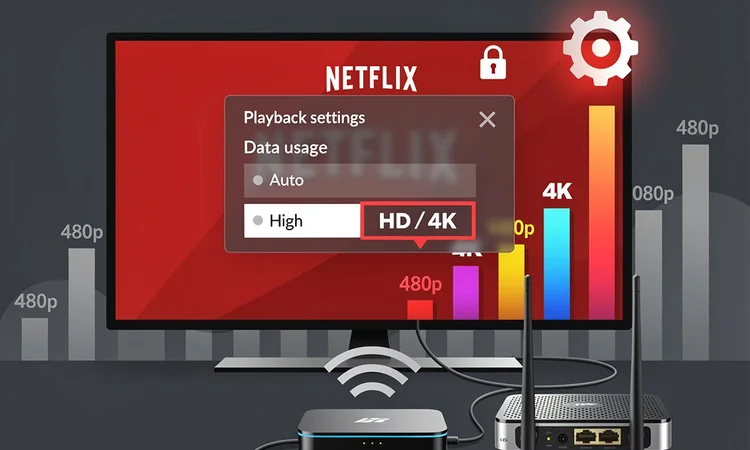
The revelation centers on Netflix’s data usage settings, a configuration option that directly impacts video resolution and bitrate allocation. According to MakeUseOf , this setting defaults to “Auto” for most users, a choice that prioritizes data conservation over visual fidelity. This automatic configuration allows Netflix’s algorithms to dynamically adjust streaming quality based on perceived network conditions, often resulting in compressed video that falls short of what users’ internet connections could actually support. For subscribers paying premium tier prices specifically for 4K and HDR content, this default setting effectively undermines the value proposition of their subscription.
The technical implications extend beyond simple resolution metrics. When Netflix operates in automatic mode, the platform employs adaptive bitrate streaming that responds to momentary fluctuations in bandwidth availability. While this approach prevents buffering interruptions, it frequently sacrifices visual quality during periods when the network could easily handle higher bitrates. Industry analysis suggests that this conservative approach stems from Netflix’s early days of streaming, when bandwidth limitations were more prevalent and buffering represented a primary user complaint. Today’s broadband infrastructure, however, has evolved considerably, with median U.S. download speeds now exceeding 200 Mbps according to recent measurements, far surpassing the 25 Mbps Netflix recommends for 4K streaming.
The Hidden Path to Quality Control
Accessing this transformative setting requires users to abandon the familiar Netflix app interface entirely. The configuration exists exclusively within account settings accessible through a web browser, deliberately separated from the streamlined app experience that most subscribers use daily. Users must navigate to their account page, locate the profile management section, and drill down into playback settings—a journey that MakeUseOf describes as intentionally obscured from casual discovery. This architectural decision reflects Netflix’s broader strategy of minimizing user interaction with technical parameters, preferring algorithmic management over manual control.
Within these playback settings, subscribers encounter four distinct options: Low, Medium, High, and Auto. The Low setting restricts streaming to basic definition quality while consuming approximately 0.3 GB per hour, suitable primarily for mobile viewing on cellular networks. Medium quality delivers standard definition at roughly 0.7 GB per hour, representing the minimum acceptable quality for most modern displays. The High setting, however, unlocks the platform’s full potential, enabling 4K Ultra HD resolution for compatible content and devices while consuming up to 7 GB per hour for premium-tier subscribers. This maximum quality setting bypasses the conservative bandwidth management of Auto mode, instructing Netflix to prioritize visual fidelity regardless of minor network fluctuations.
The Economics of Bandwidth Conservation
Netflix’s decision to default users into Auto mode rather than maximum quality settings reveals the complex economics underlying streaming services. Every gigabyte of data transmitted represents a direct cost to Netflix through content delivery network fees and infrastructure maintenance. By implementing conservative default settings, the company reduces aggregate bandwidth consumption across its 247 million global subscribers, translating to substantial operational savings. This approach particularly benefits Netflix’s bottom line in regions with less developed internet infrastructure, where high-quality streaming would strain both local networks and the company’s delivery costs.
The business model implications extend to subscriber perception and retention. By avoiding buffering interruptions through adaptive quality reduction, Netflix prioritizes seamless playback over visual excellence, betting that most users will tolerate compressed video more readily than loading delays. This calculation appears supported by user behavior data suggesting that buffering events correlate more strongly with subscription cancellations than gradual quality degradation. However, this strategy potentially undermines the value differentiation between Netflix’s Basic, Standard, and Premium tiers, as users paying for 4K access may unknowingly receive lower quality streams due to default settings.
Technical Infrastructure and Delivery Mechanisms
Understanding the quality differential requires examining Netflix’s encoding and delivery architecture. The platform employs sophisticated per-title encoding, analyzing each piece of content to determine optimal compression parameters that balance file size against perceptual quality. This process generates multiple versions of every title at various bitrates and resolutions, stored across Netflix’s global network of edge servers. When a user initiates playback, Netflix’s client software selects from these pre-encoded versions based on the configured quality setting and real-time network assessment.
The Auto setting triggers continuous monitoring of available bandwidth, packet loss, and latency metrics throughout playback. When network conditions fluctuate, the client seamlessly switches between encoded versions, sometimes multiple times during a single viewing session. While this adaptive approach prevents interruption, it introduces inconsistent quality that discerning viewers may notice as periodic shifts in sharpness, color depth, and motion clarity. The High setting, by contrast, locks playback to the highest available bitrate for the user’s subscription tier, maintaining consistent quality even if occasional buffering becomes necessary during network congestion.
The Premium Tier Paradox
For subscribers paying $22.99 monthly for Netflix’s Premium plan, the default Auto setting represents a particularly frustrating limitation. This tier explicitly promises 4K Ultra HD resolution and HDR support, features that require sustained high bitrates to deliver their intended visual impact. Yet without manually configuring playback settings, Premium subscribers frequently receive 1080p or even 720p streams when Netflix’s algorithms detect any bandwidth uncertainty. This quality reduction occurs transparently, without notification to the user, effectively delivering Standard plan quality at Premium plan pricing.
The situation becomes more complex when considering household viewing patterns. Many subscribers access Netflix across multiple devices with varying capabilities—smartphones, tablets, smart TVs, and streaming devices—each potentially requiring different quality configurations. The playback setting applies per profile rather than per device, meaning users must choose between optimizing for their best display or conserving data for mobile viewing. This limitation particularly affects families sharing accounts, where different members may have conflicting quality preferences based on their primary viewing devices and data sensitivity.
Competitive Positioning and Industry Standards
Netflix’s approach to quality settings contrasts notably with competing streaming platforms. Several rivals default to maximum quality delivery, trusting modern broadband infrastructure to support high-bitrate streaming without manual intervention. This competitive dynamic places Netflix at a potential disadvantage among videophile subscribers who prioritize visual quality and possess the technical knowledge to compare streaming performance across services. As the streaming market matures and content libraries increasingly overlap, quality differentiation may become a more significant factor in subscriber acquisition and retention.
The broader industry trend points toward transparency and user empowerment in quality control. Emerging streaming platforms increasingly surface quality settings within their primary interfaces, recognizing that today’s subscribers possess both the technical literacy and bandwidth capacity to make informed choices about their viewing experience. Netflix’s decision to maintain obscured quality controls reflects its origins as a disruptive innovator focused on accessibility and simplicity, but this philosophy may require evolution as subscriber expectations mature alongside streaming technology.
Practical Implementation and User Considerations
For subscribers determined to maximize their viewing quality, implementing the High setting requires careful consideration of their specific circumstances. Users with unlimited broadband connections and 4K-capable displays represent the ideal candidates for maximum quality streaming, as they can fully utilize the enhanced resolution without data cap concerns. However, households approaching monthly data limits or sharing bandwidth across multiple simultaneous streams may find the sevenfold increase in data consumption from Low to High settings economically or practically prohibitive.
The optimal configuration also depends on content type and viewing context. Visually complex programming such as nature documentaries, action films, and prestige dramas benefits substantially from high-bitrate delivery, where enhanced detail and color accuracy contribute meaningfully to the viewing experience. Conversely, dialogue-driven comedies and talk shows may show minimal perceptible improvement at maximum quality, making data conservation a more rational choice for such content. Unfortunately, Netflix’s current implementation requires a single quality selection across all viewing, preventing content-specific optimization without manual intervention before each session.
The Path Forward for Streaming Quality
As streaming technology continues evolving, the tension between accessibility and quality will likely intensify. Next-generation codecs promise improved compression efficiency, potentially delivering current 4K quality at significantly reduced bitrates. These advances may eventually render the quality-versus-data tradeoff less consequential, allowing platforms to default to maximum quality without proportional bandwidth increases. However, until such technology achieves widespread deployment, subscribers must navigate the current system’s limitations and hidden controls.
The Netflix quality settings revelation underscores a broader challenge facing streaming services: balancing operational efficiency against subscriber satisfaction in an increasingly competitive market. While hidden settings may optimize Netflix’s cost structure, they risk alienating quality-conscious subscribers who discover they’ve been receiving diminished value without their knowledge or consent. As streaming platforms mature from disruptive innovators to established entertainment pillars, transparency and user control may prove essential to maintaining subscriber trust and loyalty in an era of unlimited entertainment options.






Leave a Reply
Your email address will not be published.