


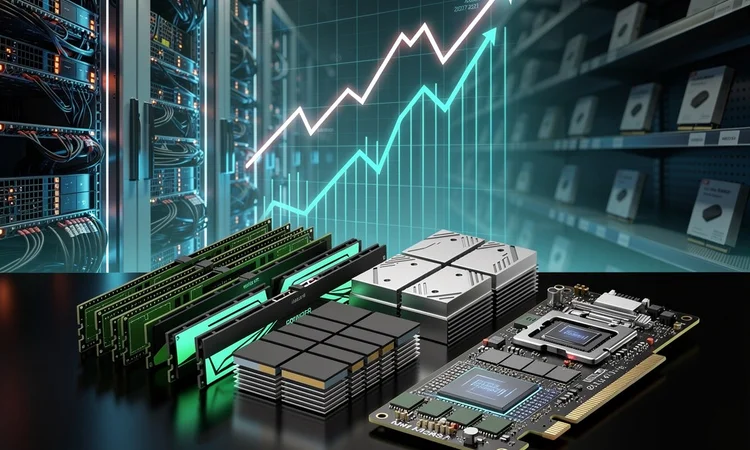
In the fast-evolving world of technology, few components have seen as dramatic a shift in fortunes as random access memory, or RAM. Prices for this essential building block of computing have skyrocketed throughout 2025, leaving consumers, businesses, and even entire industries scrambling to adapt. What began as a subtle uptick in costs has ballooned into a full-blown crisis, with some memory modules doubling or tripling in price within months. This surge isn’t just a blip; it’s a fundamental realignment driven by explosive demand from artificial intelligence applications, particularly in data centers.
At the heart of this upheaval is the insatiable need for high-bandwidth memory (HBM) and advanced DRAM variants to power AI training and inference. Major chipmakers like Samsung, SK Hynix, and Micron have redirected production lines to prioritize these specialized products, which command premium prices from tech giants building out massive AI infrastructure. As a result, the supply of standard DDR5 and DDR4 RAM for everyday devices has tightened dramatically, pushing costs upward across the board.
Industry analysts point to a perfect storm of factors exacerbating the shortage. Global memory production capacity hasn’t kept pace with the AI boom, and new fabrication plants take years to come online. Meanwhile, geopolitical tensions and supply chain disruptions have added layers of complexity, making it harder for manufacturers to ramp up output quickly.
The AI Demand Vortex
The primary culprit behind the RAM price explosion is the rapid expansion of AI data centers. These facilities require vast quantities of high-performance memory to handle the computational loads of training large language models and running generative AI services. According to reports from XDA Developers , mainstream DDR5 modules now cost at least twice what they did in mid-2025, with overall DRAM contract prices surging 171.8% in the third quarter alone. Industry officials attribute this to “explosive demand from AI data centers,” but some skeptics question whether manufacturers are artificially constraining supply to boost profits.
Posts on X, formerly Twitter, echo this sentiment, with users highlighting how companies responsible for a quarter of global DRAM supply have pivoted entirely to AI-focused production, abandoning consumer markets. One such post noted that this shift affects everything from smartphones to PCs, as suppliers like those behind Samsung and Apple devices redirect resources. This reallocation has created a ripple effect, where even older memory types like DDR4 are seeing price rallies due to sustained demand in specific sectors.
Further complicating matters, the introduction of new technologies such as GDDR7 for next-generation GPUs adds pressure on fabrication nodes. As detailed in a blog from BaCloud , strong pull-in demand for these graphics memory types means less capacity for standard system RAM, tightening supplies across segments.
Consumer Fallout and Market Disruptions
For everyday users, the impact is immediate and painful. Building a new PC, once a straightforward endeavor, has become prohibitively expensive. A 64GB DDR5 kit that cost around $209 earlier in the year now fetches upwards of $650, as reported by Jeff Geerling’s blog . This isn’t isolated; some kits have tripled in price over just three months, according to Ars Technica .
Smartphone and laptop manufacturers are also feeling the pinch, with potential price hikes looming for devices that rely on LPDDR5 memory. News from Windows Central warns that these elevated costs could persist for years, disrupting the broader tech market and forcing companies to rethink product roadmaps. In the gaming sector, consoles and GPUs face upward pressure, with forecasts suggesting at least a 30% hike in future hardware prices due to the AI-driven reallocation of resources.
Even beyond hardware, the shortage is influencing software ecosystems. The impending end of Windows 10 support could drive millions of upgrades, further straining already limited supplies, as noted in posts on X from financial analysts. This convergence of factors paints a picture of a market in disarray, where demand outstrips supply at every turn.
Industry Forecasts and Warnings
Looking ahead, experts like Gerry Chen of TeamGroup predict the crisis will intensify into 2026, with DRAM and NAND prices potentially doubling in a single month. In an interview covered by Tom’s Hardware , Chen emphasized that the diversion of capacity to HBM for AI will leave shortages through at least 2027-2028, as new fabs lag behind demand.
TrendForce data, referenced in various X posts, has upgraded projections for Q4 2025 price increases to 18-23% quarter-over-quarter, up from earlier estimates, driven by tightening server DRAM supplies. This outlook aligns with Morgan Stanley’s analysis, which describes the current cycle as a “super cycle” far surpassing historical peaks, fueled by AI rather than traditional PC or smartphone upgrades.
Emerging technologies offer a glimmer of hope, but their impact remains uncertain. Innovations like MRAM, ReRAM, and CXL-attached memory modules could supplement traditional DRAM, particularly in servers, as explored in the BaCloud outlook. However, scaling these to meet global needs will take time, and in the interim, prices are expected to remain elevated.
Historical Parallels and Lessons
This isn’t the first time memory markets have faced upheaval. Past cycles, driven by smartphone booms or cryptocurrency mining, led to similar shortages, but the AI-driven surge feels different in scale and duration. Unlike previous episodes, where supply could rebound within quarters, the current environment involves massive capital investments in AI infrastructure, locking in demand for years.
Analysts at MacroMicro, via X, note that while historical drivers were upgrade waves in consumer electronics, today’s shortages span next-gen products like HBM and DDR5, with even legacy DDR4 benefiting from niche demands in AI inference. This broad-based pressure suggests a more entrenched problem, potentially lasting a decade, as some warnings indicate.
Geopolitical elements add another layer. Trade tensions between the U.S. and China, along with export controls on advanced semiconductors, have influenced production decisions, indirectly contributing to the squeeze on consumer-grade memory.
Strategies for Navigation
For businesses and consumers navigating this turbulent period, adaptation is key. Some PC builders are turning to used markets or downgrading specs to cope with costs, while enterprises delay upgrades or explore alternative architectures. Retailers, facing volatile pricing, have begun selling RAM at market rates akin to commodities like lobster, as humorously noted in a report from Morocco World News , where DRAM prices have outpaced gold.
In the data center realm, hyperscalers are securing long-term contracts to lock in supplies, further sidelining smaller players. This dynamic, detailed in Tom’s Guide , underscores how AI’s dominance is reshaping allocation priorities.
Innovators are pushing boundaries too. The rise of Compute Express Link (CXL) expanders could alleviate some pressures by enabling more efficient memory pooling, but widespread adoption is still on the horizon.
Broader Economic Ripples
The RAM crisis extends beyond tech, influencing global economics. Energy consumption in AI data centers, already a concern, ties into environmental debates, with generative AI’s power demands likened to microwaving the planet in commentary from PCWorld . This highlights the trade-offs of rapid AI advancement.
Financial markets reflect the turmoil, with memory stocks like Micron and Rambus surging on the back of projected revenues. A post from Beth Kindig on X forecasts DRAM market growth to $136.4 billion in 2025, a 51% increase, driven by HBM and DDR5.
Yet, skepticism persists. The XDA Developers piece questions industry narratives, suggesting that while AI demand is real, coordinated production cuts might be inflating prices artificially.
Pathways to Resolution
As the year draws to a close, the memory market’s future hinges on capacity expansions. New fabs from key players are slated for 2027-2028, but until then, expect continued volatility. Consumers might find relief in emerging markets or refurbished options, while industries invest in efficiency to stretch existing resources.
The shift toward AI-optimized production could spur innovation in alternative memory technologies, potentially democratizing access in the long term. For now, though, the squeeze serves as a stark reminder of how interconnected tech ecosystems are, where breakthroughs in one area can cascade into challenges elsewhere.
Ultimately, this period may redefine value in computing, prompting a reevaluation of what constitutes essential performance versus luxury in an AI-dominated era. With prices showing no immediate signs of cooling, stakeholders must brace for a prolonged adjustment, balancing innovation’s promises against its immediate costs.






Leave a Reply
Your email address will not be published.