







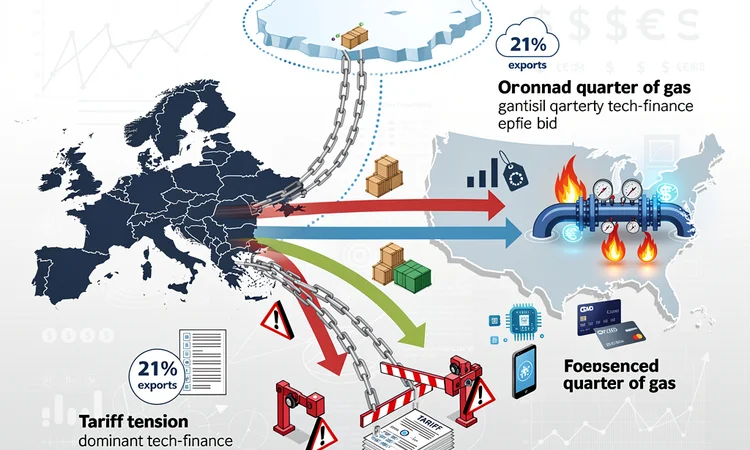
European leaders united in rejecting President Donald Trump’s renewed push to acquire Greenland, but the Continent’s entrenched reliance on American security guarantees, export markets, energy supplies and digital infrastructure underscores a harsh reality: true separation from Washington remains a distant prospect. As tensions escalate over trade tariffs and Arctic ambitions, data reveals the depth of this interdependence, with the EU exporting roughly $640 billion in goods to the U.S. in 2024—21% of its total, up from 18% in 2019, according to EU figures cited in a Wall Street Journal analysis.
This export surge nearly matches the combined value sent to the U.K. and China, Europe’s next largest markets. The U.K. mirrors this pattern, directing 16% of its goods exports stateside. Meanwhile, U.S. liquefied natural gas has filled the void left by Russian supplies post-Ukraine invasion, comprising 57% of EU LNG imports in 2025, per a report from the Institute for Energy Economics and Financial Analysis highlighted by Al Jazeera . Imports jumped from 21 billion cubic meters in 2021 to 81 billion in 2025.
The largest U.S. military base in Germany hosts more troops than Germany’s biggest domestic facility, a stark symbol of defense disparities. Visa and Mastercard dominate two-thirds of European card spending, while 80% of German firms depend on U.S. digital services, according to Bitkom’s survey referenced in the Journal.
Energy Shift Amplifies Leverage
“We’ve replaced one massive dependency with another one,” warned Henning Gloystein, managing director for energy at Eurasia Group, as noted in a New York Times report on January 27, 2026. U.S. LNG now accounts for over a quarter of EU gas imports, up from modest levels pre-2022. The Trump administration codified this in a 2025 trade deal pushing higher volumes, leaving Europe vulnerable amid tariff threats and Greenland disputes.
A Guardian analysis detailed a 61% surge in U.S. LNG to the European Economic Area in 2025, with Russian pipeline gas plummeting from 60% in 2019 to 8%. The U.S. National Security Strategy of 2025 frames energy exports as power projection, echoing Reagan-era tactics against Soviet gas deals. Recent EU pledges, including $250 billion in U.S. energy purchases from 2026-2028 under an August deal reported by Reuters , lock in this dynamic.
In Baden-Württemberg, Germany’s export powerhouse, U.S.-bound goods hit €35 billion ($42 billion) in 2024, per Ifo Institute calculations. The state imports two million tons of Louisiana LNG annually under a 20-year pact and hosts 28,000 U.S. troops. Exports to America contracted 6% yearly amid tariff fears, hurting giants like Porsche and Mercedes-Benz.
Defense Gaps Persist Amid Pushback
European NATO members sourced 64% of arms imports from the U.S. in 2020-2024, rising from 52% previously, according to Stockholm International Peace Research Institute data in Al Jazeera. NATO allies pledged 5% GDP defense spending by 2035 at the 2025 summit, buying more U.S. weapons to appease Trump, as detailed in Foreign Affairs .
“These dependencies around technology, around security, around finance and the dollar, that’s the glue that’s now keeping together the Western bloc,” said Neil Shearing, chief economist at Capital Economics, in the Journal. The U.S. holds “enormous leverage,” he added. Moritz Schularick, president of the Kiel Institute, called Europe “easy to divide and rule” due to consensus governance.
Trump’s Greenland bid—revived in early 2026—sparked a special EU summit on January 22, where leaders eyed de-risking. Yet, as Reuters reported, “Trump crossed the Rubicon. He might do it again.” Ursula von der Leyen pressed for diversification, but military shortfalls loom: Europe meets only 50% of NATO targets.
Tech and Finance Dependencies Deepen
Around 80% of German companies rely on U.S. digital tools, from cloud services to AI chips, per Bitkom. European startups lean on American giants for infrastructure. The EU Parliament voted 471-68 on January 22, 2026, to cut non-EU reliance exceeding 80% in critical digital areas, per Euronews posts on X. France plans to swap Zoom and Microsoft Teams for domestic Visio by 2027.
In finance, dollar invoicing covers one-third of EU exports; a 12% greenback drop against the euro in 2025 hurt competitiveness, as Foreign Policy noted. U.S. services surplus with the EU hit $88.6 billion in 2024 against a $237 billion goods deficit.
“Europe is easy to divide and rule,” Schularick reiterated. Clemens Fuest of Ifo highlighted counter-leverage in F-35 parts, but Stuttgart’s Claus Paal, chamber of commerce head, insisted: “There is no alternative to the U.S.”—citing bureaucracy barriers elsewhere.
Diversification Efforts Fall Short
The EU inked a free-trade pact with India and deals with Mercosur nations, yet these pale against U.S. scale. Middle-power alliances with Canada still hinge on American defense and tech, Shearing observed. A European Council on Foreign Relations piece warned Trump’s 2025 strategy traps Europe in geoeconomic binds, eyeing Russian assets while critiquing EU competitiveness.
Germany’s postwar boom traces to U.S. aid; Tübingen’s Georg Schild recalled 1960s gratitude for American presence. Baden-Württemberg’s auto sector, nurtured by U.S. post-WWII expertise, exemplifies ties. Tariff hits last year amplified planning woes, Paal said.
As Trump wields tariffs—steel at 50% post-2025—Europe weighs retaliation via anti-coercion tools, but unity fractures. German carmakers negotiated separately in 2025, per Foreign Affairs. X discussions, like Andrea Gilli’s post quoting Journal stats, echo insider alarm over multi-domain U.S. dominance.
Strategic Reckoning Looms
“Recently, people have started to realize we are probably a little bit too dependent on U.S. L.N.G.,” said Anne-Sophie Corbeau of Columbia’s Center on Global Energy Policy in the Times. EU eyes domestic drilling and Qatar deals, but import reliance hits 85% per Eurostat. Turnberry’s 2025 golf-course pact committed $750 billion in U.S. energy by 2028, risking lock-in, as ECCO critiqued.
Trump’s Oval Office berating of Zelensky in February 2025 spurred defense hikes, but implementation lags. TIME urged digital sovereignty; Carnegie called for supply-chain diversification. X user Ralph Schoellhammer noted U.S. R&D edges (12:1 ratio) delay autonomy by decades.
Europe’s postwar pact with America endures, but Trump’s transactionalism forces adaptation. As Chatham House analyzed, the 2025 NSS prioritizes deals over alliances, hammering Europe while easing on autocrats. Leaders from von der Leyen to Macron push autonomy, but structural gaps persist.






Leave a Reply
Your email address will not be published.