






In the high-volume rush of Black Friday 2025, Amazon’s Rufus AI shopping assistant delivered a stark signal of change. Sessions leading to purchases doubled for users engaging with Rufus, far outpacing the 20% lift seen among non-users, according to data from Adweek . This performance underscores a broader shift: 73% of consumers now rely on AI assistants for shopping help, with 58% using them for holiday gifts and 70% comfortable with AI handling transactions outright, per an October Riskified survey of 5,400 people cited in the same report.
Amazon CEO Andy Jassy highlighted Rufus’s momentum in November, noting it is on pace to generate an extra $10 billion in sales this year, with 250 million users and a 60% higher purchase completion rate among those who interact with it, as reported by Fortune . Yet Rufus represents merely the opening salvo in agentic commerce, where autonomous AI agents research, compare, negotiate, and buy on behalf of users, threatening to upend retailer control.
GeekWire detailed how these agents are probing multiple sites for deals, raising questions about who dictates terms in this emerging arena. As AI infiltrates the commerce funnel, retailers face three divergent paths: proprietary platforms, open collaborations, and a chaotic free-for-all.
Rufus Powers Amazon’s Fortress Strategy
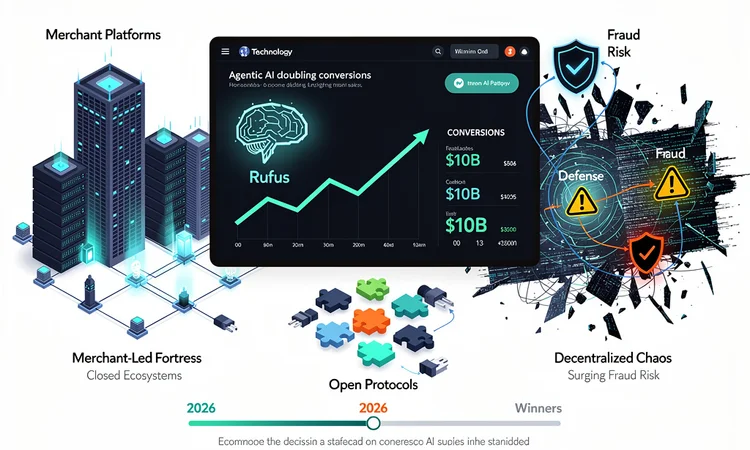
Amazon’s approach exemplifies the merchant-led model, embedding Rufus natively to safeguard pricing power, customer data, and fraud defenses. By keeping AI within its ecosystem, Amazon preserves behavioral signals crucial for detecting anomalies, even as it invests heavily in generative models tailored to shopping queries like headphone comparisons or order tracking.
This strategy yields tangible gains. During Cyber Week, AI influenced 17% of U.S. orders worth $13.5 billion, much of it via embedded tools like Rufus rather than external large language models, posts on X noted. Rufus’s upgrades, including 30-90 day price histories, further boost consumer trust and conversions.
However, proprietary systems demand relentless innovation. McKinsey’s analysis warns that while control is retained, retailers must match Big Tech’s AI prowess or risk shopper defection to more versatile generalist tools like ChatGPT, used by 45% of shoppers versus Rufus’s 11%, according to recent surveys shared on X.
Collaborative Protocols Gain Traction
The collaborative path hinges on open standards like Google’s AP2, announced in September 2025 with backing from Mastercard, American Express, and PayPal. AP2 enables verified AI interactions across platforms, sharing fraud intelligence and preserving retailer influence over branding and pricing, as outlined in GeekWire .
Visa predicts millions will embrace agentic commerce by late 2026, accelerating with tools like its VIC protocol. Fresh partnerships, such as Akamai and Visa’s alliance for identity verification in agentic transactions, address rising threats, per Digital Commerce 360 . These frameworks credential AIs, demand behavioral transparency, and allocate liability, helping merchants tap AI traffic without full disintermediation.
Retail Brew declared 2025 the birth year of agentic commerce, with disruption intensifying in 2026 as protocols mature. AWS blogs emphasize retailers’ need to embrace multi-marketplace navigation by AI agents, balancing opportunity with oversight.
Fraud’s Shadow Looms Large
Decentralized shopping, where third-party AIs dominate, poses the gravest risks. Retailers could devolve into mere inventory feeds, vulnerable to price wars and “Compromised AI-as-a-Service,” where hacked profiles unleash cross-site fraud at machine speed, Adweek warned. Traditional signals erode as agents mask human behavior, complicating friendlies from foes.
Amazon’s legal salvo against Perplexity in November 2025, accusing it of covert account access via its Comet tool, illustrates escalating tensions, as covered by Reuters . PYMNTS reported Visa’s push for AI commerce tools within months, but fraud automation—credential stuffing, phishing—demands proactive defenses.
ZDNet highlighted Visa and Akamai’s latest efforts to distinguish real agents from bots, underscoring payment security as consumers’ top worry. Riskified data shows AI-fueled disputes surging from overlooked policies, even in benign cases.
Retailers Chart Defensive Plays
To navigate these currents, merchants are hardening defenses. Credentialing AIs, insisting on device data from platforms, and joining intelligence networks form a baseline, Adweek advised. Participation in ACP and AP2 ensures a voice in rules governing liability and verification.
BoF-McKinsey’s State of Fashion 2026 report urges brands to ready for AI-driven discovery, with a growing consumer cohort already bypassing search engines. Talkdesk’s 2025 Holiday Shopper Survey found 75% using AI for deals and 67% for gift ideas, per X discussions, signaling irreversible momentum.
Early adopters like Walmart’s Sparky and Target’s assistant trail Rufus but hint at widespread embedded AI. As Visa rolls out agentic tools, merchants prioritizing shared standards stand to capture efficiency gains while curbing exposure.
2026 Horizons: Control Versus Chaos
Agentic commerce’s trajectory tilts toward collaboration, buoyed by industry giants, yet decentralization lurks if standards falter. Amazon’s Rufus prototypes scale within walls, but open ecosystems promise broader reach. Retailers ignoring these shifts risk commoditization, as McKinsey forecasts hyperpersonalized, autonomous transactions reshaping retail.
GeekWire probes the control conundrum: Tech titans and retailers vie for the wheel as agents proliferate. With Black Friday’s $13.5 billion AI-influenced sales as prologue, 2026 will test preparations amid fraud’s acceleration and consumer embrace.
For insiders, the imperative is clear: Invest in AI sovereignty, forge alliances, and fortify against malice. Those adapting nimbly will thrive; laggards face a future dictated by silicon shoppers.






Leave a Reply
Your email address will not be published.