






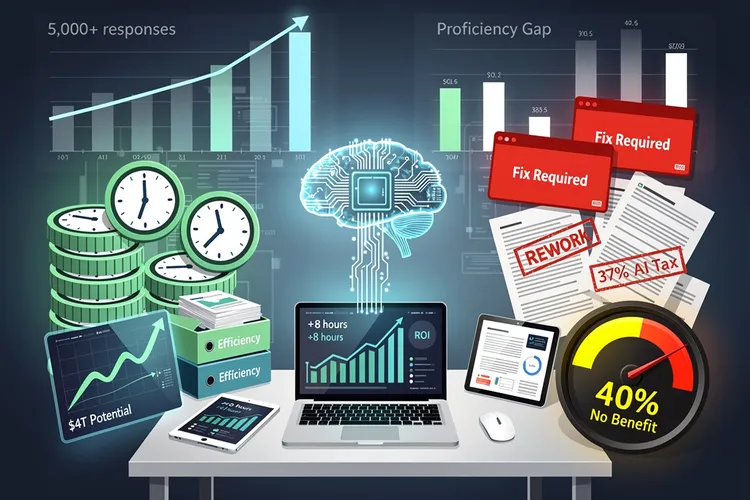

In corporate boardrooms across the U.S., artificial intelligence initiatives often boil down to a checklist: select a tool, draft a policy, conduct basic training, and distribute access. Yet a survey of 5,000 knowledge workers in the U.S., U.K., and Canada reveals a stark reality of high activity but low impact, with most employees stuck in superficial use that yields minimal productivity gains. This HCA Magazine analysis frames the issue as squarely an HR responsibility, encompassing skills development, manager expectations, role redesign, and performance metrics.
Superficial Adoption Masks Deeper Flaws
Three years after ChatGPT’s debut, the workforce splits into experimenters handling basic tasks like email rewrites or note summaries, novices barely engaging, a small cadre of practitioners weaving AI into core workflows, and rare experts. Many report no time savings or less than four hours weekly, far short of transformative potential. HR must shift from access metrics to outcomes like time reclaimed and business value generated.
The bottleneck lies in a “use case desert,” where workers grasp prompting but falter in mapping AI to real job processes. Traditional training emphasizes safety and basics over critical skills like workflow decomposition and bottleneck identification. Executives, meanwhile, overestimate progress, citing strong strategies and cultures, while employees note uneven tool access and vague guidelines—a perception chasm insulating leaders from ground truths, as detailed in the HCA report.
Individual Contributors Left Behind
Individual contributors in repetitive roles, prime for AI-driven efficiency, receive the least support: limited access, training, or reimbursement. This contrasts with managers and executives, fostering anxiety and eroding trust. Sector variations amplify disparities—tech and finance lead in proficiency, while healthcare, education, and retail lag; engineering outpaces operations despite untapped potential in coding or prototyping.
A Forbes piece warns of $5.5 trillion in global losses from skills mismatches by 2026, urging baseline AI literacy to grasp opportunities and risks. LinkedIn data shows C-suite executives three times more likely to add AI skills to profiles, with 88% prioritizing adoption acceleration.
Training Overhauls Demand Urgency
Only 38% of companies offer AI-specific training despite 82% of leaders recognizing its importance, per a Forbes council post. Randstad’s study across Europe, Asia-Pacific, and North America finds 75% of firms adopting AI but just 35% training talent recently, with gender and generational divides—42% more men report proficiency, and Gen Z/Millennials far outpace older cohorts.
HR Grapevine USA highlights U.S. firms like Hyland and Booz Allen Hamilton embedding AI literacy into curricula for IT and consultants alike. Yet AWS research shows only 14% claim advanced fluency, over half basic or nascent. The EdAssist by Bright Horizons index, via FT.com , notes 42% expect role changes from AI soon, but only 17% use it frequently, signaling an adoption void. Priya Krishnan, Chief Transformation Officer at Bright Horizons, states, “Employers who act now will not only close critical skill gaps but also build a culture of resilience and innovation.”
Emerging Class Divide in Real Time
On X, Alex Lieberman of Tenex Labs described a $50 billion tech firm’s head of AI observing a split: 60% AI-natives using tools over 20 times monthly, mining workflows, versus 40% skeptics dismissing outputs as ‘slop.’ He warns of a 10-100x productivity chasm dwarfing past tech gaps like Excel shortcuts, urging companies to upskill aggressively.
TalentLMS research confirms 43% of HR managers foresee AI-widened gaps, with upskilling/reskilling critical for 63%. Skillsoft’s 2025 Global Skills Intelligence Survey of 1,000 HR pros flags AI as the U.K.’s top shortfall at 30%, exacerbated by 19% overstating proficiency. McKinsey notes job postings mentioning AI surged 111% in 2023, demanding data literacy across roles.
HR’s Action Blueprint Takes Shape
Recommendations converge: HCA urges outcome measurement, use-case playbooks, communities, standardized individual contributor support, workflow-centric training, and leader shadowing. Forbes advocates flexible talent like contingents training permanents, as Bettina Schaller of World Employment Confederation observes in Europe under the EU AI Act.
Genpact’s 12-week immersive program hit 75% proficiency, blending coursework with projects for business results, per Udemy Business. ASCM’s AI Technology Certificate targets supply chain pros for collaboration over coexistence. World Economic Forum’s Future of Jobs 2025 prioritizes AI skills alongside emotional intelligence, predicting top demand through 2030.
Sector Disparities Fuel Competitive Edges
Tech/finance proficiency stems from access and culture, but operations/customer service underutilize despite gains in drafting or analysis. Gloat’s 2026 U.S. analysis shows only 40% provide hands-on AI training, yet systematic programs yield efficiency surges. IDC forecasts massive economic drags from inaction, positioning upskilling as a business imperative beyond HR checkboxes.
X discussions echo intra-firm divides, with entry-level roles vanishing—data entry, basic research now algorithmic—forcing unapprenticed graduates into senior demands. HR Dive notes IT leaders turning to upskilling amid machine learning shortages, as agentic AI accelerates mismatches.






Leave a Reply
Your email address will not be published.