








In the final quarter of 2025, U.S. workers already embracing artificial intelligence ramped up their reliance on the technology, with daily usage climbing from 10% to 12% and frequent use—at least a few times weekly—rising three points to 26%, according to fresh data from Gallup . This intensification among existing users marks a continuation of gradual gains since 2023, even as overall adoption—those using AI at least yearly—held steady after earlier surges. Nearly half of employees, 49%, reported no AI involvement in their roles, underscoring persistent divides in how the technology permeates American offices.
The Gallup survey, drawn from 22,368 full- and part-time workers polled October 30 to November 13, reveals a maturing pattern: growth now concentrates among heavy users rather than broad expansion. Organizational integration also stagnated, with 38% of respondents noting their employers had deployed AI for productivity gains, 41% saying no such efforts existed, and 21% unaware—a figure highlighting communication gaps. This comes amid broader surveys showing enterprise enthusiasm, yet execution lags.
Industry Fault Lines Emerge
Technology leads with 77% total usage, including 57% frequent and 31% daily, while finance jumped six points to 64% overall in Q4. Professional services rose five points to 62%, with 36% frequent users, and manufacturing edged up three points to around 43%. Retail trails at 33%, with just 19% frequent and 10% daily, per Gallup . These disparities reflect AI’s affinity for knowledge work over hands-on tasks, widening productivity chasms across sectors.
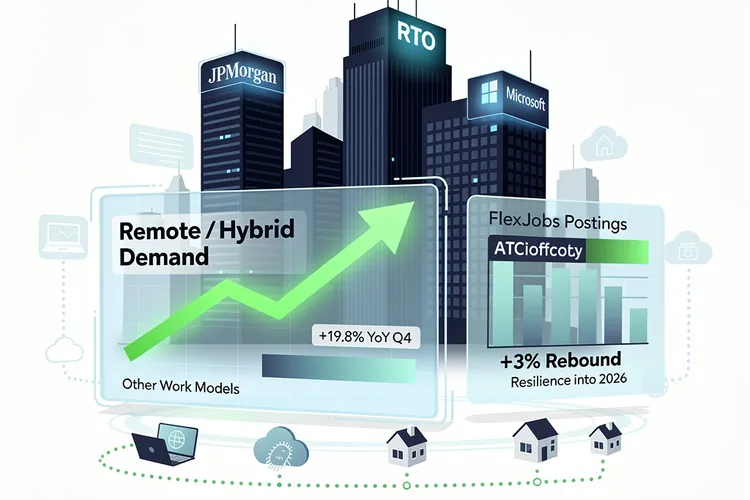
Remote-capable roles show 66% total use—40% frequent, 19% daily—versus 32% in non-remote positions (17% frequent, 7% daily), a gap ballooning since Q2 2023’s 28% to 15% baseline. Leaders report 69% usage (44% frequent), managers 55% (30% frequent), and individual contributors 40% (23% frequent), per the same data. Such hierarchies suggest executives model adoption, pulling managers and staff along unevenly.
From Q3 Momentum to Q4 Intensity
Contextualizing Q4, Gallup’s prior Q3 report—covering August 5-19 with 23,068 respondents—saw overall use hit 45% from 40%, frequent at 23% from 19%, and daily at 10% from 8%, as detailed in Gallup . Q3 industries mirrored Q4 leaders: tech at 76%, finance 58%, professional services 57%; retail 33%. Common applications included consolidating information (42%), idea generation (41%), and learning (36%), with chatbots dominating at over 60% tool preference.
Q4’s plateau in total users signals maturation: early adopters deepen engagement while barriers persist for others. eWeek noted Q3’s knowledge-job dominance, with managers and leaders outpacing contributors, and uncertainty highest among frontline staff (26% unaware of company AI vs. 7% for leaders). Frequent users leaned toward advanced tools like coding assistants (22% vs. 8% for casuals).
Enterprise Hype Meets Reality
Beyond Gallup, McKinsey’s 2025 State of AI survey of 1,993 global respondents found 88% of organizations using AI in at least one function, up sharply, but only 33% scaling beyond pilots, per McKinsey . Agents drew 23% scaling in functions like IT, with high performers three times more likely to have leader buy-in. OpenAI’s enterprise report echoed deepening: messaging up 8x year-over-year, workers saving 40-60 minutes daily, as shared by COO Brad Lightcap on X.
Anthropic’s Economic Index, analyzing Claude conversations, showed 49% of U.S. jobs using AI for at least 25% of tasks—up from 36% early 2025—with 52% augmentation over automation, per Anthropic . Software debugging topped uses at 6%, complex college-level work sped 12x. X discussions highlighted divides: 60% “AI-native” workers versus 40% skeptics, per Alex Lieberman.
Barriers and Uneven Gains
Despite rises, hurdles loom. Gallup Q3 identified unclear value propositions as top barrier (16%). Inc. stressed leaders’ role, noting only 53% at AI-implementing firms see manager support. X user Michael Kove pointed to training gaps and job fears biasing surveys. McKinsey high performers embed AI via dedicated teams and leader role-modeling.
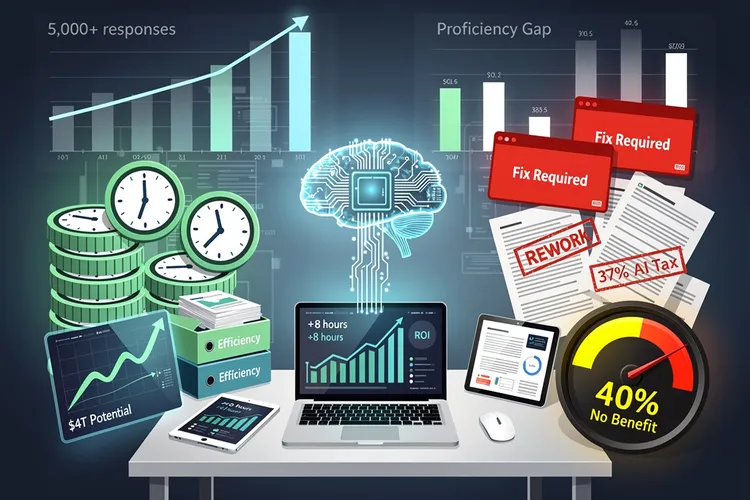
Industries like healthcare (41-43%) and government lag tech’s 77%, but finance’s Q4 surge signals catch-up. Brookings noted 39.6% gen AI use by late 2024, with small firms at 58% per U.S. Chamber. Yet, 95% of organizations see no ROI, per MIT via X’s Unusual Whales, tempering optimism.
Job Shifts and Future Pressures
AI fragments roles: Anthropic found no full automation but task diffusion, boosting productivity in coding and analysis. Business Insider listed top uses from Gallup Q3: info consolidation, ideas, learning. Fears persist—43% worry automation in two years per ManpowerGroup’s 2026 Barometer—yet few see imminent job loss.
Leaders widen gaps: Gallup leaders’ frequent use quadrupled since 2023. X’s Aadit Sheth cited McKinsey: top 6% redesign workflows for EBIT impact. As Q4 data shows deepening without broadening, firms face pressure to train non-users, clarify cases, and integrate equitably to harness gains.
Strategic Imperatives Ahead
With daily use at 12%, Gallup implies role-specific strategies: remote jobs thrive, frontline lag. McKinsey urged rewiring across strategy, talent, data. Anthropic predicts convergence, but uneven now. X threads like God of Prompt’s McKinsey breakdown warn pilots trap value; scaling demands ambition. For insiders, Q4 signals pivot: deepen for leaders, bridge for laggards, or risk divergence.






Leave a Reply
Your email address will not be published.