







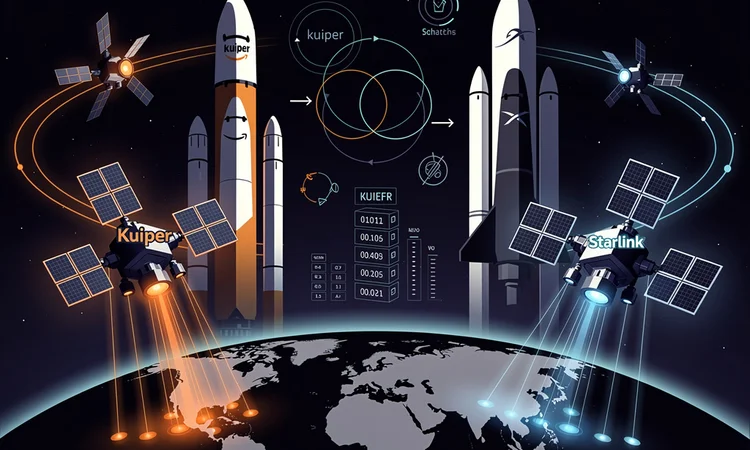
Amazon has formally requested the Federal Communications Commission grant additional time to deploy its Project Kuiper satellite constellation, a move that underscores both the technical complexities of building a space-based internet network and the company’s pragmatic willingness to rely on rival SpaceX for launch services. The request comes as Amazon intensifies efforts to compete in the burgeoning low-Earth orbit broadband market, where SpaceX’s Starlink has already established a commanding lead with thousands of operational satellites.
According to CNBC , Amazon is seeking regulatory flexibility as it continues to purchase additional launch capacity from SpaceX, despite the two companies competing directly in the satellite internet sector. The extension request reflects the reality that Amazon’s ambitious timeline for deploying 3,236 satellites has encountered the inevitable delays that plague complex aerospace ventures. The FCC’s current rules require Amazon to launch and operate half of its planned constellation by July 2026 to maintain its spectrum license, a deadline the company now acknowledges it cannot meet.
The irony of Amazon purchasing launch services from its primary competitor has not been lost on industry observers. SpaceX, through its Starlink division, has already deployed more than 5,000 satellites and serves over two million customers globally. Amazon’s reliance on SpaceX’s proven Falcon 9 rockets demonstrates the limited options available for companies seeking reliable, cost-effective access to space, even when those launches directly benefit a competitor’s market position.
Regulatory Framework and Deployment Challenges
The FCC’s milestone requirements for satellite constellations were designed to prevent spectrum warehousing and ensure that companies with orbital licenses actually deploy their systems. Under current regulations, Amazon must have 50% of its constellation operational by mid-2026 and the full network completed by July 2029. The company’s extension request seeks to push these deadlines back, citing manufacturing complexities, supply chain constraints, and the limited availability of launch vehicles capable of delivering satellites to their designated orbits.
Amazon has invested more than $10 billion in Project Kuiper, according to company statements, representing one of the largest capital commitments in the satellite communications sector. The company has secured launch contracts with United Launch Alliance, Arianespace, and Blue Origin—the latter founded by Amazon executive chairman Jeff Bezos—in addition to its SpaceX agreements. However, delays in developing Blue Origin’s New Glenn rocket and production challenges with Amazon’s satellite manufacturing have complicated the deployment schedule.
Market Dynamics and Competitive Pressures
The satellite internet market has evolved dramatically since Amazon first received FCC approval for Project Kuiper in 2020. SpaceX’s Starlink has moved from experimental service to a mature product offering coverage across multiple continents, including maritime and aviation connectivity. The service has proven particularly valuable in conflict zones and disaster areas, where terrestrial infrastructure has been damaged or is nonexistent. This first-mover advantage has allowed SpaceX to refine its technology, reduce costs through vertical integration, and establish brand recognition in a market that Amazon hoped to enter as an early participant.
OneWeb, another competitor in the low-Earth orbit broadband sector, has also made significant progress despite its own financial restructuring. The company has deployed its initial constellation and begun commercial service, particularly focusing on enterprise and government customers. The competitive environment has intensified as traditional satellite operators and new entrants alike recognize the potential of LEO constellations to deliver low-latency internet service that rivals or exceeds terrestrial options in many regions.
Technical Architecture and Service Differentiation
Amazon’s Project Kuiper satellites are designed to operate at altitudes between 590 and 630 kilometers, placing them in the lower range of LEO constellations. This orbital selection offers potential advantages in latency—the time it takes for data to travel between user terminals and satellites—but requires more satellites to provide continuous coverage compared to higher-altitude systems. The company has emphasized that its satellites incorporate advanced phased-array antennas and optical inter-satellite links, technologies intended to maximize network capacity and flexibility.
The customer terminal design represents another critical differentiator. Amazon has stated that its terminals will be more affordable than early Starlink equipment, though specific pricing has not been publicly disclosed. The company’s vast logistics network and manufacturing expertise could provide advantages in terminal production and distribution, particularly if Project Kuiper integrates with Amazon’s e-commerce platform for consumer sales. However, these advantages remain theoretical until the service launches commercially.
Launch Infrastructure and Supply Chain Realities
Amazon’s multi-provider launch strategy reflects both risk management and the constrained nature of the global launch market. While the company has publicly emphasized its commitment to Blue Origin’s New Glenn rocket, that vehicle has yet to complete its first orbital flight. United Launch Alliance’s Vulcan rocket, another key component of Amazon’s launch plan, only began flying in 2024 and has limited production capacity. Arianespace’s Ariane 6, similarly, has faced development delays that have impacted its availability for commercial customers.
These realities have pushed Amazon toward SpaceX, which operates the world’s most active launch program. SpaceX’s ability to rapidly reuse Falcon 9 boosters and maintain a high flight rate makes it an attractive option for any company needing to deploy large satellite constellations quickly. The company’s willingness to launch payloads for competitors suggests a business calculation that launch revenue and the demonstration of Falcon 9’s reliability outweigh concerns about strengthening rival satellite operators.
Regulatory Precedent and Industry Implications
The FCC has historically shown flexibility in granting deadline extensions to satellite operators facing legitimate technical or commercial challenges. However, the Commission has also demonstrated willingness to revoke licenses from companies that fail to make meaningful progress toward deployment. Amazon’s request will likely be evaluated based on evidence of concrete progress, including satellite production numbers, completed launches, and investments in ground infrastructure.
Industry analysts suggest that the FCC may grant a limited extension while imposing additional reporting requirements or intermediate milestones to ensure continued progress. Such conditions would balance the Commission’s interest in promoting competition in the satellite broadband market against its mandate to prevent spectrum warehousing. The decision could establish precedents affecting other satellite operators seeking similar regulatory relief.
Strategic Positioning and Long-Term Viability
Amazon’s persistence with Project Kuiper despite significant challenges and SpaceX’s market lead suggests confidence in the long-term market potential for satellite internet services. The company has emphasized that Project Kuiper will serve not only consumer customers but also enterprise clients, government agencies, and telecommunications carriers seeking to extend coverage to underserved areas. Amazon Web Services, the company’s highly profitable cloud computing division, could integrate satellite connectivity into its service offerings, creating synergies that pure-play satellite operators cannot match.
The total addressable market for satellite broadband remains subject to debate. Optimistic projections suggest that hundreds of millions of potential customers in rural and remote areas lack access to high-speed internet, representing a multi-billion-dollar annual revenue opportunity. More conservative analyses note that satellite service economics remain challenging in regions where terrestrial fiber or fixed wireless options exist, potentially limiting the market to truly remote locations and mobile applications. Amazon’s ability to leverage its existing customer relationships and infrastructure could prove decisive in determining which scenario proves more accurate.
Financial Implications and Investment Rationale
The $10 billion-plus investment in Project Kuiper represents a significant commitment even for a company of Amazon’s scale. The project must ultimately generate returns that justify this capital allocation, competing against alternative uses including expansion of Amazon’s core e-commerce and cloud computing businesses. The company has not publicly disclosed detailed financial projections for Project Kuiper, making it difficult for outside observers to assess the investment’s potential return profile.
Some industry observers have questioned whether Amazon’s entry into satellite internet represents genuine strategic vision or an expensive hedge against the possibility that SpaceX’s Starlink could disrupt telecommunications markets in ways that might disadvantage Amazon’s other businesses. The company’s willingness to seek deadline extensions suggests a long-term commitment rather than a project facing potential cancellation, though the ultimate scale and scope of Project Kuiper may evolve based on market conditions and competitive dynamics. As the satellite internet sector continues to mature, Amazon’s ability to execute its deployment plan and differentiate its service offering will determine whether Project Kuiper becomes a significant business line or an expensive lesson in the challenges of competing in capital-intensive aerospace markets.






Leave a Reply
Your email address will not be published.