








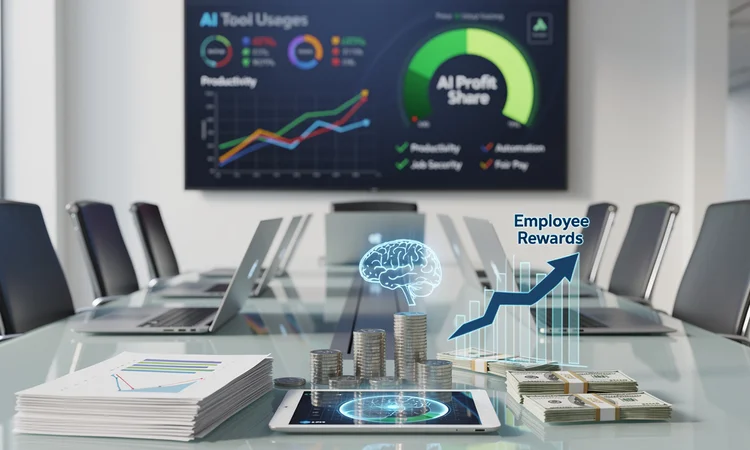
In an era where artificial intelligence adoption often meets employee resistance and corporate mandates fall flat, one company has discovered a deceptively simple solution: pay workers to use it. The approach, which ties employee compensation directly to AI utilization and productivity gains, represents a fundamental shift in how organizations incentivize technological transformation—and early results suggest it may be the blueprint other companies have been searching for.
According to Business Insider , the unnamed company implemented a profit-sharing program specifically designed to reward employees who embrace AI tools in their daily workflows. Rather than simply providing access to ChatGPT or other generative AI platforms and hoping for organic adoption, leadership created financial incentives tied directly to measurable productivity improvements enabled by artificial intelligence. The program allocates a portion of efficiency gains—quantified through metrics like time saved, output increased, and cost reductions—back to the employees who generated those improvements through AI usage.
This compensation model addresses a critical challenge that has plagued AI implementation across industries: the disconnect between corporate investment in technology and individual employee motivation to change established work habits. Traditional change management approaches rely on training sessions, executive enthusiasm, and top-down directives—methods that have consistently underperformed when introducing disruptive technologies. By contrast, profit-sharing creates alignment between organizational goals and personal financial interests, transforming AI from a potential job threat into a direct path to higher earnings.
The Mathematics of Motivation: How Financial Incentives Drive Adoption
The mechanics of the profit-sharing program reveal sophisticated thinking about behavioral economics and organizational change. Employees receive baseline training on available AI tools, then track their usage and document productivity improvements through a centralized system. Management reviews these submissions quarterly, verifying claimed efficiencies through output metrics, quality assessments, and time-tracking data. Validated improvements generate a calculated dollar value, and employees receive a predetermined percentage of that value as a bonus payment.
This structure creates multiple psychological drivers for adoption. First, it provides immediate, tangible rewards rather than abstract promises of future career development. Second, it empowers employees to experiment and discover AI applications relevant to their specific roles, rather than forcing one-size-fits-all solutions. Third, it transforms peer dynamics from competitive to collaborative, as successful AI implementations can be shared across teams, multiplying the profit pool available for distribution. The result is a self-reinforcing cycle where early adopters become evangelists, not because they’re told to, but because they have direct financial stake in spreading effective practices.
Beyond the Carrot: Addressing the Underlying Anxiety of Automation
The profit-sharing approach also tackles a deeper, more existential employee concern about AI: job security. When companies introduce automation technologies without clear communication about how workers benefit, rational employees perceive—often correctly—that they’re being asked to facilitate their own obsolescence. This creates what organizational psychologists call “innovation resistance,” where workers consciously or unconsciously sabotage new systems to protect their positions.
By sharing profits from AI-driven efficiency, the company signals that productivity gains won’t simply flow to shareholders while headcount gets reduced. Instead, workers who make themselves more valuable through AI augmentation receive direct compensation increases. This reframes the technology from replacement threat to enhancement opportunity. Employees aren’t competing against AI; they’re partnering with it to generate value that benefits both the organization and themselves. The psychological shift is profound: AI becomes a tool for personal economic advancement rather than an instrument of displacement.
Industry Patterns: The Broader Context of AI Compensation Experiments
This profit-sharing model emerges against a backdrop of widespread corporate struggle with AI adoption rates. Despite massive investments in generative AI tools— Gartner research indicates 55% of organizations are piloting or deploying generative AI—actual employee usage often lags far behind availability. Many companies report that fewer than 20% of employees regularly use provided AI tools, even when access is free and training is mandatory.
The compensation disconnect isn’t unique to AI. Historically, companies have struggled to incentivize adoption of productivity-enhancing technologies from email to enterprise resource planning systems. What makes the current moment different is the pace of AI capability improvement and the competitive pressure to capture efficiency gains quickly. Organizations that successfully mobilize their workforce to leverage AI tools gain compounding advantages over slower-moving competitors. The profit-sharing model offers a potential solution to this adoption velocity problem, creating urgency through personal financial motivation rather than corporate deadline pressure.
Measurement Challenges: Quantifying AI’s Contribution to Productivity
Implementing profit-sharing based on AI usage requires solving a significant technical challenge: accurately measuring productivity improvements. Unlike manufacturing environments where output per hour is easily quantified, knowledge work productivity has always been notoriously difficult to assess. How do you value a marketing campaign developed in half the time? What’s the dollar impact of a customer service representative handling 30% more inquiries with AI assistance? These questions don’t have obvious answers.
The company featured in the Business Insider report addresses this through a combination of quantitative and qualitative metrics. Time savings are tracked through project management software that logs hours against deliverables. Output quality is assessed through existing performance review mechanisms, ensuring that speed gains don’t come at the expense of work product. Cost reductions are calculated by comparing resource consumption before and after AI implementation. For harder-to-measure contributions, peer review committees evaluate AI-assisted work against historical baselines. While imperfect, this multi-metric approach provides sufficient rigor to prevent gaming the system while remaining flexible enough to capture diverse productivity improvements across different roles.
The Risk Calculus: What Could Go Wrong
Despite promising early results, the profit-sharing model carries inherent risks that organizations must consider. First, there’s the possibility of creating perverse incentives where employees prioritize easily measurable but low-value AI applications over more impactful but harder-to-quantify improvements. An employee might focus on using AI to generate routine emails quickly rather than tackling complex strategic analysis, simply because the former produces clearer time-saving metrics.
Second, profit-sharing based on individual productivity could undermine collaborative work cultures. If employees compete for a fixed pool of AI-driven efficiency bonuses, they may hoard effective prompts, techniques, and use cases rather than sharing them with colleagues. The company attempts to mitigate this through team-based components in the profit-sharing formula, but the tension between individual reward and collective benefit remains. Third, there’s the challenge of sustainability: as AI tools become standard and baseline productivity expectations rise, the profit pool generated by efficiency gains may shrink, potentially creating employee dissatisfaction when bonuses decline despite continued AI usage.
Regulatory and Ethical Considerations in AI-Linked Compensation
The intersection of artificial intelligence and employee compensation also raises regulatory questions that remain largely unresolved. If workers are financially incentivized to use AI tools, who bears liability when those tools produce errors, biased outputs, or compliance violations? Traditional employment law assumes human decision-making and accountability; AI augmentation complicates these assumptions. An employee using AI to draft contracts or analyze financial data might miss errors that wouldn’t have occurred in manual processes, but the profit-sharing system rewards the speed gain.
Data privacy represents another concern. Effective AI profit-sharing requires detailed tracking of employee work processes, tool usage, and output—levels of monitoring that might trigger privacy concerns or even legal restrictions in some jurisdictions. European Union regulations around workplace surveillance, for instance, impose strict limitations on employee monitoring that could conflict with the data collection necessary to validate AI-driven productivity claims. Companies implementing similar programs will need to navigate these regulatory frameworks carefully, potentially customizing approaches for different geographic markets.
The Competitive Implications: First-Mover Advantages in AI Adoption
From a strategic perspective, the profit-sharing approach offers potential competitive advantages that extend beyond simple productivity gains. Companies that achieve high AI adoption rates develop organizational capabilities that are difficult for competitors to replicate. Employees become skilled at identifying AI applications, crafting effective prompts, and integrating tools into workflows—tacit knowledge that doesn’t transfer easily to other organizations. This creates a form of competitive moat built on human capital rather than technology access, since competitors can purchase the same AI tools but can’t quickly develop the same organizational competency in using them.
Additionally, companies with successful AI incentive programs may gain advantages in talent markets. As AI skills become increasingly valuable, workers will gravitate toward employers who provide both tools and financial rewards for developing expertise. The profit-sharing model essentially offers employees free training with paid practice, allowing them to build marketable AI capabilities while earning bonuses. This could create virtuous cycles where top talent joins, develops advanced AI skills, shares knowledge with colleagues, and attracts more skilled workers—all while driving productivity improvements that fund the profit-sharing pool.
Implementation Roadmap: Lessons for Other Organizations
For companies considering similar approaches, the profit-sharing model offers several transferable lessons. First, start with clear baseline measurements before introducing AI tools. Without accurate pre-AI productivity data, validating improvements becomes impossible and the profit-sharing system loses credibility. Second, involve employees in designing the incentive structure. Top-down compensation formulas often miss important nuances about how work actually gets done; frontline workers can identify appropriate metrics and realistic targets that management might overlook.
Third, build in flexibility for experimentation. The most valuable AI applications often emerge from unexpected use cases that employees discover through trial and error. Rigid profit-sharing formulas that only reward predetermined productivity metrics may inadvertently discourage the exploratory behavior that leads to breakthrough applications. Fourth, communicate transparently about how the program works, how profits are calculated, and how the system may evolve. Employee skepticism about new compensation structures is natural and justified; detailed transparency helps build the trust necessary for enthusiastic participation.
The Future of Work: Rethinking Value Creation and Distribution
The profit-sharing model represents more than a tactical solution to AI adoption challenges; it signals a potential shift in how organizations think about value creation in an AI-augmented economy. Traditional employment models assume relatively stable productivity levels with incremental improvements over time. Compensation structures reflect this assumption, with modest annual raises and occasional promotions marking career progression. AI disrupts this stability, offering the possibility of dramatic, discontinuous productivity jumps that fundamentally change what individual workers can accomplish.
If a marketing professional using AI can produce in one day what previously required a week, should they be compensated the same as before? Traditional thinking says yes—they’re doing the same job, just more efficiently, and the company captures the value. The profit-sharing model says no—the employee’s contribution to organizational value has increased, even if the nature of their work has changed, and compensation should reflect that increased contribution. This philosophical shift could have profound implications for how companies structure compensation, career paths, and organizational hierarchies in an era of rapidly advancing artificial intelligence. The experiment underway at this unnamed company may be an early indicator of how forward-thinking organizations will navigate the complex intersection of human talent, artificial intelligence, and economic value distribution in the years ahead.






Leave a Reply
Your email address will not be published.