




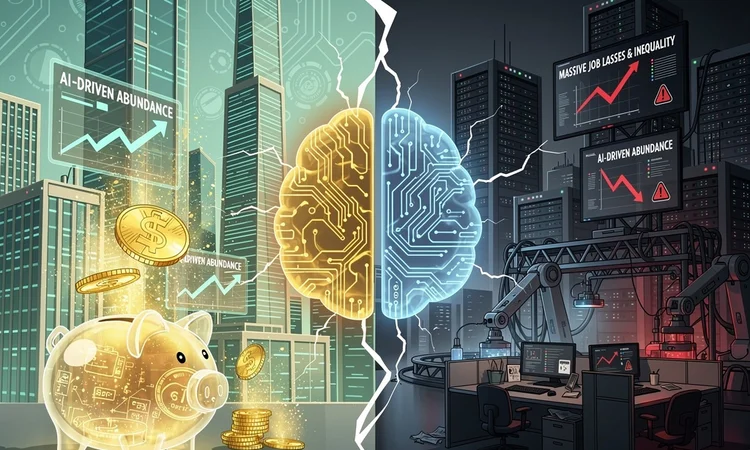
Elon Musk envisions a near future where artificial intelligence and robotics usher in such vast plenty that traditional retirement savings become pointless. “If any of the things that we’ve said are true, saving for retirement will be irrelevant,” Musk declared on the Moonshots with Peter Diamandis podcast in early January 2026. The Tesla and SpaceX CEO, whose net worth tops $600 billion, painted a picture of AI-driven productivity exploding to eliminate scarcity, granting everyone access to superior healthcare, unlimited goods, and a “universal high income.”
Just weeks later, Anthropic CEO Dario Amodei issued a stark counterpoint in a 20,000-word essay titled “The Adolescence of Technology.” Amodei warned that AI’s rapid ascent—potentially surpassing humans at every task within a few years—would trigger an “unprecedented” labor market shock. “Workers displaced by AI could form an unemployed or very-low-wage ‘underclass,'” he wrote, with a tiny elite capturing most gains and risking societal fracture. Amodei, whose firm builds the Claude AI model, stressed that this “brutal rite of passage” demands urgent collaboration among AI firms, governments, and philanthropists.
These clashing visions from two AI titans highlight a deepening rift in Silicon Valley over technology’s economic fallout. Musk’s optimism hinges on breakthroughs in energy, robotics, and compute power creating overflow resources by 2030, when he predicts AI will eclipse all human intelligence combined. Amodei, however, flags the pace of change as too swift for human adaptation, forecasting half of entry-level white-collar jobs vanishing in one to five years and unemployment spiking to 10-20%.
Musk’s Blueprint for Post-Scarcity
Musk doubled down at Davos 2026, calling AI and robotics a “supersonic tsunami” toward zero scarcity. “By 2030, AI will surpass the intelligence of all humans combined,” he stated in a Fortune interview, with humanoid robots outnumbering people soon after. White-collar roles, he said, are already half automatable, paving the way for work to become “optional” in 10-20 years. His companies—Tesla’s Optimus robots, xAI’s Grok, and SpaceX’s Starship—form the backbone, promising deflationary prices for everything from housing to medicine.
This abundance, Musk argues, obsoletes money itself, evolving currency toward “wattage” from solar megastructures. Yet he acknowledged turbulence: “The road will be bumpy,” with potential social unrest as jobs evaporate. On X, Musk has echoed this since December 2025: “There will be no poverty in the future and so no need to save money.” Financial experts, however, caution against complacency; a Federal Reserve survey shows only 55% of Americans have three months’ emergency funds, and most lag on retirement.
Industry insiders note Musk’s track record tempers his timelines—he once pegged full self-driving for 2018—but his influence shapes markets. Tesla’s robotaxi ambitions and xAI’s AGI push by 2026 underscore bets on exponential growth outstripping today’s $600 billion net worth.
Amodei’s Alarm on Labor Upheaval
Amodei’s essay, published January 26, 2026, details AI’s dual edge: supercharging growth while concentrating wealth. “A tiny minority could capture most financial gains from AI, creating a level of wealth concentration that will break society,” he cautioned. Entry-level roles in law, consulting, finance, and administration face wipeout first, as AI handles “repetitive-but-variable tasks.” At Davos, he reiterated: software engineers obsolete in six to 12 months.
Unlike past shifts from farms to factories, AI’s speed leaves retraining impossible. “The pace of progress in AI is much faster than for previous technological revolutions,” Amodei wrote in CNBC . He predicts AI coding 90% of Anthropic’s software in three to six months, nearing full autonomy. This forms a “country of geniuses in a data center,” but risks democracy if ordinary workers lose economic leverage.
Amodei and cofounders pledged 80% of their wealth to causes, with Anthropic matching billions in staff donations. Still, UBI falls short: “only a small part of a solution,” per his 2024 essay “Machines of Loving Grace.” Broader fixes—like taxing AI firms 3% of revenues or steering enterprises toward innovation over layoffs—are essential.
Expert Pushback and Savings Imperative
Personal finance gurus interviewed by Business Insider unanimously advise ignoring Musk’s siren song. Alicia Munnell of Boston College called it oblivious: “He has no idea how American lives work.” Wharton’s Olivia Mitchell sees productivity gains but no quick fix for costs like healthcare. Robert R. Johnson urged homeowners to save amid uneven transitions.
Goldman Sachs’ David Mericle forecasts net job losses rising in 2026 for AI-exposed sectors. Geoffrey Hinton, AI’s “godfather,” backs UBI explorations. Sam Altman of OpenAI and Vinod Khosla echo calls for safety nets, while Jensen Huang of Nvidia quipped Amodei fears AI “but only [Anthropic] should do it.”
Retirement insecurity persists: surveys show half of Americans can’t cover $2,000 emergencies, per the Fed. Musk’s vision risks delaying contributions if unfulfilled, amplifying inequality Amodei dreads.
Policy and Philanthropy Crossroads
Amodei urges AI companies to prioritize “innovation” hires over cost cuts, reassigning workers creatively. Governments must bolster unemployment insurance over thin UBI. Philanthropists, he says, shun cynicism—his pledges prove impact possible. At Davos, CEOs split: some see augmentation, others substitution like Amodei.
Musk eyes China leading AI compute by 2026 via solar dominance, pressuring U.S. policy. Both leaders converge on AGI timelines—2026-2027—amplifying stakes. xAI, Anthropic, and OpenAI race amid geopolitical tensions, with Musk warning of U.S.-China chip battles.
Their debate forces insiders to grapple: abundance or underclass? Musk’s utopia assumes equitable distribution; Amodei’s realism demands proactive safeguards. As AI writes code and displaces coders, 2026 looms as pivot year.
Technological Timelines Colliding
Musk predicts AGI by 2026 latest, superintelligence by 2030, robot surgeons in three years, and doubled lifespans. Amodei aligns: AGI 2026-2027, white-collar halved soon after. Both see post-AGI economies defying models—UBI or AI capitalism distributing gigantic pies.
Recent X chatter amplifies urgency: posts cite Musk’s “no poverty” mantra against Amodei’s underclass fears. Yet real-world pilots lag; Tesla’s Optimus trails, Claude trails GPT in benchmarks. Investors pour billions, betting on disruption.






Leave a Reply
Your email address will not be published.