









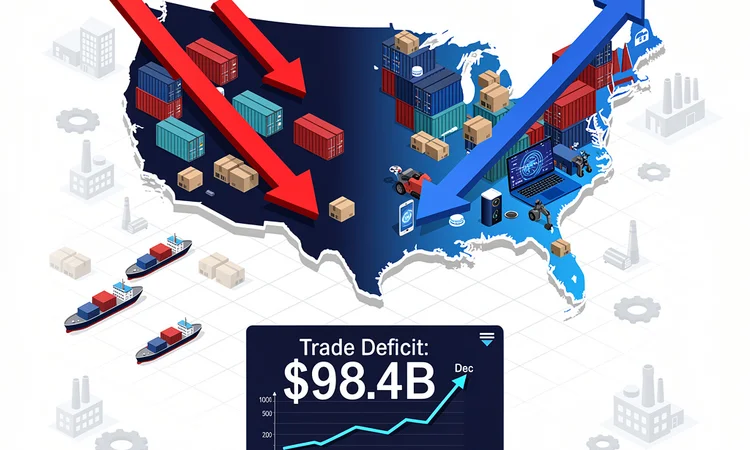
The United States trade deficit expanded to its widest margin in nearly three years this December, a stark indicator that American consumers’ appetite for foreign goods remains insatiable even as global demand for U.S. exports continues to soften. According to data released by the Commerce Department, the trade gap swelled by 21.6% to $98.4 billion, marking the largest monthly increase since March 2022 and underscoring fundamental imbalances in the nation’s economic relationship with the rest of the world.
The December figures represent a significant deterioration from November’s revised $80.9 billion deficit, with Yahoo Finance reporting that imports surged 2.3% to $357.6 billion while exports declined 1.4% to $259.2 billion. This simultaneous movement—rising imports coupled with falling exports—paints a concerning picture for policymakers already grappling with questions about American competitiveness in the global marketplace. The widening gap comes at a particularly sensitive moment, as the incoming administration has signaled intentions to reshape trade policy through aggressive tariff measures.
For the full year 2024, the goods and services deficit increased 8.2% to $973.5 billion from $899.9 billion in 2023, representing the first annual increase since 2021. This expansion occurred despite efforts by the previous administration to rebalance trade relationships and reduce dependence on foreign manufacturing. The persistent deficit raises fundamental questions about the sustainability of current consumption patterns and the structural challenges facing American exporters in an increasingly competitive global economy.
Consumer Demand Drives Import Acceleration Despite Economic Headwinds
The December import surge was broadly distributed across multiple categories, with consumer goods, capital goods, and industrial supplies all posting significant gains. Notably, imports of consumer goods jumped $3.5 billion, driven primarily by pharmaceutical preparations, cell phones, and household goods. This robust import growth suggests that American consumers maintained their spending momentum through the holiday season and into year-end, even as concerns about inflation and interest rates dominated economic discourse.
Capital goods imports increased $2.2 billion, led by civilian aircraft, telecommunications equipment, and computers. This category’s strength indicates that American businesses continue investing in equipment and technology, much of it sourced from overseas manufacturers. The reliance on foreign capital goods highlights a structural challenge for U.S. industrial policy: despite rhetoric about reshoring manufacturing, American companies still depend heavily on imported machinery and equipment to maintain productivity.
Industrial supplies and materials imports rose $1.9 billion, with crude oil accounting for a significant portion of the increase. Energy imports remain a volatile component of the trade balance, subject to global price fluctuations and geopolitical developments. While the United States has achieved energy independence in certain categories, particularly natural gas, the nation continues to import substantial quantities of petroleum products to meet refining needs and regional demand patterns.
Export Weakness Reflects Diminishing Global Competitiveness
The simultaneous decline in exports presents perhaps the more troubling aspect of December’s trade figures. American exports fell across multiple categories, with capital goods dropping $2.7 billion, led by decreases in civilian aircraft, industrial machines, and semiconductors. The semiconductor decline is particularly noteworthy given the sector’s strategic importance and recent government investments through the CHIPS Act intended to bolster domestic production and export capabilities.
Consumer goods exports decreased $1.2 billion, with pharmaceutical preparations and gem diamonds accounting for much of the decline. Industrial supplies exports fell $0.8 billion, driven by decreases in fuel oil and nonmonetary gold. These declines suggest weakening demand from key trading partners, potentially reflecting slower economic growth in Europe, ongoing challenges in China’s economy, and the impact of a stronger dollar making American goods more expensive for foreign buyers.
Services exports, which typically represent a bright spot in the U.S. trade picture, increased only modestly by $0.2 billion to $92.4 billion. The muted growth in this category—which includes financial services, intellectual property, and tourism—indicates that even America’s competitive advantages in high-value services are facing headwinds. The services surplus of $27.5 billion in December, while positive, was insufficient to offset the massive $125.9 billion deficit in goods trade.
Bilateral Deficits Highlight Concentrated Trade Imbalances
The geographic distribution of America’s trade deficit reveals concentrated imbalances with specific trading partners that have become focal points for policy debates. The goods deficit with China, while not specifically detailed in the December report, remains the largest bilateral imbalance and continues to drive discussions about supply chain dependencies and economic security. The persistent deficit with China across consumer electronics, textiles, and manufactured goods reflects decades of offshoring decisions by American companies seeking lower production costs.
The deficit with Mexico has grown substantially in recent years, partly reflecting the success of nearshoring initiatives as companies relocate production from Asia to locations closer to U.S. markets. However, this shift has not reduced the overall trade deficit, merely changing its geographic composition. Mexican imports now include significant quantities of automobiles, auto parts, and electronics assembled in factories operated by American and Asian companies, complicating simple narratives about trade imbalances and their causes.
The European Union represents another significant source of trade deficit, particularly in pharmaceuticals, machinery, and luxury goods. The transatlantic trade relationship has faced tensions over various issues, including digital services taxes, aircraft subsidies, and regulatory standards. These ongoing disputes complicate efforts to address trade imbalances through bilateral negotiations, as both sides maintain entrenched positions on key issues affecting competitiveness.
Tariff Threats and Policy Uncertainty Cloud Trade Outlook
The widening trade deficit arrives as political leaders contemplate significant changes to trade policy, including potential universal tariffs on imports and targeted measures against specific countries or sectors. Proponents argue that such measures could protect American industries, reduce trade deficits, and generate government revenue. However, economists broadly warn that tariffs typically lead to higher consumer prices, supply chain disruptions, and retaliatory measures from trading partners that ultimately harm American exporters.
The historical record on tariffs’ effectiveness in reducing trade deficits remains mixed at best. Previous tariff implementations, including those imposed during 2018-2019, failed to meaningfully reduce the overall trade deficit, as import substitution proved difficult and retaliatory tariffs damaged export sectors. The economic literature suggests that trade deficits primarily reflect macroeconomic factors—particularly the balance between domestic savings and investment—rather than trade policy per se, meaning that tariffs alone cannot address underlying imbalances.
Business uncertainty surrounding potential policy changes may already be affecting trade flows, as companies accelerate imports to build inventory ahead of possible tariffs while foreign buyers delay purchases of American goods pending clarity on trade relationships. This dynamic could temporarily worsen trade figures even before any policy changes take effect, creating a self-fulfilling cycle of deteriorating trade performance that strengthens political arguments for protectionist measures.
Manufacturing Sector Faces Structural Challenges Beyond Trade Policy
The trade figures reflect deeper structural issues facing American manufacturing that extend beyond trade policy debates. Decades of underinvestment in industrial capacity, workforce development, and applied research have eroded competitiveness in many sectors. While the United States maintains advantages in certain high-technology areas and capital-intensive industries, labor-intensive manufacturing has largely migrated to countries with lower costs and, increasingly, more supportive industrial policies.
The strong dollar, driven by the currency’s role as the global reserve currency and relatively attractive U.S. interest rates, makes American exports more expensive and imports cheaper. This persistent dollar strength represents a structural headwind for exporters that trade policy cannot easily address. Some economists argue that the trade deficit is essentially the price America pays for the dollar’s reserve currency status, which provides significant benefits including lower borrowing costs for government and businesses.
Productivity growth in the manufacturing sector, while positive, has not kept pace with competitors in key Asian and European markets. Countries like Germany, Japan, and South Korea have maintained stronger manufacturing bases through sustained investment in automation, workforce training, and industry-university partnerships. China’s industrial policy, despite its controversial aspects, has successfully built competitive advantages in numerous sectors including electric vehicles, renewable energy equipment, and advanced electronics.
Economic Growth Implications and GDP Impact
Trade deficits directly subtract from GDP calculations, meaning the December deterioration will weigh on fourth-quarter economic growth figures. Economists estimate that net exports could reduce fourth-quarter GDP growth by as much as one percentage point, partially offsetting strength in consumer spending and business investment. This mathematical relationship has led some policymakers to focus intensely on reducing trade deficits as a means of boosting measured economic growth.
However, the relationship between trade deficits and economic welfare is more complex than simple GDP accounting suggests. Trade allows consumers to access goods at lower prices and greater variety than domestic production alone could provide, effectively increasing real incomes even if the trade deficit widens. Similarly, imported capital goods and industrial inputs enable American businesses to operate more efficiently and competitively than they could relying solely on domestic suppliers.
The sustainability of large, persistent trade deficits depends ultimately on foreign willingness to accumulate dollar-denominated assets. As long as global investors view U.S. Treasury securities, corporate bonds, and equities as attractive investments, the current account deficit can persist indefinitely. However, any erosion of confidence in American assets or the dollar’s reserve currency status could force a painful adjustment through currency depreciation, higher interest rates, or both.
Looking Forward: Structural Reforms Versus Quick Fixes
Addressing America’s trade imbalances requires confronting uncomfortable truths about consumption patterns, savings rates, and industrial competitiveness. The United States consumes more than it produces, reflected in both trade deficits and low national savings rates. Household savings rates, while improved from historic lows, remain well below levels in other developed economies. Government deficits further reduce national savings, contributing to the trade imbalance through macroeconomic channels that trade policy cannot directly address.
Meaningful progress on trade balances would require comprehensive reforms spanning education, infrastructure investment, research and development support, and fiscal policy. Improving workforce skills to support advanced manufacturing, upgrading transportation and digital infrastructure to reduce business costs, and increasing public and private R&D investment could all enhance American competitiveness over time. However, these structural reforms require sustained commitment and investment over decades, offering no quick political wins.
The December trade figures serve as a reminder that despite political rhetoric and policy initiatives, fundamental economic forces continue to drive trade flows. As policymakers debate responses ranging from aggressive tariffs to industrial policy initiatives, the basic challenge remains: how to make American production more competitive globally while maintaining the consumption standards and market openness that have characterized the U.S. economy for generations. The answer likely requires moving beyond simplistic solutions toward comprehensive strategies that address the complex, interconnected factors determining trade performance in the modern global economy.






Leave a Reply
Your email address will not be published.