








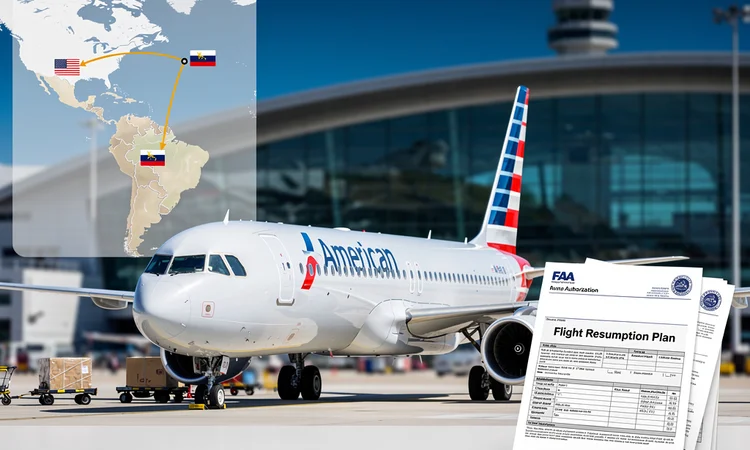
American Airlines Group Inc. announced plans Thursday to resume nonstop daily service to Venezuela, marking the first U.S. carrier flights there since 2019 and signaling a rapid normalization of ties following the U.S. military’s capture of former President Nicolás Maduro earlier this month. The Fort Worth, Texas-based airline, which suspended operations amid political unrest and a U.S. government ban, stated it is working with federal authorities on security assessments and permissions, with details to follow in coming months. This move comes days after President Donald Trump directed the Transportation Department to reopen Venezuelan airspace for commercial traffic.
“We have a more than 30-year history connecting Venezolanos to the U.S., and we are ready to renew that incredible relationship,” said Nat Pieper, American’s Chief Commercial Officer, in a statement from the American Airlines Newsroom . “By restarting service to Venezuela, American will offer customers the opportunity to reunite with families and create new business and commerce with the United States.” The carrier, which began flying to Venezuela in 1987 and was the largest U.S. operator there before halting service, emphasized opportunities for business, leisure and humanitarian travel.
From Suspension to Swift Reboot
American’s 2019 suspension stemmed from its pilots’ union directing members to avoid the country after the U.S. State Department urged citizens to evacuate amid escalating unrest, as detailed in the original CNBC report . Delta Air Lines and United Airlines had paused earlier in 2017. A Transportation Department order from the first Trump administration prohibited direct U.S. flights, citing safety risks. Now, with Maduro’s seizure from his Caracas compound and Delcy Rodríguez acting as interim president, Trump declared, “American citizens will be very shortly able to go to Venezuela, and they’ll be safe there,” according to Reuters .
Transportation Secretary Sean Duffy posted on X: “We are clearing the way for travel between the United States and Venezuela.” The Federal Aviation Administration echoed readiness to facilitate regular travel. Analysts note American’s aggressive positioning, potentially capturing a key Latin American market long dominated by foreign carriers during U.S. absence.
Maduro Capture Ignites Airspace Chaos
The path to resumption was paved by early January’s dramatic events. On January 3, 2026, U.S. strikes captured Maduro and his wife Cilia Flores, triggering FAA emergency restrictions over Venezuelan airspace and adjacent Caribbean regions due to “safety-of-flight risks associated with ongoing military activity.” Hundreds of flights were canceled, stranding thousands during holiday peaks, with impacts rippling to hubs like San Juan’s Luis Muñoz Marín International Airport.
American responded swiftly post-lift, adding nearly 5,000 seats via extra flights and Boeing 777-300 deployments for routes like Miami-San Juan, as reported by WCNC . JetBlue canceled 215 flights, United and Delta adjusted schedules, per Reuters . Duffy confirmed expiration at midnight ET January 4: “The original restrictions around the Caribbean airspace are expiring at 12:00 a.m. ET and flights can resume.”
Strategic Stakes for U.S. Carriers
For American, reclaiming Venezuela bolsters its dominant Caribbean-Latin America network, connecting more nonstop U.S. destinations than rivals. Pre-2019, it operated extensively from Miami, a Venezuelan diaspora hub. Resumption could add significant revenue, especially with 7 million-plus Venezuelans abroad remitting billions annually. Shares of American Airlines rose modestly post-announcement, reflecting investor optimism amid its 2026 centennial celebrations.
Competitors remain silent. Delta and United, which exited earlier, offered no immediate comment to CNBC . Rivals like JetBlue faced near-misses, including evasive maneuvers avoiding a U.S. tanker near Venezuela, heightening pre-capture risks per Los Angeles Times .
Regulatory and Security Hurdles Ahead
FAA assessments loom critical, unlikely before months given protocols. A prior 2019 order reversal requires Transportation Department action. American vows coordination with unions, regulators and stakeholders. State Department letters signal phased embassy reopening in Caracas, per Los Angeles Times .
Broader implications include thawed U.S.-Venezuela commerce. Trump discussed airspace with Rodríguez, paving bilateral security pacts. For airlines, it reopens a market shunned amid Maduro-era hyperinflation and migration waves, potentially spurring tourism to sites like Caracas Botanical Garden, as in American’s historical expansions noted by American Airlines investor site .
Industry Ripples and Passenger Impacts
The episode underscores aviation’s vulnerability to geopolitics. January’s Caribbean scramble saw American waive change fees for January 2-4 tickets, aiding recovery per Palm Beach Post . Now, resumption promises family reunions for Miami’s Venezuelan community. “Operations are resuming to all markets today,” American spokesperson Dan Landson told Miami Herald post-January closures.
Industry watchers via Aviation Week highlight how FAA NOTAMs forced diversions, inflating fuel costs 15-20% for Latin routes. American’s lead positions it to dominate, leveraging its 6,000 daily flights across 350 destinations.






Leave a Reply
Your email address will not be published.