








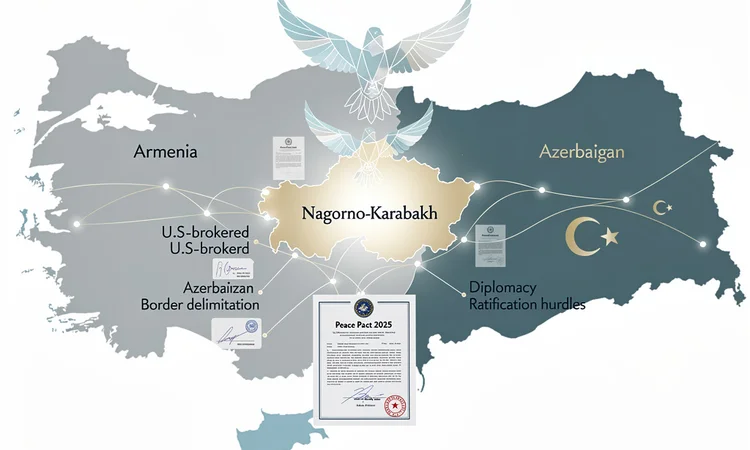
In a dimly lit room at the White House on August 8, 2025, Armenian Prime Minister Nikol Pashinyan and Azerbaijani President Ilham Aliyev put their initials to a historic 17-article peace agreement, brokered by U.S. President Donald Trump. This pact, formally titled the ‘Agreement on the Establishment of Peace and Interstate Relations between the Republic of Armenia and the Republic of Azerbaijan,’ marks the potential end to over three decades of bloodshed in the South Caucasus. The deal addresses core disputes over Nagorno-Karabakh, border delimitation, and transport corridors, amid a backdrop of displacement and economic strain.
The agreement stipulates Armenia’s recognition of Azerbaijan’s sovereignty over Nagorno-Karabakh, following Baku’s 2023 military offensive that expelled over 100,000 ethnic Armenians from the region. In return, Azerbaijan commits to ensuring rights for remaining Armenian cultural sites, while both sides pledge to open borders and establish diplomatic ties. A key concession involves Armenia facilitating a route—labeled the ‘Zangezur corridor’ by Azerbaijan—linking mainland Azerbaijan to its Nakhchivan exclave through southern Armenia, a provision long demanded by Baku and Ankara. Wikipedia details the document’s origins in bilateral talks.
Recent diplomatic momentum has accelerated implementation. On December 24, 2025, Turkish President Recep Tayyip Erdogan reaffirmed Ankara’s backing for the process during a call with Aliyev, emphasizing continued trade and security cooperation between Turkey and Azerbaijan. This comes as border commissions finalize delimitation maps, with 12.7 kilometers already adjusted in April 2024, returning four Azerbaijani villages without violence. Anadolu Agency reported Erdogan’s direct endorsement.
Roots of a Frozen War Thaw
The Nagorno-Karabakh conflict erupted in the late 1980s as the Soviet Union crumbled, pitting ethnic Armenians seeking independence against Azerbaijan. Yerevan backed the self-declared Republic of Artsakh, occupying not just the enclave but surrounding districts. The 1994 ceasefire left Azerbaijan controlling 20% of its territory, fueling revanchism in Baku. A 2020 war shifted momentum, with Azerbaijan reclaiming swaths of land using Turkish drones and Israeli tech. Council on Foreign Relations tracks these escalations through 2025.
Azerbaijan’s 2023 lightning offensive ended Artsakh’s autonomy, prompting mass exodus. International Crisis Group notes in a December 2025 report that Yerevan’s peace push now risks domestic backlash from Karabakh refugees, deepening political rifts. Pashinyan, once hailed as a democratizer, faces protests accusing him of capitulation. Baku, flush with oil wealth, views the pact as vindication of its military investments.
Mediation shifted from Russia and the EU to the U.S., with Trump’s involvement sealing the deal. The Joint Declaration signed alongside the initialed treaty commits to ratification, troop withdrawals from borders, and economic normalization. Posts on X highlight optimism, with users noting direct talks in Doha where negotiators publicly affirmed trust-building steps. Euronews hosted the rare joint interview.
Border Maps Redrawn, Tensions Ease
Delimitation efforts, ongoing since 2021 Alma-Ata protocols, have yielded tangible results. In 2024, Armenia ceded control of villages like Baghanis Ayrum to Azerbaijan, verified by GPS coordinates. Azerbaijan’s Foreign Minister Jeyhun Bayramov stated in December 2025 that Baku’s 2024 proposal remains open, urging Yerevan to host talks on its soil. This process, spanning over 1,000 kilometers, mirrors Georgia-Azerbaijan efforts but accelerated by peace imperatives. Report.az quotes Aliyev crediting Azerbaijan as treaty architect.
Security dynamics evolve with Russia’s withdrawal from Armenian borders, a pact stipulation reducing Moscow’s leverage. Armenia pivots westward, eyeing EU integration, while Azerbaijan strengthens Turkic alliances. Trade potential looms large: reopening routes could slash transport costs, boosting Eurasia’s connectivity. Yet hurdles persist, including Armenia’s constitutional references to Karabakh and Azerbaijan’s demands for enclave access guarantees.
European Parliament analysis warns of fragility, citing domestic politics and external meddlers. Azerbaijan’s AIR Center trained media on peace narratives in December 2025, signaling confidence. X sentiment reflects cautious hope, with insiders praising bloodless border handovers as models for resolution. European Parliament Think Tank outlines vulnerabilities.
Corridor Dreams and Economic Stakes
The Zangezur corridor symbolizes post-peace prosperity. Azerbaijan’s Nakhchivan, cut off since Soviet times, stands to gain rail and road links to Turkey, enhancing the Middle Corridor trade artery rivaling Russia’s routes. Armenia secures transit fees and guarantees of non-militarization. Analyst Gevorg Papoyan advocated opening land borders pre-ratification, per recent X discussions.
Energy plays a pivotal role. Azerbaijan’s gas exports to Europe surged post-Ukraine war, funding reconstruction in recaptured areas. Peace enables joint infrastructure, like pipelines skirting Armenia. International Center for Transitional Justice calls the August declaration a ‘fragile framework’ needing global backing to sustain refugee returns and heritage preservation. International Center for Transitional Justice stresses support.
Ratification timelines tighten as 2026 looms. Aliyev marked martyrs’ remembrance by reiterating peace authorship, while Pashinyan navigates opposition. Reuters previews status amid White House trilateral, underscoring U.S. stakes in regional stability. Reuters provides negotiation insights.
Global Ripples and Ratification Road
Turkey’s involvement amplifies stakes. Erdogan’s December call with Aliyev, covered by Yeni Safak , ties peace to broader Black Sea security. Iran’s concerns over corridor encirclement prompted quiet diplomacy, while Russia laments lost influence. For industry watchers, normalized ties unlock $10 billion in annual trade potential, per think tank estimates.
Refugee integration challenges both capitals. Azerbaijan’s IDPs return to Shusha and Aghdam, backed by petrodollars. Armenia grapples with 100,000 Karabakh Armenians straining welfare. CivilNet reports Crisis Group’s warning on social tensions. Progress hinges on confidence-building, like joint patrols and cultural exchanges outlined in Article 17.
As 2025 closes, Erdogan’s support and border advances signal momentum. Azerbaijani media training via the Foreign Ministry fosters positive narratives. X posts from insiders like Onnik Krikorian query sequencing but affirm border openings’ urgency. QNA echoes regional endorsement.
Path Forward Amid Lingering Shadows
Ratification demands parliamentary approval, with Armenia’s snap polls and Azerbaijan’s controlled assembly key variables. Provisions ban revanchist rhetoric and mandate history textbook reviews. Economic forums in Baku and Yerevan preview joint ventures in tech and agriculture. Trend.az highlights media initiatives as soft power tools.
For insiders, the pact reconfigures South Caucasus geopolitics, diluting Russia’s monopoly and elevating U.S.-Turkish sway. Delimitation’s success—four villages swapped peacefully—sets precedent for the full 1,000-km line. Euronews’ Doha interview reveals negotiators’ rapport, a far cry from 2020 trenches. Trend.az covers training details.
The White House handshake, initialed amid fanfare, now tests endurance. Aliyev’s authorship claim underscores Baku’s leverage, yet Pashinyan’s concessions avert war. As Erdogan pledges continuity, the region edges toward stability, with corridors poised to redefine trade flows into 2026 and beyond. Azernews captures early optimism.






Leave a Reply
Your email address will not be published.