







China’s manufacturing sector presents a tale of two economies in January, as private enterprises demonstrate continued expansion while state-owned factories contract, revealing fundamental tensions in the world’s second-largest economy. The divergence between private and public sector performance underscores the challenges facing Beijing as it attempts to stabilize growth amid persistent structural headwinds and mounting cost pressures that are eroding business confidence to levels not seen in nine months.
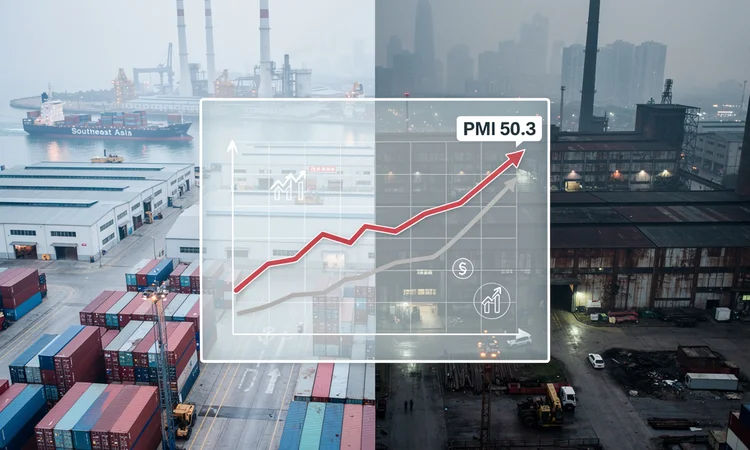
According to the Wall Street Journal , the RatingDog China general manufacturing purchasing managers index, compiled by S&P Global, edged up to 50.3 in January from 50.1 in December. The reading, which sits just above the critical 50 threshold separating expansion from contraction, suggests that private manufacturers are maintaining momentum despite broader economic uncertainties. The modest improvement comes as production accelerated and new orders increased, providing a glimmer of optimism for an economy that has struggled to regain its pre-pandemic dynamism.
The expansion in private manufacturing activity stands in stark contrast to official government data released over the weekend. The official manufacturing PMI, which tracks predominantly large state-owned enterprises, fell to 49.3 in January from 50.1 in December, marking an unexpected return to contractionary territory. This divergence highlights the increasingly bifurcated nature of China’s industrial economy, where nimble private firms are adapting to market conditions more effectively than their state-owned counterparts, which often face political directives that may conflict with pure economic efficiency.
Export Orders Signal Shifting Trade Patterns
A particularly noteworthy development in the January data was the return of new export orders to expansion territory after contracting in December. Yao Yu, founder at RatingDog, noted that this rebound was “primarily buoyed by increased demand from Southeast Asia and other overseas markets.” This shift in export destinations reflects China’s ongoing efforts to diversify its trading relationships amid persistent tensions with Western economies and the continued reshaping of global supply chains.
The strengthening of export orders to Southeast Asian markets represents a strategic pivot that Chinese manufacturers have been cultivating for several years. As companies in the region seek alternatives to more expensive production in developed economies, Chinese factories are positioning themselves as reliable suppliers of intermediate goods and components. This trend has accelerated as regional trade agreements, including the Regional Comprehensive Economic Partnership, have reduced barriers and facilitated greater economic integration across Asia.
However, the improvement in export orders should be viewed with caution. While Southeast Asian demand provides a buffer, it cannot fully compensate for weakness in traditional Western markets, which continue to grapple with their own economic challenges. The European Union faces stagnation, while the United States navigates the impacts of higher interest rates and shifting consumer spending patterns. Chinese manufacturers remain vulnerable to any significant downturn in global demand, particularly as geopolitical tensions continue to influence trade flows and investment decisions.
Employment Growth Masks Underlying Fragility
The RatingDog survey identified improving employment as the main driver of January’s activity expansion, with hiring linked primarily to growth in new orders. This represents a positive signal for China’s labor market, which has faced significant pressure in recent years, particularly among young workers. The manufacturing sector’s ability to absorb additional workers suggests that at least some segments of the economy are experiencing genuine demand-driven growth rather than merely managing existing capacity.
Yet this employment growth exists against a backdrop of deteriorating business confidence, which slipped to a nine-month low in January. The contradiction between expanding hiring and weakening sentiment reveals the complex psychology of Chinese business owners, who may be filling orders and adding workers in the short term while harboring deep concerns about medium-term prospects. This disconnect suggests that current expansion may be fragile and vulnerable to rapid reversal if conditions deteriorate.
Cost pressures emerged as the primary factor weighing on business confidence, according to the survey. Chinese manufacturers face a challenging cost environment characterized by elevated raw material prices, persistent energy costs, and wage pressures in an increasingly competitive labor market. These factors squeeze profit margins and force difficult decisions about pricing, investment, and expansion. For many private manufacturers operating on thin margins, even modest cost increases can threaten viability, particularly when they lack the pricing power to pass costs along to customers.
The State Versus Private Sector Divide
The methodological differences between the RatingDog and official PMI surveys illuminate a fundamental divide in China’s economic structure. The RatingDog survey, which focuses on smaller private companies, captures the experiences of enterprises that must respond quickly to market signals and operate without the safety net of state support. These firms represent the dynamic edge of China’s economy, driving innovation and employment but also bearing the brunt of economic volatility.
In contrast, the official PMI tracks large state-owned enterprises that benefit from preferential access to credit, government contracts, and policy support. These companies often prioritize objectives beyond pure profitability, including employment stability, technological advancement in strategic sectors, and implementation of government industrial policy. When the official PMI contracts while the private sector expands, it suggests that state enterprises may be responding to different incentives or facing distinct challenges related to their size, structure, or political mandates.
This divergence has important implications for understanding China’s economic trajectory. Private sector vitality is essential for job creation, innovation, and efficient resource allocation, yet the state sector remains dominant in strategic industries and exerts enormous influence over overall economic direction. When these two engines move in opposite directions, it creates uncertainty about which signal more accurately reflects underlying conditions and which will ultimately determine the economy’s path.
Policy Implications and Future Outlook
Beijing’s policymakers face a delicate balancing act as they interpret these mixed signals. The expansion in private manufacturing suggests that recent stimulus measures and supportive policies are gaining some traction, at least in parts of the economy. However, the contraction in state enterprise activity and the decline in business confidence indicate that deeper structural issues remain unresolved. Chinese authorities have pledged to support the economy through a combination of monetary easing, fiscal stimulus, and targeted industry support, but the effectiveness of these measures remains uncertain.
The cost pressures cited by businesses as a key concern point to the need for policies that address supply-side constraints rather than simply boosting demand. China’s manufacturing competitiveness has historically rested on low costs and efficient production, but these advantages are eroding as wages rise and environmental regulations tighten. To maintain their position in global markets, Chinese manufacturers must move up the value chain, investing in technology, automation, and higher-quality products that can command premium prices.
The strengthening of export orders to Southeast Asia and other developing markets suggests one possible path forward. As China’s domestic market matures and growth slows, manufacturers may increasingly look to emerging economies for expansion opportunities. This strategy aligns with Beijing’s Belt and Road Initiative and other efforts to deepen economic ties with developing countries. However, success in these markets requires adapting products and business models to different consumer preferences, regulatory environments, and competitive dynamics.
Structural Challenges Persist Despite Short-Term Gains
While January’s private sector expansion offers a modicum of encouragement, it does little to address the fundamental challenges confronting China’s economy. The property sector remains mired in crisis, with major developers struggling under massive debt burdens and housing demand significantly depressed. Local government finances are strained by falling land sales revenues and accumulated debt from infrastructure investments. Consumer confidence remains weak, with households preferring to save rather than spend amid uncertainty about employment and income prospects.
The manufacturing sector cannot single-handedly drive China’s economic recovery, particularly as the country seeks to rebalance toward consumption-led growth. Manufacturing accounts for a declining share of GDP as services expand, and the sector faces increasing competition from other emerging economies with lower labor costs. Vietnam, India, and other countries are attracting investment from multinational corporations seeking to diversify supply chains away from China, a trend accelerated by geopolitical tensions and pandemic-related disruptions.
Moreover, the weak business confidence revealed in the January survey suggests that manufacturers themselves are skeptical about the sustainability of current conditions. When business owners lack confidence in the future, they become reluctant to make the long-term investments in capacity, technology, and workforce development that drive sustained growth. This hesitancy can become self-fulfilling, as underinvestment leads to reduced competitiveness and diminished growth prospects over time.
Global Implications of China’s Manufacturing Performance
China’s manufacturing sector remains deeply integrated into global supply chains, meaning that its performance has far-reaching implications for companies and consumers worldwide. The expansion in production and new orders suggests that Chinese factories will continue to supply global markets with goods ranging from consumer electronics to industrial components. However, the cost pressures facing manufacturers could translate into higher prices for imported goods in other countries, contributing to inflationary pressures at a time when central banks worldwide are working to bring inflation under control.
The divergence between private and state sector performance also raises questions about the reliability of Chinese economic data and the appropriate interpretation of official statistics. International investors and policymakers rely on these indicators to make decisions about capital allocation, trade policy, and economic forecasting. When different surveys point in opposite directions, it becomes more difficult to assess true conditions and anticipate future developments. This uncertainty can lead to greater volatility in financial markets and more cautious business planning by companies with exposure to China.
As China’s economy evolves, the manufacturing sector’s role will continue to shift. The country’s leaders have articulated a vision of moving toward higher-value production, greater technological self-sufficiency, and reduced dependence on exports. Achieving these goals while maintaining employment and social stability represents one of the most significant economic challenges of the coming decade. January’s mixed manufacturing data suggests that this transition remains very much a work in progress, with private sector resilience providing hope even as broader structural issues cast shadows over the path ahead.






Leave a Reply
Your email address will not be published.