






Enterprise security leaders face a pivotal year as cyber threats bleed into physical operations, demanding unified defenses amid surging AI-powered attacks and cloud dependencies. The 2025 AWS outage, which halted physical access systems nationwide, exposed how digital failures cascade into real-world disruptions, costing large firms up to $9,000 per minute in downtime according to the Ponemon Institute . Christopher Ciabarra, co-founder and CTO of Athena Security, warns in Security Magazine that “cyber incidents cause physical shutdowns, physical breaches create digital vulnerabilities.”
Microsoft’s 2025 Threat Intelligence report reveals AI-assisted cyberattacks have surged across at least four government-backed actors, automating exploits faster than human defenders can react. This convergence forces enterprises to rethink siloed cyber and physical protections, integrating badge readers with cloud identity platforms and IoT sensors into shared operations centers.
ISC2’s 2024 Cybersecurity Workforce Study projects a global shortfall of 4.8 million professionals, amplifying pressures as more than 40% of security-service providers cite labor shortages as their top challenge.
Cyber-Physical Fusion Reshapes Defenses
Badge access tied to HR databases and building networks sharing infrastructure with business apps mean a single compromised IoT device can pivot into core systems. Enterprises are building unified incident response teams, as Ciabarra notes, because “independent treatment of threats is impossible.” The BlackFog analysis echoes this, urging holistic strategies embedding cyber thinking from boardrooms to infrastructure amid AI-enhanced malware and zero-day exploits expanding attack surfaces.
Cloud fragility emerged as a core concern after the AWS event stalled authentication for mobile credentials and logistics. Leaders now prioritize multi-region resilience and uptime guarantees in risk frameworks, per Security Magazine .
Remote screening via cloud-connected systems allows one team to oversee multiple sites, mirroring SOC evolution with AI triage. This shift from optional to essential addresses staffing gaps while enabling consistent oversight in hospitals, campuses, and factories.
AI’s Dual-Edged Surge
Attackers wield AI for phishing automation, vulnerability scouting, deepfakes, and adaptive malware, with the Information Systems Audit and Control Association (ISA) warning that “generative AI will be one of the most significant multipliers of adversarial capability in the next two years.” Defenders counter with AI-driven anomaly detection across millions of data points, reducing false alarms in video analytics and SOC workflows.
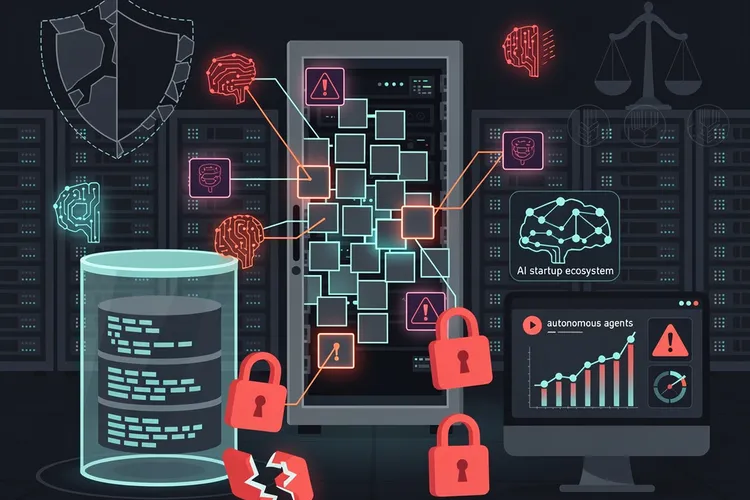
IBM’s predictions for 2026 highlight shadow AI risks, forecasting major incidents where unapproved tools compromise intellectual property, as autonomous agents access sensitive data sans oversight. Palo Alto Networks anticipates a “massive wave of AI agents” providing force multipliers for SOCs but demanding secured deployment to avoid catastrophic vulnerabilities.
Transparency and hybrid human-AI models are critical, ensuring systems resist manipulation. Enterprises must govern AI rigorously, as IBM stresses embedding security into AI development from inception.
Quantum Shadows and Crypto Agility
Quantum threats loom with “harvest now, decrypt later” tactics archiving encrypted data for future cracks. Jisa Softech forecasts 2026 focus on post-quantum cryptography (PQC), crypto agility for rapid algorithm swaps, and lifecycle management visibility. Enterprise Management Associates (EMA) calls for quantum readiness alongside agentic AI and continuous threat exposure management (CTEM).
Regulations like Europe’s NIS2 and U.S. state AI laws intensify vendor accountability, demanding proof of uptime, accuracy, and bias mitigation. Boards seek evidence over assurances, transforming procurement into evidence-based processes.
Zero Trust evolves from buzzword to mandate, with Splunk noting 81% of organizations planning implementation by 2026, driven by attacks, remote work, and privacy rules. INE Security predicts AI-driven defenses, identity security, and regulatory accountability redefining networks.
Regulatory Hammers Fall Harder
ISACA outlines six trends shaping 2026, emphasizing trust via continuous resilience demonstrations over periodic audits. Platforms like Vanta normalize ongoing monitoring, but AI governance under GDPR, NIST, and ISO standards demands upfront transparency to dodge compliance pitfalls.
Check Point’s Cyber Security Report 2026 analyzes global attacks, revealing shifts in AI-driven operations, ransomware, hybrid environments, and social engineering. BlackFog stresses proactive layered defenses prioritizing resilience amid faster-evolving vectors.
Zscaler’s 2026 AI Threat Report notes a 91% year-over-year surge in AI activity, widening oversight gaps and requiring Zero Trust platforms, as shared on X by Tenet Research.
Workforce and Resilience Imperatives
AI agents promise to triage alerts and block threats in seconds, per Palo Alto, addressing the 4.8 million-worker gap drowning teams in fatigue. Dr. Khulood Almani on X forecasts AI-autonomous defenses, quantum risks, surging budgets to $240 billion globally, and regulations like DORA mandating board-level focus.
Trend Micro warns AI accelerates zero-day discovery targeting supply chains and IoT/OT. Naoris Protocol highlights quantum-proofing robotics and industrial automation via decentralized validation meshes.
Enterprises must adopt predictive security, continuous exposure management, and intelligent SecOps over legacy SIEM, shifting from reaction to adaptation at machine speed.






Leave a Reply
Your email address will not be published.