









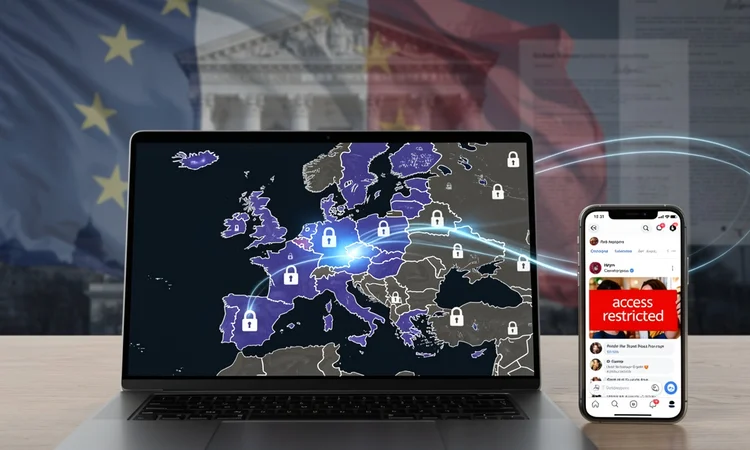
France’s Interior Minister Bruno Retailleau has set off alarm bells across the digital privacy community with his recent announcement that virtual private networks could face government scrutiny following the country’s controversial decision to ban social media access for children under 15. The move represents a significant escalation in European efforts to regulate digital spaces, potentially setting a precedent that could reverberate across the continent and beyond.
According to TechRadar , Retailleau stated that VPNs are “next on my list” during discussions about enforcing the new social media restrictions. The statement came as French lawmakers debated implementation mechanisms for the under-15 social media ban, raising concerns that children might circumvent age restrictions using VPN services that mask their true location and identity. This regulatory approach mirrors China’s restrictive internet policies, where VPN usage is heavily controlled, though France insists its motivations center on child protection rather than broader censorship.
The timing of France’s VPN evaluation coincides with growing international momentum toward stricter internet regulation. The European Union has already implemented the Digital Services Act, which requires platforms to take greater responsibility for content moderation and user safety. France’s proposal, however, goes further by potentially targeting the tools citizens use to access the internet privately, rather than just the platforms themselves. Privacy advocates argue this represents a fundamental shift in how democratic nations approach digital rights, potentially undermining the very foundations of online privacy that VPN technology was designed to protect.
The Technical Challenge of Enforcing Age Restrictions
The practical implementation of France’s social media ban presents enormous technical hurdles that explain why officials are eyeing VPN restrictions. Social media platforms rely primarily on user-submitted age information, which can be easily falsified. More robust age verification systems, such as facial recognition or government ID checks, raise their own privacy concerns and have faced resistance from civil liberties organizations. VPNs complicate enforcement further by allowing users to appear as if they’re accessing services from different countries with different regulatory requirements.
France’s approach differs markedly from other nations attempting similar restrictions. Australia recently passed legislation requiring social media platforms to verify user ages, but stopped short of targeting VPN usage. The United Kingdom’s Online Safety Act places responsibility on platforms rather than restricting user tools. France’s willingness to consider VPN regulations suggests a more comprehensive, and potentially more invasive, regulatory framework that could require internet service providers to block or monitor VPN traffic—a technically complex and controversial proposition.
Global Precedents and Their Concerning Implications
The international precedents for VPN restrictions offer sobering lessons about potential consequences. China maintains a sophisticated system known as the Great Firewall that blocks unauthorized VPN services, though it permits government-approved VPNs for business purposes. Russia has banned VPN providers that don’t comply with government censorship requirements, effectively eliminating privacy-focused services. Iran periodically cracks down on VPN usage during periods of civil unrest. These authoritarian approaches stand in stark contrast to France’s democratic traditions, yet the technical mechanisms being considered may not differ substantially.
Turkey provides a particularly relevant case study for European observers. The country has blocked numerous VPN services while maintaining it seeks only to prevent access to banned content, not to eliminate privacy tools entirely. However, the practical effect has been to significantly restrict Turkish citizens’ ability to access uncensored information. France’s stated goal of protecting children may be genuine, but privacy experts warn that infrastructure built for one purpose can easily be repurposed for broader restrictions once established.
The Privacy Industry’s Response and Economic Implications
Major VPN providers have responded forcefully to France’s trial balloon. ExpressVPN, NordVPN, and other leading services have issued statements defending their role in protecting user privacy and security. The VPN industry, valued at over $44 billion globally, argues that their services serve legitimate purposes far beyond circumventing age restrictions: protecting journalists, enabling secure remote work, safeguarding financial transactions on public WiFi, and allowing travelers to access home country services abroad.
The economic ramifications extend beyond VPN companies themselves. France hosts numerous technology companies and startups that rely on VPN technology for secure operations. Cybersecurity firms use VPNs as fundamental components of their security architectures. Any restrictions could disadvantage French businesses in the global digital economy, potentially driving technology talent and investment to countries with more permissive internet policies. The French tech sector, which has grown substantially in recent years, could face competitive disadvantages if companies must navigate complex VPN regulations that competitors elsewhere don’t face.
Legal and Constitutional Questions Loom Large
Constitutional scholars have raised significant questions about whether VPN restrictions would survive legal challenges under French and European law. The European Convention on Human Rights protects privacy and freedom of expression, rights that VPN technology helps safeguard. The EU’s General Data Protection Regulation (GDPR) enshrines data protection as a fundamental right. Any French law restricting VPN usage would likely face immediate court challenges arguing it violates these established legal protections.
Previous attempts to restrict encryption and privacy tools in democratic nations offer instructive precedents. The United States abandoned the Clipper Chip proposal in the 1990s after intense opposition from privacy advocates and technology companies. Australia’s encryption backdoor laws have faced ongoing criticism and compliance challenges. The technical community has consistently argued that weakening privacy tools for one purpose inevitably weakens them for all purposes, creating vulnerabilities that malicious actors can exploit.
The Child Protection Rationale Under Scrutiny
While protecting children online commands broad public support, experts question whether VPN restrictions represent an effective or proportionate approach. Child safety organizations note that most young people lack the technical sophistication to use VPNs, suggesting the problem may be overstated. More concerning, they argue, is that focusing on VPN restrictions may distract from more effective interventions like improved digital literacy education, better platform design, and enhanced parental control tools that don’t require government surveillance infrastructure.
Research on internet restrictions and child safety yields mixed results. Countries with extensive internet filtering, like China, still face significant problems with online child exploitation and harmful content. Conversely, nations with minimal restrictions but strong educational programs and platform accountability measures have achieved better outcomes. The evidence suggests that blunt technical restrictions may be less effective than comprehensive approaches addressing root causes of online harms while preserving digital rights.
What Implementation Could Actually Look Like
If France proceeds with VPN regulations, the technical implementation would require unprecedented cooperation from internet service providers and potentially invasive monitoring systems. Deep packet inspection technology could identify VPN traffic, but such systems raise privacy concerns and can be circumvented with increasingly sophisticated VPN protocols. Blocking known VPN server IP addresses creates a cat-and-mouse game as providers simply deploy new servers. Requiring VPN providers to register with the government and comply with age verification requirements might prove more practical but would likely drive privacy-focused providers out of the French market entirely.
The enforcement mechanism matters enormously for both effectiveness and civil liberties implications. A light-touch approach requiring platforms to implement age verification without actively blocking VPNs might prove largely symbolic. A comprehensive system with ISP-level blocking and criminal penalties for VPN usage would represent a dramatic expansion of government internet control. The details, which French officials have not yet specified, will determine whether the policy represents a measured child protection effort or a fundamental reshaping of internet freedom in France.
Broader Implications for European Digital Policy
France’s VPN deliberations arrive at a pivotal moment for European digital policy. The continent has positioned itself as a global leader in technology regulation, balancing innovation with consumer protection and fundamental rights. The Digital Services Act, GDPR, and proposed AI regulations reflect this approach. However, VPN restrictions would mark a departure from regulating platforms and services toward controlling the tools citizens use to access the internet—a more intrusive regulatory philosophy.
Other European nations are watching France’s moves carefully. Countries facing similar challenges with online child safety and content moderation may view French VPN regulations as a template worth adopting. Conversely, nations prioritizing digital rights and internet freedom may see France’s approach as a cautionary tale. The outcome could influence whether Europe maintains its current regulatory philosophy or shifts toward more restrictive internet governance models. For an internet that knows no borders, France’s decision will inevitably affect users far beyond French territory, potentially fragmenting the European digital single market that policymakers have worked years to build.






Leave a Reply
Your email address will not be published.