






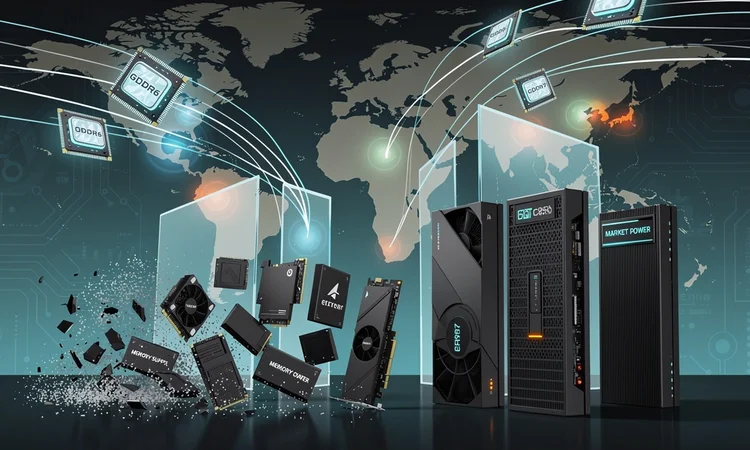
The graphics card industry stands at a precipice. In an unusually candid warning that has sent ripples through the technology sector, Zotac—one of the world’s major graphics card manufacturers—has declared the current memory supply situation “extremely serious,” cautioning that smaller GPU makers could face extinction if the crisis persists. The stark assessment comes as the industry grapples with a perfect storm of supply constraints, escalating costs, and geopolitical tensions that threaten to reshape the competitive dynamics of a market worth tens of billions of dollars annually.
According to TechRadar , Zotac’s warning emerged from discussions about the increasingly precarious position of graphics card manufacturers who depend on a concentrated supply of high-bandwidth memory chips. The company’s executives have indicated that the combination of limited GDDR6 and GDDR7 memory availability, coupled with skyrocketing prices, has created an environment where only the largest players with the deepest pockets and strongest supplier relationships may survive. This consolidation threat arrives at a particularly inopportune moment, as demand for graphics cards continues to surge driven by artificial intelligence applications, gaming, and professional visualization workloads.
The memory crisis represents more than a temporary supply chain hiccup. It reflects fundamental structural challenges in the semiconductor industry, where the capital-intensive nature of memory fabrication has led to an oligopoly of suppliers. Samsung, SK Hynix, and Micron collectively control the overwhelming majority of global memory production, creating a bottleneck that GPU manufacturers cannot easily circumvent. When these suppliers prioritize production for higher-margin products or face their own capacity constraints, graphics card makers find themselves in an increasingly vulnerable position, forced to compete not just with each other but with smartphone manufacturers, data center operators, and other memory-hungry industries.
The Economics of Memory Scarcity
The financial implications of the memory shortage extend far beyond simple supply and demand dynamics. Graphics cards typically incorporate between 8GB and 24GB of high-performance memory, representing a substantial portion of the bill of materials for each unit. As memory prices have climbed—in some cases doubling or tripling from previous baselines—manufacturers face an untenable choice: absorb the increased costs and sacrifice profitability, or pass them along to consumers and risk pricing themselves out of competitive segments. For smaller manufacturers operating on thin margins, neither option offers a sustainable path forward.
Industry analysts have noted that the current crisis differs markedly from previous supply disruptions. While past shortages often resulted from temporary production issues or sudden demand spikes, the present situation stems from longer-term structural factors including underinvestment in memory fabrication capacity, the transition to newer memory standards, and the explosive growth of AI-related demand that has permanently elevated baseline memory consumption across the technology sector. The transition from GDDR6 to GDDR7 memory has proven particularly challenging, as manufacturers must navigate a period where older memory types become scarcer while newer alternatives remain in limited production and command premium prices.
Geopolitical Pressures Compound Supply Challenges
The memory crisis cannot be separated from broader geopolitical tensions that have increasingly weaponized semiconductor supply chains. Export controls, trade restrictions, and the push for domestic semiconductor production in multiple countries have introduced additional complexity and uncertainty into an already strained system. Chinese graphics card manufacturers, in particular, face compounded challenges as Western restrictions on advanced chip technology limit their access to cutting-edge memory components, while domestic Chinese memory production has yet to achieve the scale and technological sophistication necessary to fully substitute for imports.
The concentration of memory production in East Asia—particularly South Korea and Taiwan—creates additional vulnerability to regional instabilities. Any disruption to production facilities, whether from natural disasters, political tensions, or other factors, could rapidly cascade through the entire graphics card supply chain. This geographic concentration has prompted calls for diversification, but the multi-billion dollar investments required to establish new memory fabrication facilities, combined with the years-long timelines for bringing new fabs online, mean that relief from this vulnerability remains distant at best.
Market Consolidation Looms as Smaller Players Struggle
Zotac’s warning about potential industry casualties reflects a broader trend toward consolidation that has accelerated in recent years. The graphics card market has already witnessed significant contraction, with numerous smaller manufacturers either exiting the business entirely or being absorbed by larger competitors. The current memory crisis threatens to accelerate this consolidation, potentially leaving the market dominated by a handful of major players with the financial resources and supplier relationships necessary to weather extended periods of supply constraint and price volatility.
The implications of this consolidation extend beyond corporate balance sheets to affect consumers, enterprises, and the broader technology ecosystem. Reduced competition typically leads to higher prices, less innovation, and fewer choices for end users. For PC gaming enthusiasts, content creators, and professionals who depend on graphics cards for their work, a more concentrated market could mean paying premium prices for products that advance more slowly than they would in a more competitive environment. The AI boom has only intensified these concerns, as data center operators compete with consumer markets for the same limited supply of graphics processing resources.
Nvidia and AMD’s Advantaged Position
The crisis has highlighted the structural advantages enjoyed by GPU chip designers Nvidia and AMD compared to the board partners who manufacture and sell graphics cards under their own brands. As the creators of the GPU silicon itself, Nvidia and AMD maintain direct relationships with memory suppliers and can leverage their scale and importance to secure preferential allocation and pricing. Board partners like Zotac, ASUS, MSI, and Gigabyte operate with less leverage, dependent on both GPU chip allocation from Nvidia or AMD and their own separate memory procurement—a dual dependency that leaves them exposed to supply shocks from multiple directions.
This dynamic has led some industry observers to question the long-term viability of the board partner model. If memory supply constraints persist and smaller manufacturers continue to struggle, the industry could evolve toward a structure where GPU designers either sell more cards directly to consumers or work with a smaller number of well-capitalized manufacturing partners. Such a shift would represent a fundamental restructuring of a market that has operated under broadly similar principles for decades, with potentially far-reaching implications for product diversity, pricing, and innovation.
Technology Transitions Add Complexity
The timing of the memory crisis coincides with significant technological transitions that add layers of complexity to an already challenging situation. The shift to GDDR7 memory promises substantial performance improvements, with bandwidth increases that will enable next-generation graphics cards to deliver meaningful gains in gaming, AI inference, and professional applications. However, the ramp-up of GDDR7 production has proceeded more slowly than anticipated, while GDDR6 production has begun to decline as manufacturers shift capacity toward newer standards.
This transition period creates a gap where neither memory type is available in optimal quantities, forcing graphics card manufacturers to make difficult decisions about product roadmaps and inventory management. Companies must balance the desire to launch products with cutting-edge GDDR7 memory against the reality of limited supply and high costs, while also managing the risk that products launched with GDDR6 memory may quickly appear outdated. For smaller manufacturers with limited resources, navigating this transition while simultaneously managing the broader supply crisis presents challenges that may prove insurmountable.
Industry Responses and Adaptation Strategies
Graphics card manufacturers have not remained passive in the face of these challenges. Some companies have pursued strategies to secure long-term memory supply through advance purchase agreements, accepting higher costs in exchange for greater certainty. Others have adjusted product portfolios to focus on segments where they can maintain better margins or where memory requirements are less demanding. A few manufacturers have explored alternative memory configurations or architectures that could reduce dependence on the most constrained memory types, though such approaches require significant engineering investment and may not be feasible for smaller players.
The industry has also intensified lobbying efforts aimed at encouraging greater investment in memory production capacity. Trade associations and individual companies have pressed governments and memory manufacturers to expand fabrication facilities and accelerate the deployment of new production lines. However, the capital requirements for memory fabs—often exceeding $10 billion for a single facility—combined with the technical complexity of advanced memory production, mean that meaningful capacity additions will take years to materialize even if investment decisions are made today.
Long-Term Implications for Technology Markets
The graphics card memory crisis serves as a microcosm of broader challenges facing the technology industry as it grapples with the consequences of concentrated, complex global supply chains. The semiconductor sector has long operated on principles of extreme specialization and geographic concentration, with different regions and companies focusing on specific aspects of chip design, manufacturing, and assembly. While this model has driven remarkable efficiency and innovation, it has also created vulnerabilities that become apparent during periods of stress.
As artificial intelligence applications continue to proliferate and demand for computational resources shows no signs of abating, the pressure on memory supply will likely intensify rather than ease. Graphics cards represent just one category of products competing for limited memory resources, alongside smartphones, servers, networking equipment, and emerging applications in automotive and industrial sectors. Without significant expansion of memory production capacity, the industry may face recurring cycles of shortage and surplus that complicate planning and investment decisions.
The path forward requires coordinated action across multiple fronts. Memory manufacturers must invest in expanded capacity, even as they balance the risks of overcapacity that have plagued the industry in past cycles. GPU designers and graphics card manufacturers need to develop more resilient supply chain strategies that reduce vulnerability to single points of failure. Policymakers must consider how to encourage necessary investments without distorting markets or creating unsustainable subsidies. For the smaller graphics card manufacturers that Zotac warns could be “wiped out,” the coming months will test their ability to adapt, consolidate, or find new niches in an industry undergoing fundamental transformation. The stakes extend beyond corporate survival to encompass the health of the broader technology ecosystem and the pace of innovation in graphics processing that has driven advances across gaming, professional visualization, and artificial intelligence for decades.






Leave a Reply
Your email address will not be published.