






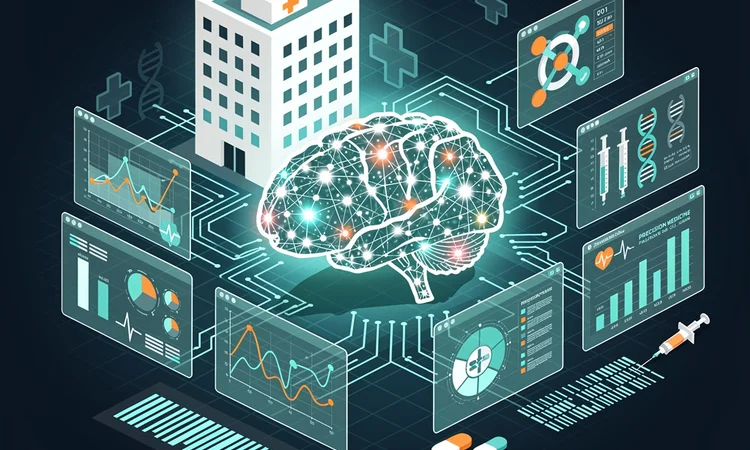
The healthcare industry stands at an unprecedented intersection of technology and patient care, where data science has emerged as a transformative force capable of revolutionizing everything from diagnostic accuracy to treatment protocols. With healthcare organizations generating approximately 30% of the world’s data volume, according to industry estimates, the sector has become a fertile ground for advanced analytics, machine learning, and artificial intelligence applications that promise to fundamentally alter how medical professionals approach disease prevention, diagnosis, and treatment.
The integration of data science into healthcare represents more than just technological advancement—it signals a paradigm shift in medical practice itself. From predicting patient deterioration hours before clinical symptoms manifest to identifying optimal drug combinations for individual genetic profiles, data scientists are working alongside clinicians to unlock insights buried within vast repositories of electronic health records, medical imaging, genomic sequences, and real-time monitoring data. This convergence of computational power and medical expertise is creating opportunities to address some of healthcare’s most persistent challenges, including rising costs, variable care quality, and the growing burden of chronic diseases.
According to New York Institute of Technology , healthcare data scientists are now playing pivotal roles in clinical settings, research institutions, and pharmaceutical companies, with compensation reflecting the critical nature of their work. The institution notes that these professionals combine expertise in statistics, programming, and domain knowledge to extract actionable insights from complex medical datasets, with platforms like Glassdoor providing valuable insights into career trajectories and salary expectations in this rapidly expanding field.
Predictive Analytics Transforming Patient Care Delivery
One of the most significant applications of data science in healthcare involves predictive analytics, which enables medical teams to anticipate adverse events before they occur. Hospitals are deploying machine learning algorithms that continuously analyze patient vital signs, laboratory results, and historical data to identify individuals at high risk of sepsis, cardiac arrest, or other life-threatening conditions. These early warning systems have demonstrated remarkable success in reducing mortality rates and preventing costly intensive care unit admissions by alerting clinicians to intervene during critical windows of opportunity.
The Johns Hopkins Hospital, for instance, has implemented predictive models that assess sepsis risk across its patient population, allowing rapid response teams to initiate treatment protocols hours earlier than traditional clinical recognition would permit. Such systems analyze dozens of variables simultaneously—including heart rate variability, temperature trends, white blood cell counts, and medication histories—to generate risk scores that update in real-time as new data becomes available. This proactive approach represents a fundamental departure from reactive medicine, where interventions typically occur only after patients exhibit obvious signs of deterioration.
Precision Medicine and Genomic Data Integration
The explosion of genomic data has created both opportunities and challenges for healthcare systems seeking to deliver truly personalized medicine. Data scientists are developing sophisticated algorithms that correlate genetic variations with drug responses, disease susceptibilities, and optimal treatment pathways. These computational approaches are essential for making sense of the three billion base pairs in the human genome and identifying the specific mutations that drive individual cases of cancer, rare diseases, and complex conditions like diabetes and heart disease.
Oncology has emerged as a particularly promising domain for precision medicine applications. By analyzing tumor genomic profiles alongside patient characteristics and treatment outcomes from thousands of similar cases, machine learning models can recommend targeted therapies most likely to be effective for specific cancer subtypes. This approach has proven especially valuable in identifying patients who will benefit from immunotherapy—an expensive treatment with dramatic results in some patients but minimal impact in others. The ability to predict treatment response before initiating therapy saves both time and resources while sparing patients from ineffective treatments and their associated side effects.
Medical Imaging and Computer Vision Breakthroughs
Computer vision algorithms trained on millions of medical images are achieving diagnostic accuracy that rivals—and in some cases surpasses—experienced radiologists. Deep learning models can detect subtle patterns in X-rays, CT scans, and MRIs that might escape human observation, identifying early-stage cancers, fractures, and neurological abnormalities with remarkable precision. These tools are not replacing radiologists but rather augmenting their capabilities, allowing them to focus on complex cases while AI handles routine screenings and provides second opinions on challenging diagnoses.
Diabetic retinopathy screening represents a particularly successful application of this technology. Algorithms trained on hundreds of thousands of retinal images can now identify signs of diabetes-related eye damage with accuracy exceeding 90%, enabling screening programs in primary care settings and underserved communities where ophthalmologists may be scarce. Similar approaches are being applied to mammography interpretation, where AI systems flag suspicious lesions for radiologist review, potentially reducing both false positives and false negatives in breast cancer screening programs.
Operational Efficiency and Resource Optimization
Beyond direct patient care applications, data science is transforming healthcare operations and resource allocation. Hospitals are using predictive models to forecast patient admission volumes, optimize staff scheduling, and manage supply chains more effectively. These operational improvements directly impact patient care by reducing wait times, preventing bed shortages, and ensuring that critical resources are available when and where they’re needed most.
Emergency department overcrowding, a persistent challenge in healthcare systems worldwide, has proven amenable to data-driven solutions. By analyzing historical patterns, seasonal trends, and real-time data feeds, predictive models can anticipate surge periods hours or even days in advance, allowing administrators to adjust staffing levels and prepare for increased patient volumes. Some health systems have reported reductions in average wait times of 20-30% after implementing such forecasting tools, demonstrating that data science applications need not be clinically focused to improve patient outcomes.
Drug Discovery and Clinical Trial Optimization
The pharmaceutical industry has embraced data science as a means of accelerating drug development and reducing the astronomical costs associated with bringing new medications to market. Machine learning algorithms can screen millions of molecular compounds virtually, identifying promising drug candidates far more quickly than traditional laboratory methods. This computational approach to drug discovery has the potential to compress development timelines from years to months for certain applications, particularly in repurposing existing drugs for new indications.
Clinical trial design and patient recruitment have also been revolutionized by data analytics. By analyzing electronic health records across large populations, researchers can identify eligible trial participants more efficiently and predict which patients are most likely to complete study protocols. This targeted recruitment approach reduces the time and cost required to enroll trials while improving the likelihood of detecting meaningful treatment effects. Furthermore, real-world evidence derived from analysis of millions of patient records is increasingly being used to supplement traditional clinical trial data in regulatory submissions, providing broader insights into drug safety and effectiveness across diverse populations.
Population Health Management and Preventive Care
Data science is enabling a shift from reactive sick care to proactive population health management, where the goal is preventing disease rather than simply treating it. By analyzing demographic data, social determinants of health, environmental factors, and individual risk profiles, health systems can identify communities and individuals at highest risk for specific conditions and deploy targeted interventions. This approach has proven particularly effective in managing chronic diseases like diabetes and hypertension, where early intervention and lifestyle modifications can prevent costly complications.
Accountable care organizations and value-based payment models have accelerated adoption of population health analytics, as providers increasingly bear financial risk for patient outcomes. Predictive models identify patients likely to become high-cost utilizers of healthcare services, enabling care management teams to intervene with preventive services, medication adherence programs, and social support before expensive hospitalizations occur. These data-driven interventions are demonstrating measurable returns on investment while improving patient quality of life.
Challenges in Data Quality and Interoperability
Despite the tremendous promise of healthcare data science, significant obstacles remain. Data quality issues plague many healthcare datasets, with missing values, inconsistent coding practices, and errors in electronic health records undermining the reliability of analytical models. The lack of interoperability between different healthcare IT systems means that patient data often remains siloed, preventing the comprehensive view necessary for optimal decision-making. Addressing these infrastructure challenges requires sustained investment and collaboration across the healthcare ecosystem.
Privacy and security concerns also loom large in healthcare data science applications. The sensitive nature of medical information demands robust safeguards against breaches and unauthorized access, while regulations like HIPAA impose strict requirements on data handling and sharing. Balancing the need for data access to train effective machine learning models with the imperative to protect patient privacy represents an ongoing challenge that requires technical solutions like differential privacy and federated learning, as well as thoughtful policy frameworks that enable responsible data use.
The Evolving Role of Healthcare Data Professionals
The growing importance of data science in healthcare has created surging demand for professionals who combine technical skills with medical domain knowledge. Healthcare data scientists must understand not only statistical methods and programming languages but also clinical workflows, medical terminology, and the regulatory environment governing healthcare data. This unique combination of expertise commands premium compensation, with experienced healthcare data scientists earning six-figure salaries according to industry surveys.
Educational institutions are responding to this demand by developing specialized programs that bridge the gap between computer science and healthcare. These programs emphasize practical applications of machine learning and statistics to real-world medical problems, often incorporating clinical rotations or partnerships with healthcare organizations to provide hands-on experience. As the field matures, professional certifications and standards are emerging to ensure that healthcare data scientists possess the competencies necessary to work effectively in clinical environments where analytical errors can have life-or-death consequences.
The Path Forward for Data-Driven Healthcare
Looking ahead, the integration of data science into healthcare will only deepen as technologies mature and healthcare organizations build the infrastructure necessary to support advanced analytics at scale. The emergence of real-time data streams from wearable devices and remote monitoring systems will provide unprecedented opportunities for continuous health assessment and early intervention. Advances in natural language processing will unlock insights from the vast amounts of unstructured clinical notes and medical literature that currently remain underutilized.
The ultimate promise of healthcare data science lies not in replacing human clinicians but in empowering them with tools and insights that enhance their decision-making capabilities. As algorithms become more sophisticated and datasets more comprehensive, the practice of medicine will increasingly be guided by evidence derived from millions of patient experiences rather than limited clinical observations. This transformation will require not only technological innovation but also cultural change within healthcare organizations, as clinicians learn to trust and effectively utilize AI-powered decision support tools. The organizations that successfully navigate this transition will be positioned to deliver higher quality care at lower costs, fulfilling the long-standing promise of healthcare’s digital revolution.






Leave a Reply
Your email address will not be published.