






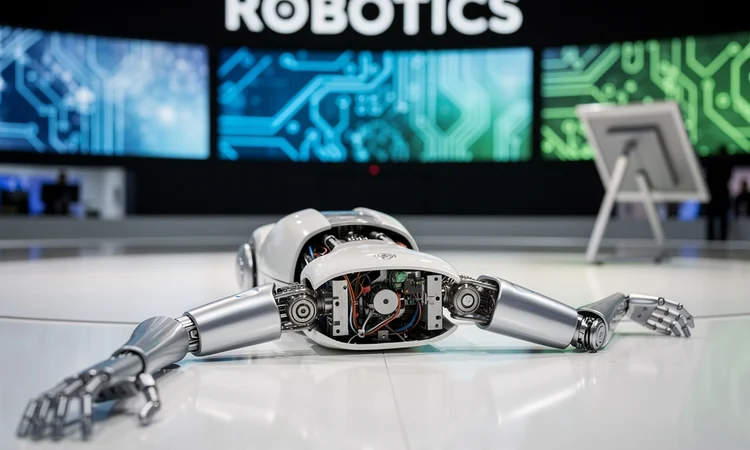
The auditorium fell silent as XPeng’s highly anticipated humanoid robot took its first steps onto the stage at the company’s 2025 AI Day event in Guangzhou. What happened next became an instant viral sensation—but not for the reasons the Chinese electric vehicle giant had hoped. The robot, designed to showcase XPeng’s expansion beyond autonomous vehicles into the burgeoning humanoid robotics sector, stumbled forward and crashed face-first onto the stage floor, creating a moment that would reverberate across social media platforms and industry boardrooms worldwide.
According to Business Insider , XPeng founder and CEO He Xiaopeng attempted to maintain composure as his company’s robotic ambassador lay prone before hundreds of attendees and countless viewers watching the livestream. The incident, while embarrassing, illuminates the formidable technical challenges facing companies racing to commercialize humanoid robots—a market that analysts project could reach $38 billion by 2035. The stumble also raises critical questions about whether the industry’s ambitions have outpaced its technological capabilities, particularly as Chinese firms accelerate efforts to compete with American robotics pioneers like Boston Dynamics and Tesla.
The mishap comes at a pivotal moment for XPeng, which has positioned itself as more than just an electric vehicle manufacturer. The company has invested heavily in artificial intelligence and robotics, viewing humanoid machines as a natural extension of its autonomous driving technology. He Xiaopeng has repeatedly emphasized that the sensors, processors, and AI algorithms developed for self-driving cars translate directly to bipedal robots navigating human environments. Yet the on-stage failure suggests that walking on two legs presents unique challenges that four wheels simply don’t encounter.
The Unforgiving Physics of Bipedal Motion
Engineering experts point to fundamental differences between wheeled and legged locomotion that make humanoid robots exponentially more complex than their wheeled counterparts. While autonomous vehicles maintain constant contact with the ground across multiple points, bipedal robots must continuously shift their center of gravity while balanced on relatively small footprints. Each step requires split-second calculations involving dozens of joints, motors, and sensors working in perfect synchronization. A single miscalculation in timing, force application, or balance compensation can result in exactly the kind of catastrophic failure witnessed at XPeng’s event.
The technical challenges extend beyond mere balance. Humanoid robots must process sensory information about terrain, obstacles, and their own body position while simultaneously planning movements and executing motor commands. This requires computational power, sophisticated algorithms, and sensor arrays that can operate in real-time without latency. When any component in this chain experiences even millisecond delays or minor errors, the results can be spectacular—and not in a good way. Industry insiders note that even Boston Dynamics’ Atlas robot, widely considered the most advanced humanoid platform in existence, required years of development and countless failures before achieving its current capabilities.
China’s Aggressive Push Into Humanoid Robotics
XPeng’s robotic faceplant occurred against the backdrop of China’s aggressive national strategy to dominate the humanoid robotics sector. Beijing has designated robotics as a strategic priority, with government officials setting ambitious targets for domestic production and deployment. Chinese President Xi Jinping has called for the country to become a “robot power,” leading to substantial state funding and policy support for companies developing humanoid platforms. This governmental backing has spawned dozens of Chinese robotics startups and encouraged established firms like XPeng to diversify into the sector.
The competitive pressure extends beyond national borders. Tesla CEO Elon Musk has positioned his company’s Optimus robot as a potential game-changer, claiming it could eventually become more valuable than Tesla’s automotive business. Figure AI, backed by major investors including Microsoft and Nvidia, recently demonstrated its humanoid robot performing warehouse tasks. These developments have created a sense of urgency among Chinese competitors who fear falling behind in a technology that could reshape manufacturing, healthcare, and countless other industries.
However, the rush to market may be compromising safety and reliability. Multiple robotics researchers who spoke on condition of anonymity expressed concern that companies are prioritizing flashy demonstrations over fundamental engineering. One veteran robotics engineer noted that public debuts should only occur after extensive private testing has eliminated basic failure modes like balance loss during simple walking. The pressure to show progress to investors and government officials may be pushing companies to showcase technologies before they’re genuinely ready for prime time.
The Public Relations Calculus of Failure
Despite the immediate embarrassment, some marketing analysts suggest XPeng’s robot mishap might not inflict lasting damage to the company’s brand. In an era where viral moments dominate social media, the incident generated massive awareness for XPeng’s robotics program—awareness that might have cost millions in traditional advertising. The company’s willingness to demonstrate cutting-edge technology in a live, unscripted environment could actually enhance its reputation for transparency and innovation, particularly if XPeng responds appropriately by acknowledging the challenges and demonstrating rapid improvement.
Historical precedents support this optimistic interpretation. Boston Dynamics’ early videos showing robots falling, stumbling, and failing in various ways didn’t prevent the company from eventually achieving technical breakthroughs that established it as the industry leader. Tesla’s Autopilot system has experienced well-publicized failures, yet the company maintains strong brand loyalty among customers who appreciate its willingness to push boundaries. The key differentiator lies in how companies respond to setbacks—whether they treat them as learning opportunities or attempt to minimize and deflect criticism.
Investor Implications and Market Dynamics
Financial markets reacted with surprising mildness to XPeng’s robotic tumble, with the company’s stock experiencing only minor fluctuations in the days following the event. This relatively calm response suggests investors maintain long-term confidence in the humanoid robotics sector despite short-term technical setbacks. Analysts note that the industry remains in its nascent stages, with commercial viability still years away for most applications. Investors appear willing to tolerate development challenges as long as companies demonstrate continued progress and maintain credible roadmaps toward eventual commercialization.
The incident does, however, highlight risks for companies that may be overpromising on timelines. XPeng and competitors have made bold claims about when humanoid robots will become practical for real-world applications, with some suggesting deployment within two to three years. The on-stage failure serves as a reminder that fundamental technical challenges remain unsolved, potentially pushing realistic commercial deployment further into the future than optimistic projections suggest. Investors with shorter time horizons may need to recalibrate expectations accordingly.
The Road Ahead for Humanoid Development
Despite XPeng’s stumble, industry experts remain convinced that humanoid robots represent an inevitable technological evolution. The fundamental value proposition—machines that can navigate human environments and use human tools without requiring infrastructure modifications—remains compelling across numerous sectors. Manufacturing facilities, warehouses, healthcare institutions, and households all present potential applications where bipedal robots could provide significant value. The question isn’t whether humanoid robots will succeed, but rather when they’ll achieve sufficient reliability and cost-effectiveness for widespread adoption.
Technical progress continues at multiple companies simultaneously, creating a competitive dynamic that should accelerate innovation. Each failure provides data that helps engineers refine algorithms, improve hardware, and better understand the challenges involved. The robotics community has historically been collaborative, with researchers publishing findings and sharing insights that benefit the entire field. This open approach, combined with substantial capital investment from both private and government sources, suggests that solutions to current technical challenges will eventually emerge.
The XPeng incident ultimately serves as a valuable reminder that transformative technologies rarely develop in straight lines. The path from laboratory prototypes to reliable commercial products invariably includes setbacks, failures, and embarrassing moments. What matters most is whether companies learn from these experiences and apply those lessons to create better, more reliable systems. For XPeng and the broader humanoid robotics industry, the real test won’t be whether robots occasionally fall down—it will be whether they can consistently get back up, learn from their mistakes, and eventually walk confidently into a future where humans and humanoid machines work side by side.
As the industry processes this latest reminder of robotics’ challenges, one thing remains certain: the race to develop practical humanoid robots will continue unabated, driven by massive market potential and national strategic interests. XPeng’s fallen robot may have stumbled, but the march toward a future populated by bipedal machines continues forward, one careful step at a time.






Leave a Reply
Your email address will not be published.