



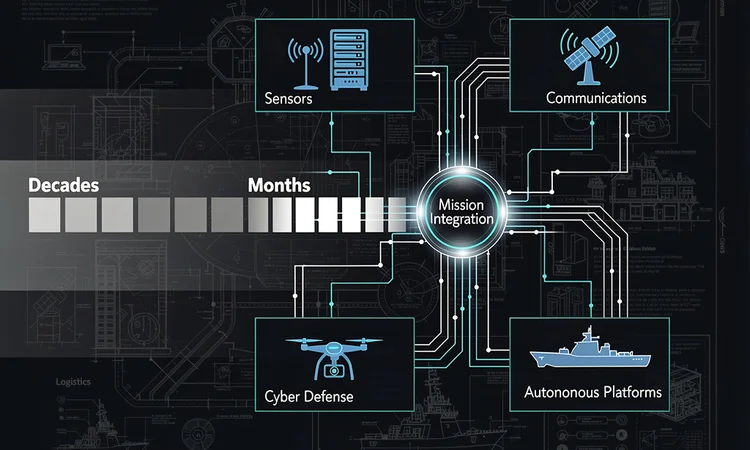
Defense contractors are racing to compress the timeline between technological innovation and battlefield deployment, a challenge that has grown increasingly urgent as global threats evolve faster than traditional acquisition cycles can accommodate. Bob Ritchie, chief technology officer at Science Applications International Corporation (SAIC), has emerged as a leading voice advocating for a fundamental shift in how the defense industry approaches capability delivery through what he calls “mission integration.”
According to ExecutiveBiz , Ritchie’s vision centers on breaking down the traditional silos that separate technology development from operational deployment. Rather than treating these as sequential phases, mission integration treats them as parallel, interconnected processes that must work in concert from the earliest stages of program conception. This approach represents a departure from decades of established defense procurement methodology, where requirements definition, technology development, testing, and fielding have historically progressed through rigid, waterfall-style gates.
The urgency behind this transformation stems from a stark reality: America’s peer competitors are not constrained by the same acquisition frameworks that can stretch U.S. defense programs across decades. The traditional model, which can take 15 to 20 years to field major weapons systems, has become a strategic liability in an era where artificial intelligence, autonomous systems, and cyber capabilities can become obsolete within a fraction of that timeframe. SAIC’s approach aims to compress these timelines dramatically while maintaining the rigorous testing and validation standards essential for military operations.
Bridging the Valley Between Innovation and Implementation
Mission integration, as Ritchie describes it, requires defense contractors to embed themselves more deeply within the operational environment they serve. This means moving beyond the traditional model where contractors deliver specified products and instead becoming partners in solving mission challenges. The distinction is subtle but profound: rather than asking “what technology can we build?” the question becomes “what mission outcome must we enable?”
This philosophy aligns with broader trends across the defense industrial base. The Department of Defense has increasingly emphasized the need for agile acquisition pathways, modular open systems architectures, and continuous software delivery models. However, translating these concepts from policy documents into operational reality has proven challenging for organizations accustomed to traditional program structures and incentive frameworks.
The Technical Architecture of Accelerated Delivery
At the heart of SAIC’s mission integration approach lies a technical architecture designed for adaptability. Modern defense systems increasingly rely on software-defined capabilities that can be updated and enhanced without requiring entirely new hardware platforms. This shift from platform-centric to capability-centric thinking enables incremental improvements that can be fielded on compressed timelines.
Ritchie’s strategy emphasizes the importance of modular, interoperable systems that can integrate new technologies as they mature. Rather than designing monolithic systems optimized for a specific threat environment, this approach creates adaptable frameworks that can evolve alongside changing mission requirements. The technical implementation requires robust application programming interfaces, standardized data formats, and security architectures that can accommodate rapid capability insertion without compromising system integrity.
The challenge extends beyond pure technology to encompass organizational culture and business models. Defense contractors have traditionally generated revenue through long development cycles and sustainment contracts that can span decades. Mission integration, with its emphasis on rapid capability delivery and continuous evolution, requires different economic models and risk-sharing arrangements between government customers and industry partners.
Lessons from Commercial Technology Adoption
The commercial technology sector has demonstrated that rapid capability delivery is achievable when organizational structures align with that objective. Cloud service providers routinely deploy new features and security updates on timelines measured in days or weeks rather than years. While the stakes and regulatory requirements differ substantially in defense applications, the underlying principles of continuous integration and deployment offer valuable lessons.
SAIC’s approach borrows from these commercial best practices while adapting them to the unique requirements of national security applications. This includes implementing DevSecOps methodologies that integrate security considerations throughout the development process rather than treating security as a final gate. It also means adopting continuous testing frameworks that can validate new capabilities against operational requirements without requiring lengthy formal test events.
The human dimension of mission integration may ultimately prove more challenging than the technical aspects. Defense acquisition professionals, military operators, and contractor personnel all must adapt to new ways of working that emphasize collaboration, rapid experimentation, and acceptance of calculated risk. This cultural transformation requires leadership commitment and sustained investment in training and organizational change management.
Overcoming Institutional Barriers to Rapid Deployment
The defense acquisition system, codified in thousands of pages of regulations and policy documents, was designed primarily to prevent failures rather than to accelerate success. While this risk-averse approach has merit in preventing catastrophic program failures, it can also create friction that slows capability delivery. Mission integration requires navigating this regulatory framework while finding pathways to move faster.
Recent acquisition reforms, including the establishment of the Software Acquisition Pathway and expanded use of Other Transaction Authorities, have created more flexible contracting mechanisms. However, utilizing these authorities effectively requires expertise and willingness to deviate from familiar processes. SAIC’s mission integration approach must operate within this evolving acquisition environment, leveraging new authorities while maintaining the accountability and transparency that Congress and taxpayers rightfully demand.
The role of the chief technology officer in a defense contractor has evolved significantly in recent years. Where CTOs once focused primarily on internal research and development investments, leaders like Ritchie now must serve as strategic bridges between emerging technologies, operational requirements, and acquisition processes. This requires fluency in technical domains, deep understanding of military operations, and sophisticated knowledge of defense acquisition regulations and business models.
Measuring Success in Mission Outcomes Rather Than Program Milestones
Traditional defense programs measure success through milestone completions, technical performance parameters, and adherence to cost and schedule baselines. While these metrics remain important, mission integration demands additional measures focused on operational outcomes. Did the capability arrive in time to address the threat? Can it adapt as threats evolve? Does it integrate effectively with existing systems and operational concepts?
This shift toward outcome-based metrics requires closer collaboration between contractors and the warfighters who will ultimately employ the capabilities being developed. SAIC’s approach emphasizes embedding engineers and developers with operational units to gain firsthand understanding of mission challenges and operational constraints. This proximity to the end user enables faster feedback loops and ensures that technical solutions address real operational needs rather than theoretical requirements.
The defense industry stands at an inflection point. The traditional model of long development cycles, platform-centric thinking, and sequential acquisition phases is increasingly misaligned with the pace of technological change and the urgency of emerging threats. Mission integration, as articulated by leaders like Bob Ritchie, offers a pathway forward that could fundamentally transform how defense capabilities move from concept to combat employment.
The Competitive Imperative Driving Change
The push for mission integration is not merely about efficiency or cost savings—it reflects a strategic imperative driven by great power competition. China’s military modernization and Russia’s demonstrated willingness to employ military force have created a security environment where technological advantage can erode quickly. The United States military’s historical edge in areas like precision strike, intelligence surveillance and reconnaissance, and command and control cannot be taken for granted.
Maintaining technological superiority requires the ability to field new capabilities faster than adversaries can develop countermeasures. This competitive dynamic favors approaches that emphasize rapid iteration, continuous improvement, and tight integration between technology developers and operational users. Mission integration, properly implemented, could provide the United States with a sustainable competitive advantage by creating an innovation cycle that adversaries struggle to match.
The broader defense industrial base is watching SAIC’s mission integration initiatives closely. If this approach demonstrates measurable improvements in capability delivery timelines and operational effectiveness, it could catalyze wider adoption across the industry. Conversely, if implementation proves too challenging within existing acquisition frameworks, it may highlight the need for more fundamental reforms to defense procurement policies and regulations.
Building the Workforce for Continuous Capability Evolution
Implementing mission integration at scale requires a workforce with different skills and mindsets than traditional defense programs demand. Engineers must understand operational contexts and be comfortable with rapid iteration rather than perfection before deployment. Program managers need expertise in agile methodologies and continuous delivery models. Security professionals must integrate their work throughout the development process rather than conducting reviews at predetermined gates.
SAIC and other defense contractors face competition for this talent from commercial technology companies that often offer higher compensation and more flexible work arrangements. Attracting and retaining the workforce needed to execute mission integration strategies requires defense contractors to adapt their value propositions, emphasizing the mission significance of defense work while creating technical environments that rival those of leading technology companies.
The next several years will reveal whether mission integration can fulfill its promise of dramatically accelerating capability delivery to warfighters. Success will require sustained commitment from defense contractors, government acquisition organizations, and military operators. It will demand willingness to challenge established processes, accept calculated risks, and measure success by operational outcomes rather than program milestones. Bob Ritchie’s advocacy for this approach at SAIC represents an important test case that could shape the future of defense technology development and deployment for decades to come.






Leave a Reply
Your email address will not be published.