





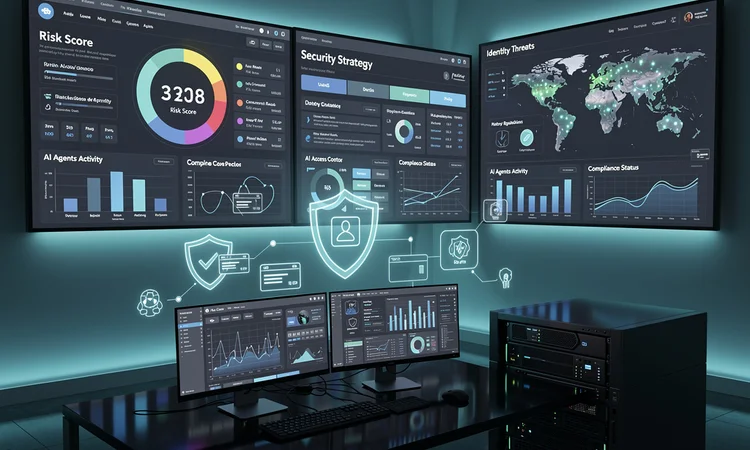
Cybersecurity is entering a turning point. For years, security programs have focused on building stronger technical controls, increasing awareness, and meeting compliance requirements. While these efforts improved baseline security, they did not keep pace with how work actually happens inside modern organizations. Human behavior remained difficult to measure. Identity risk continued to grow. And now, AI agents are introducing a new class of workforce activity that operates faster and with broader reach than any human ever could. These shifts are forcing security leaders to rethink long-held assumptions, as outlined in the Health-ISAC white paper “Human Risk Management Trends 2026,” authored by Living Security.
The trends described point to a future where outcomes matter more than checklists, behavior is treated as a core security signal alongside technology, and human and AI risk are managed together as part of a unified workforce strategy. “2026 is the year human risk management in cybersecurity becomes a board-level priority,” declares a report from Segura Security . This elevation reflects persistent realities: human conduct causes approximately 70–85% of breaches, despite decades of awareness programs, according to Forbes .
From Checklists to Behavioral Signals
A 2019 study found that mandatory training sessions for high-risk employees who failed phishing simulation tests did not improve human cybersecurity. Offenders were just as likely to click on a malicious email link again after the awareness training, notes UpGuard . Compartmentalizing human cyber risk mitigation strategies into separate categories produces a point-in-time risk management framework, encouraging false confidence about an organization’s human error potential. Instead, continuous measurement, behavioral insight, and adaptive intervention are emerging as the new standard, as detailed in The Hacker News .
“Human risk management is about understanding why risky behavior happens — and changing it over time,” says Jordan Daly, Chief Marketing Officer at usecure, quoted in The Hacker News. Organizations are adopting behavioral analytics, real-time “human risk scores,” and friction-to-flow optimization, treating culture, fatigue, and trust as measurable security variables, predicts Jane Frankland .
Phishing, vishing, and other social engineering techniques continue to bypass technical controls by exploiting human trust. Attacks are more targeted, persistent, and aligned with business processes, warns Nomios Group . In 2026, organizations must treat social engineering as a systemic risk.
AI Agents Complicate the Workforce Equation
By 2026, many organizations will have agentic AI – with direct access to critical data – operating as a non-human workforce, demanding controls beyond traditional oversight. The primary risk lies in Identity and Access Management, where existing frameworks are designed for human users, not autonomous agents, according to Ecosystm . Nefarious actors will shift their sights from phishing human employees to prompt-injection attacks targeting AI agents.
“The growing use of AI has CISOs in 2026 prioritizing another longstanding area of security work: identity and access management,” reports CSO Online , citing Jon France, CISO of ISC2. This extends to managing not just human identities but thing identities as well. To secure non-human identities with the same precision as human ones, organizations must develop modern security strategies that incorporate zero-trust security, least-privilege access, automated credential rotation, and secrets management, as emphasized in The Hacker News .
Health-ISAC underscores that security leaders must govern AI agents and manage human/AI risks in a unified way. The white paper’s trends, informed by independent industry research across global organizations, prioritize outcomes over checklists.
Boardrooms Demand Quantifiable Human Risk
In 2026, cyber risk programs will be judged on their ability to explain risk clearly, justify decisions defensibly, and quantify business exposure consistently, writes SecurityWeek . “Tie resilience metrics to executive compensation. Use cyber risk quantification to express exposure in financial terms in a language the board understands,” advises Steve Durbin, Chief Executive of the Information Security Forum.
PwC’s 2026 Global Digital Trust Insights found that 60% of 3,887 business and tech executives across 72 countries ranked cyber risk investment in their top three strategic priorities amid geopolitical uncertainty, per CSO Online. Boards now expect narratives like “we reduced our most material cyber exposures by Y% and cut expected annual loss by roughly $Z,” rather than just threat blocks, as noted in Nucamp .
As a result, 2026 will usher in a major shift toward human risk management as a discipline, with organizations investing in proactive resilience, board-level accountability, and fast recovery planning, according to Jane Frankland.
Regulatory Pressures Elevate Human Factors
Regulations such as NIS2 and DORA increase expectations around risk management, resilience, and accountability. Zero Trust principles help, but only when translated into concrete controls and operational processes, states Nomios Group. Cybersecurity compliance is increasingly tied to governance and accountability, requiring demonstration that controls work in practice through monitoring, testing, and clear ownership.
The Global Cybersecurity Outlook 2026 survey shows 87% of respondents identified AI-related vulnerabilities as the fastest-growing cyber risk over 2025, per the World Economic Forum . Highly resilient organizations exemplify front-line practices across leadership, governance, people and culture, business processes, technical systems, crisis management, and ecosystem engagement.
“In 2026, the primary metric for cybersecurity resilience won’t be speed of detection, but the depth of human trust,” quotes Nucamp from Kip Boyle, vCISO. Authentic human relationships will become our most unhackable asset.
Tools and Strategies for Unified Risk Control
Living Security quantifies human risk using its proprietary Human Risk Index (HRI), analyzing data from security tools and offline sources on user behaviors, external threats, and user access to categorize risk levels, as per its 2025 Human Risk Report . The Forrester Wave™: Human Risk Management Solutions, 2024, praises it for measuring security culture and correlating it to behavior.
TrustLayer will continue enhancing human-risk analytics to build a more resilient workforce, notes its leaders Gareth Lockwood and Tom Beresford in TrustLayer . “Businesses are relying on more external tools, vendors, and SaaS platforms than ever before. But every vendor becomes part of your security posture and introduces another layer of risk.”
In pentesting over 1,000 hours in 2025, layers beyond EDR—such as app control, NDR, ITDR, deception, and AD auditing—enabled faster identification of attacks, tweets pentester @techspence on X. Defense in depth across prevent, detect, respond, contain, and recover is essential.
Insider Threats and Evolving Attack Vectors
Insider threats are poised to become massive, with ransomware gangs like Play seeking to buy access from private sector employees, warns @vxdb on X. Least privilege automation is the next trend as social engineering awareness grows. Ransomware remains the most disruptive threat, striking critical infrastructure with evolved extortion tactics, per TechDemocracy .
Employees experimenting with generative AI tools leak sensitive data via “Shadow AI,” bypassing reviews, as flagged in Nucamp and iCert Global’s trends. In 2026, insider risk programs will blend detection, prevention, and human coaching, predicts Cyberhaven .
The organizations that succeed in 2026 will view cybersecurity as a strategic, business-wide priority, combining governance, automation, human expertise, and risk intelligence, concludes BlackFog .






Leave a Reply
Your email address will not be published.