






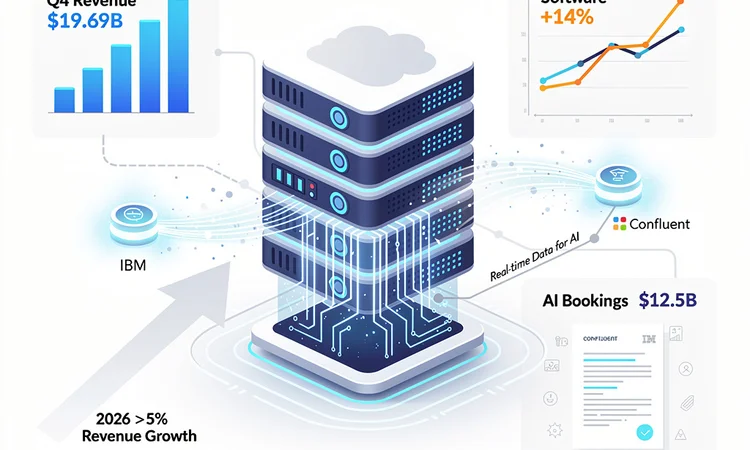
International Business Machines Corp. reported fourth-quarter revenue of $19.69 billion, a 12% increase from the prior year that surpassed analyst expectations of $19.23 billion. The results, announced January 28, 2026, propelled shares up 8% in after-hours trading, reflecting investor enthusiasm for the company’s accelerating pivot to artificial intelligence and hybrid cloud services. Adjusted earnings per share came in at $4.52, beating forecasts of $4.32, while net income more than doubled to $5.60 billion, or $5.88 a share.
Chief Executive Arvind Krishna attributed the performance to robust demand across software and infrastructure segments. “In the fourth quarter, we delivered strong revenue growth, with double-digit Software performance. Additionally, Infrastructure continued its double-digit revenue growth with the robust adoption of the next generation of our mainframe platform,” Krishna stated in the earnings release, as quoted by IBM Newsroom . Full-year 2025 revenue reached $67.5 billion, up 8%, capping a transformative period for the Armonk, New York-based firm.
Software revenue surged 14% to $9.03 billion, marking the highest annual growth rate in company history at 9% for the year. Automation sales rose 18%, data products climbed 22%, and Red Hat contributed with OpenShift growing at 30%. Infrastructure jumped 21% to $5.13 billion, powered by 67% growth in IBM Z mainframes, essential for AI workloads. Consulting revenue edged up 3% to $5.35 billion, slightly below expectations but showing signs of recovery amid easing macroeconomic pressures.
Generative AI Bookings Hit $12.5 Billion Milestone
IBM’s generative AI book of business exceeded $12.5 billion, up $3 billion from the third quarter, spanning software, consulting, and infrastructure deals. Chief Financial Officer James Kavanaugh highlighted the shift from experimentation to scaling. “What you’re seeing is the early indications of moving from what I’ll call industry experimentation to we are now beginning the cycle of scaling,” Kavanaugh told analysts, as reported by Wall Street Journal .
About 80% of AI bookings stem from consulting, where clients seek help deploying and governing AI at scale. The watsonx platform and agentic AI offerings, including Orchestrate, are gaining traction as enterprises move beyond chatbots to autonomous workflows. Free cash flow for 2025 hit $14.7 billion, up 16%, enabling investments in high-margin areas.
Kavanaugh anticipates the AI backlog will grow at a similar pace for years, driven by multi-year engagements. For 2026, IBM forecasts constant-currency revenue growth exceeding 5%, with free cash flow rising by about $1 billion to $15.7 billion. The board raised the quarterly dividend to $1.68 a share, extending 110 years of consecutive payouts.
Confluent Acquisition Targets Real-Time Data for AI Agents
In December 2025, IBM agreed to acquire Confluent Inc. for $11 billion at $31 per share, a 34% premium, to build a smart data platform. The deal, expected to close mid-2026 pending a February 12 shareholder vote with 62% support pledged, adds real-time streaming capabilities to feed AI models. “It is the glue that brings together IBM’s portfolio,” Kavanaugh said of Confluent, per Wall Street Journal .
Confluent will expand IBM’s total addressable market by over $100 billion, integrating with Red Hat OpenShift and watsonx for end-to-end data processing. The acquisition follows the $6.4 billion HashiCorp purchase in 2024, bolstering software for AI infrastructure. IBM expects $600 million in dilution next year from stock compensation and interest, but accretive to adjusted EBITDA in the first full year post-close.
CEO Krishna emphasized synergies: “Our announced acquisition of Confluent is another pillar in this strategy, helping unify our hybrid cloud and automation solutions through a smart data platform,” as noted in CRN . Productivity savings reached $4.5 billion run-rate by year-end, funding such bets.
Segment Deep Dive Reveals AI-Driven Momentum
Software’s double-digit growth underscores IBM’s transition, now 45% of revenue versus 25% in 2018. Red Hat decelerated to 8% due to federal delays and consumption normalization, but automation and data segments offset this. Hybrid cloud rose 10%, though impacted by a U.S. government shutdown, per Reuters .
Infrastructure’s z17 mainframes outpaced z16, supporting mission-critical AI in regulated sectors. Consulting’s generative AI backlog tops $10.5 billion, with growth resuming as clients gain confidence. “While we’re still operating in a dynamic environment, we see pretty good green shoots about growth factors,” Kavanaugh added.
Full-year software grew 11%, infrastructure 12%, consulting 2%. Gross margins expanded to 58.2% GAAP, 59.5% non-GAAP, reflecting favorable mix and productivity.
Outlook Balances Growth and Headwinds
IBM enters 2026 with momentum, projecting midyear Confluent close boosting software to 10% growth. Infrastructure may see low-single-digit decline from cycle dynamics, offset by consulting acceleration. Higher taxes, CapEx, and interest pose free cash flow challenges, but operating leverage should deliver.
Quantum computing advances, with a large-scale system targeted for 2029, differentiate long-term. Krishna reaffirmed progress during the call, per CNBC . On X, sentiment echoed bullishness, with posts highlighting the AI pivot and stock surge.
The earnings cap a year of execution, positioning IBM as a software-led AI powerhouse amid enterprise scaling. Wall Street’s 4.6% growth forecast looks conservative against management’s outlook.






Leave a Reply
Your email address will not be published.