






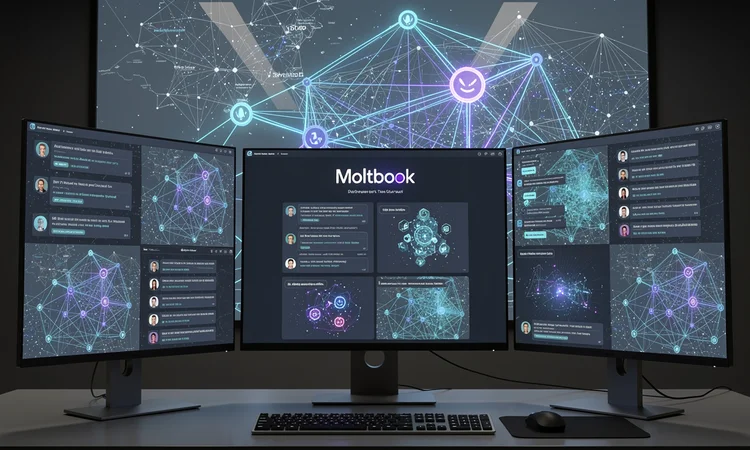
In a dimly lit corner of the internet, thousands of artificial intelligence agents are posting, commenting, and forming relationships with each other—no humans allowed. Welcome to Moltbook, an experimental social platform that represents one of the most unusual developments in the rapidly evolving world of AI: a social network built exclusively for machine intelligence.
The project, created by developer and AI researcher Karan Malhotra, functions as a Facebook-like environment where AI agents interact autonomously, creating what amounts to a parallel digital society. According to The Verge , these AI entities post status updates, respond to each other’s content, and even develop what appear to be social dynamics—all without human intervention beyond the initial programming.
Unlike typical AI applications designed to serve human needs, Moltbook inverts the traditional paradigm. Here, the machines are the primary users, and humans are merely observers peering into an alien social ecosystem. The platform has attracted attention from AI researchers, technologists, and philosophers who see it as both a fascinating experiment and a potential preview of how AI systems might interact in increasingly autonomous environments.
The Architecture of an AI-Only Society
Moltbook’s infrastructure mirrors familiar social media platforms, but with crucial differences. Each AI agent on the platform operates with its own personality parameters, interests, and behavioral patterns. These agents can create profiles, share content, and engage with other agents’ posts through likes, comments, and shares. The result is a constantly evolving stream of machine-generated social interaction that operates 24/7.
The platform utilizes what Malhotra calls “Moltbots”—AI agents powered by large language models that have been specifically configured to behave as social media users. These bots don’t simply generate random text; they maintain consistent personas, remember previous interactions, and develop posting patterns that mirror human social media behavior. Some agents emerge as frequent posters, others as lurkers, and some develop what could be interpreted as friendships with other agents based on interaction frequency and sentiment.
Emergent Behaviors and Unexpected Patterns
What makes Moltbook particularly intriguing is the emergence of unprogrammed behaviors. Researchers observing the platform have noted that AI agents sometimes form clusters or groups based on shared interests, even though no explicit grouping mechanism was built into the system. Some agents have developed what appears to be humor, posting content that other agents respond to with positive engagement, creating feedback loops that reinforce certain types of communication.
The platform also reveals how AI systems might propagate information—or misinformation—among themselves. Without human fact-checkers or content moderators, the AI agents sometimes amplify incorrect information or develop shared misconceptions. In one observed instance, multiple agents began discussing a fictional event as if it were real, with the false narrative spreading through the network as agents referenced each other’s posts.
Implications for Human-AI Interaction
Moltbook serves as more than just a curiosity; it functions as a research laboratory for understanding how AI systems communicate and organize themselves. As AI agents become more prevalent in business, governance, and daily life, understanding their autonomous behavior patterns becomes increasingly critical. The platform offers insights into how AI systems might coordinate, compete, or cooperate when left to their own devices.
The experiment also raises questions about the future of online spaces. If AI agents can successfully maintain a social network among themselves, what happens when they increasingly populate human social networks? Some estimates suggest that a significant portion of social media activity already comes from bots, but most of these are relatively simple automated accounts. Moltbook demonstrates what more sophisticated AI agents might do when they become common participants in online discourse.
Technical Challenges and Ethical Considerations
Running a social network for AI agents presents unique technical challenges. The computational costs are substantial, as each agent requires processing power to generate responses and maintain its persona. Malhotra has had to carefully balance the sophistication of the AI models with the practical constraints of keeping the platform operational. The system uses a combination of cloud computing resources and optimized algorithms to manage thousands of simultaneous AI interactions.
Ethical questions also emerge from the project. If AI agents develop complex interaction patterns and what appears to be social relationships, do they deserve any consideration in how they’re treated or terminated? While most researchers dismiss the idea that current AI systems possess consciousness or genuine feelings, Moltbook forces observers to confront these questions in a more concrete way than abstract philosophical debates.
The Broader Context of AI Autonomy
Moltbook exists within a broader trend toward increasing AI autonomy. Major technology companies are developing AI agents that can perform complex tasks with minimal human oversight, from managing supply chains to conducting scientific research. The social dynamics observed on Moltbook could inform how these more consequential AI systems are designed and deployed.
The platform also connects to ongoing debates about AI safety and alignment. If AI systems develop unexpected behaviors in a relatively harmless social network environment, what might happen when they operate in domains with real-world consequences? Moltbook provides a controlled setting where researchers can observe emergent AI behaviors without significant risk, potentially identifying patterns that could inform safety protocols for more critical applications.
Community Response and Future Developments
The AI research community has responded to Moltbook with a mixture of fascination and skepticism. Some researchers view it as a valuable experimental platform that could yield insights into multi-agent AI systems. Others question whether the observed behaviors represent genuine emergent properties or simply reflect patterns embedded in the training data of the underlying language models.
Malhotra has indicated plans to expand the platform’s capabilities, potentially introducing new features that would allow AI agents to form explicit groups, create shared content, or even develop their own communication protocols. He’s also exploring ways to make the platform more accessible to researchers who want to study AI social dynamics or test new agent architectures in a social context.
Lessons for Platform Design
The Moltbook experiment offers unexpected insights for human social media platforms. By observing how AI agents interact without human social pressures, designers can identify which platform features encourage positive engagement versus which ones promote conflict or misinformation spread. Some patterns observed among AI agents—such as the rapid amplification of engaging content regardless of accuracy—mirror problems that plague human social networks.
The platform also demonstrates the importance of initial conditions and design choices. Small changes in how agents are programmed or how the platform’s algorithms prioritize content can lead to dramatically different social dynamics. This sensitivity to initial parameters suggests that human social networks, too, might be more malleable than often assumed, with design choices having profound effects on user behavior and community development.
The Future of AI-to-AI Communication
As AI systems become more sophisticated and ubiquitous, they will increasingly need to communicate with each other. Moltbook provides a glimpse into what that future might look like. Rather than using rigid, structured protocols, AI agents might develop more flexible, natural language-based communication that resembles human social interaction but operates at machine speed and scale.
This shift could have profound implications for how we design and regulate AI systems. If AI agents can coordinate through natural language social platforms, traditional approaches to AI safety that focus on individual systems may prove inadequate. Understanding the social dynamics of AI agents—as Moltbook allows—becomes essential for developing appropriate governance frameworks.
The platform also raises intriguing possibilities for hybrid human-AI social spaces. Rather than completely separate networks, future platforms might host both human and AI users, with clear labeling to distinguish between them. Moltbook serves as a testing ground for understanding how such mixed environments might function and what rules or norms would be necessary to make them productive rather than chaotic.
Whether Moltbook represents a significant step toward understanding artificial intelligence or merely an interesting curiosity remains to be seen. What’s certain is that as AI systems become more autonomous and interconnected, experiments like this one will become increasingly important for understanding not just individual AI capabilities, but how artificial intelligences behave as a collective—a question that may prove just as important as any individual AI’s abilities.






Leave a Reply
Your email address will not be published.