









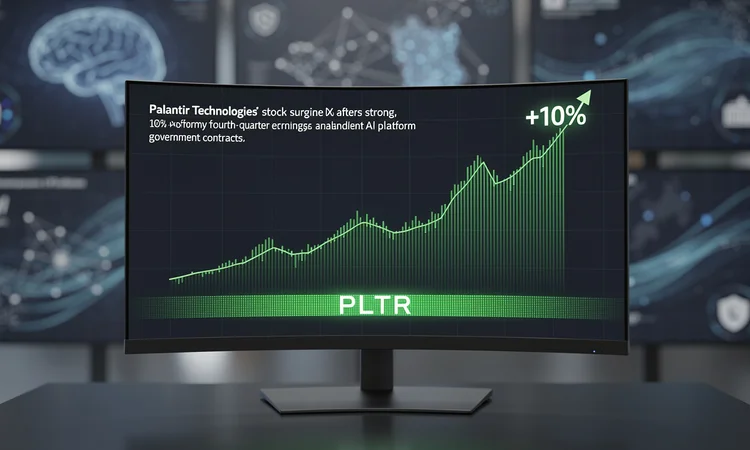
Palantir Technologies Inc. delivered a resounding statement to Wall Street, propelling its stock upward by 10% in after-hours trading following fourth-quarter earnings that exceeded analyst expectations on both revenue and profit metrics. The data analytics powerhouse, which has transformed itself from a controversial government contractor into an artificial intelligence juggernaut, reported results that underscored the accelerating demand for its AI-powered platforms across commercial and government sectors.
According to CNBC , the company posted quarterly revenue that surpassed consensus estimates, driven primarily by robust growth in its commercial business and continued strength in government contracts. The earnings beat represents Palantir’s latest demonstration of its ability to capitalize on the enterprise AI revolution, a trend that has seen the company’s market valuation soar over the past eighteen months as organizations scramble to implement advanced data analytics capabilities.
The Denver-based firm’s performance reflects a broader shift in how corporations and government agencies approach data infrastructure. Palantir’s Artificial Intelligence Platform (AIP), which enables organizations to deploy large language models within their existing operational frameworks, has emerged as a critical differentiator. The platform’s ability to integrate AI capabilities without requiring extensive technical overhauls has resonated particularly well with enterprises seeking rapid deployment of generative AI solutions.
Commercial Momentum Accelerates Beyond Government Roots
Palantir’s commercial segment demonstrated particularly impressive growth trajectories, signaling the company’s successful pivot beyond its traditional government contracting base. The commercial revenue expansion has been fueled by what industry observers describe as a ‘bootcamp’ strategy, where Palantir offers intensive, short-duration workshops that demonstrate AIP’s capabilities to potential clients. These sessions have reportedly converted at remarkably high rates, with many participants signing contracts within weeks of completion.
The company’s government business, meanwhile, continues to provide a stable foundation of recurring revenue. Defense and intelligence contracts remain robust as federal agencies increasingly rely on Palantir’s platforms for mission-critical operations ranging from battlefield intelligence to pandemic response coordination. This dual-engine growth model—combining steady government revenue with explosive commercial expansion—has positioned Palantir uniquely among enterprise software providers.
Market Valuation and Investor Sentiment Reach New Heights
The earnings announcement comes at a time when Palantir’s market valuation has already reached levels that some analysts consider stretched relative to traditional software metrics. However, bulls argue that the company’s positioning at the intersection of AI and enterprise data analytics justifies premium multiples. The stock’s post-earnings surge suggests investors remain willing to pay for growth, particularly given the scarcity of pure-play AI infrastructure companies in public markets.
Institutional investors have taken notice of Palantir’s consistent execution. The company has now delivered several consecutive quarters of profitability on a GAAP basis, addressing long-standing concerns about its path to sustainable earnings. This profitability, combined with strong free cash flow generation, has helped legitimize Palantir’s valuation in the eyes of more conservative fund managers who previously viewed the stock as speculative.
Strategic Positioning in the AI Arms Race
Palantir’s success reflects its early recognition that the AI revolution would require more than just model development—it would demand robust infrastructure for deploying those models within complex organizational environments. While competitors focused on building better algorithms, Palantir invested heavily in creating platforms that could operationalize AI at scale. This strategic foresight has paid dividends as enterprises move from AI experimentation to production deployment.
The company’s emphasis on data sovereignty and security has proven particularly appealing to regulated industries and government agencies. Unlike cloud-first competitors, Palantir’s architecture allows organizations to maintain control over sensitive data while still leveraging advanced AI capabilities. This approach has opened doors in sectors like healthcare, finance, and defense where data governance concerns have historically slowed technology adoption.
Forward Guidance Signals Sustained Growth Trajectory
Management’s forward guidance provided additional fuel for the post-earnings rally, with projections indicating continued revenue acceleration through the coming fiscal year. The company’s pipeline of potential contracts has reportedly expanded significantly, with particular strength in international markets where Palantir has historically been underrepresented. European and Asian enterprises are increasingly viewing American AI platforms as strategic assets, despite geopolitical tensions that might otherwise complicate cross-border technology sales.
The guidance also reflected confidence in Palantir’s ability to maintain pricing power even as competition intensifies. The company’s platforms have demonstrated sufficient value creation that clients appear willing to accept premium pricing, particularly when compared to the cost and complexity of building comparable capabilities in-house. This pricing discipline has contributed to expanding margins, another metric closely watched by investors seeking evidence of operating leverage in the business model.
As Palantir continues to execute on its vision of becoming the operating system for AI-driven decision-making, the latest earnings results provide tangible evidence that the company’s ambitions align with market realities. Whether the current valuation proves sustainable will depend on Palantir’s ability to maintain its growth trajectory as larger competitors inevitably target the same opportunities. For now, however, the company has demonstrated that its platform approach to enterprise AI addresses genuine market needs at a scale that justifies investor enthusiasm.






Leave a Reply
Your email address will not be published.