





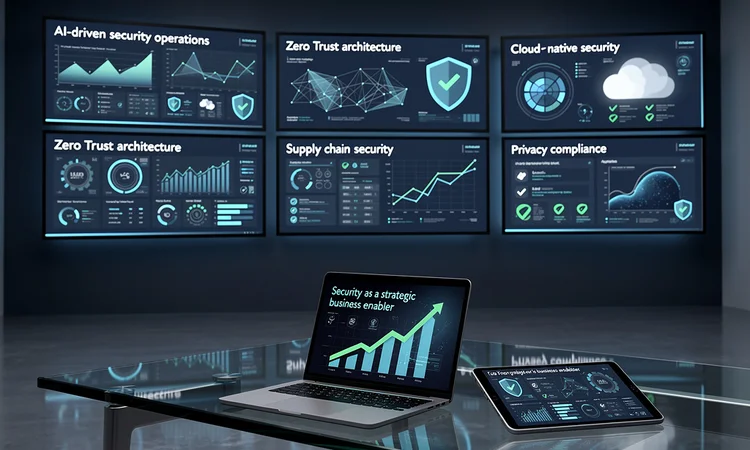
As organizations navigate an increasingly complex threat environment, chief information security officers face unprecedented pressure to balance innovation with protection. According to insights from Google Cloud’s latest analysis , security leaders are fundamentally reshaping their strategies around five critical priorities that will define enterprise cybersecurity through 2026 and beyond.
The role of the CISO has evolved from technical gatekeeper to strategic business enabler, requiring leaders who can simultaneously manage emerging threats while accelerating digital transformation. This dual mandate represents a significant departure from traditional security approaches, where protection often came at the expense of agility. Today’s security chiefs must architect defenses that enhance rather than hinder business velocity, a challenge that demands both technical acumen and executive-level strategic thinking.
The AI Revolution Transforms Security Operations
Artificial intelligence has emerged as the dominant force reshaping cybersecurity operations, with CISOs prioritizing AI-driven security tools as their primary investment area. Google Cloud’s research indicates that security leaders are moving beyond experimental AI deployments to production-scale implementations that fundamentally alter how threats are detected, analyzed, and neutralized. This shift reflects a broader recognition that human analysts alone cannot process the volume and velocity of security data generated by modern enterprises.
The integration of AI into security operations centers represents more than incremental improvement—it enables entirely new defensive capabilities. Machine learning models can now identify subtle patterns in network traffic that would escape human observation, correlating seemingly unrelated events across vast infrastructure to detect sophisticated attack campaigns. Security teams are leveraging AI to automate routine tasks, freeing analysts to focus on complex investigations that require human judgment and creativity. This redistribution of labor addresses the persistent talent shortage plaguing the cybersecurity industry while simultaneously improving detection accuracy and response times.
Zero Trust Architecture Moves From Concept to Reality
The second major priority centers on implementing comprehensive zero trust frameworks that eliminate implicit trust from network architectures. CISOs are abandoning perimeter-based security models in favor of identity-centric approaches that verify every access request regardless of origin. This transition requires fundamental changes to infrastructure, applications, and operational processes, representing multi-year transformation initiatives rather than simple technology deployments.
Organizations are discovering that zero trust implementation demands more than deploying new security products—it requires cultural change and process reengineering across the enterprise. Security teams must collaborate closely with application developers, infrastructure engineers, and business units to embed continuous verification into every system and workflow. The complexity of this undertaking explains why many organizations struggle to move beyond pilot projects, yet those that succeed report significant improvements in their security posture and ability to detect lateral movement by attackers who breach initial defenses.
Supply Chain Security Becomes Board-Level Priority
The third critical focus area addresses the expanding attack surface created by complex software supply chains. Recent high-profile compromises have elevated supply chain security from technical concern to board-level risk, forcing CISOs to develop comprehensive strategies for evaluating and monitoring third-party code, components, and services. This challenge extends beyond traditional vendor risk management to encompass open-source dependencies, cloud service providers, and the entire software development lifecycle.
Security leaders are implementing software bill of materials (SBOM) practices, automated vulnerability scanning, and continuous monitoring of dependencies to gain visibility into their supply chain risks. However, achieving meaningful supply chain security requires industry-wide collaboration and standardization, areas where progress remains frustratingly slow. CISOs must balance the need for thorough vetting against business demands for rapid deployment, creating tension between security rigor and operational velocity. Organizations are developing risk-based approaches that apply different levels of scrutiny based on the criticality and exposure of specific systems and data.
Cloud Security Maturity Reaches Inflection Point
As enterprises complete their cloud migrations, security priorities are shifting from basic cloud adoption to advanced cloud-native security capabilities. CISOs are investing in tools and practices specifically designed for multi-cloud environments, moving beyond adapting on-premises security approaches to embracing cloud-native architectures. This evolution includes implementing infrastructure as code security, container security, and serverless security controls that match the dynamic nature of cloud computing.
The maturation of cloud security practices reflects growing sophistication among security teams and vendors alike. Organizations are leveraging cloud-native security services that provide deeper integration with infrastructure platforms, enabling more granular control and better visibility than traditional bolt-on solutions. However, the complexity of managing security across multiple cloud providers, hybrid environments, and edge computing resources creates significant operational challenges. CISOs are prioritizing unified security platforms that provide consistent policy enforcement and visibility across diverse environments, reducing the management overhead that comes with point solutions.
Privacy Regulation Drives Technical Architecture Decisions
The fifth major priority involves navigating the expanding web of privacy regulations that now span multiple jurisdictions with varying requirements. CISOs must architect systems that enable compliance with regulations like GDPR, CCPA, and emerging frameworks in Asia and Latin America while maintaining operational efficiency. This challenge extends beyond legal compliance to encompass customer trust and brand reputation, making privacy a strategic business concern rather than purely technical requirement.
Organizations are implementing privacy-enhancing technologies including data minimization, anonymization, and encryption to reduce their exposure to privacy risks. Security teams are working closely with legal, compliance, and business units to embed privacy considerations into product development and data processing activities. The technical complexity of implementing privacy controls across global operations while maintaining data utility for analytics and business intelligence represents one of the most challenging aspects of modern security leadership.
Talent Development Emerges as Strategic Imperative
Underlying all five priorities is the persistent challenge of building and retaining skilled security teams. CISOs are investing heavily in training and development programs, recognizing that technology alone cannot solve security challenges without talented people to operate and optimize these systems. The competition for cybersecurity talent remains intense, forcing organizations to develop comprehensive strategies that include competitive compensation, career development opportunities, and workplace flexibility.
Security leaders are also rethinking traditional hiring practices, looking beyond conventional credentials to identify candidates with transferable skills and aptitude for security work. This includes recruiting from adjacent technology fields, military veterans, and career changers who bring diverse perspectives and problem-solving approaches. Organizations are developing internal training programs that allow employees to transition into security roles, creating career pathways that address talent shortages while improving retention.
Business Alignment Defines Security Success
The most successful CISOs are those who frame security initiatives in business terms, demonstrating how security investments enable revenue growth, market expansion, and competitive advantage. This requires security leaders to develop business acumen that complements their technical expertise, understanding financial metrics, market dynamics, and strategic priorities. Security can no longer operate as an isolated function but must integrate deeply with business strategy and operations.
Organizations are measuring security effectiveness through business-relevant metrics rather than purely technical indicators. This includes quantifying the business impact of security incidents, calculating the return on security investments, and demonstrating how security capabilities enable new business opportunities. CISOs who successfully make this transition become trusted advisors to executive leadership and board members, elevating security from cost center to strategic enabler.
Looking Ahead: Security as Business Differentiator
As these five priorities converge, forward-thinking organizations are positioning security as a competitive differentiator rather than compliance obligation. Companies that demonstrate superior security practices can command customer trust, access new markets with stringent security requirements, and attract partners seeking reliable collaborators. This strategic positioning of security represents the ultimate evolution of the CISO role from technical specialist to business strategist.
The path forward requires sustained investment, cultural change, and executive commitment. Organizations that treat these priorities as isolated initiatives rather than integrated transformation programs will struggle to achieve meaningful progress. Success demands coordination across technology, operations, and business functions, with security serving as the connective tissue that enables safe innovation and sustainable growth in an increasingly digital economy.






Leave a Reply
Your email address will not be published.