








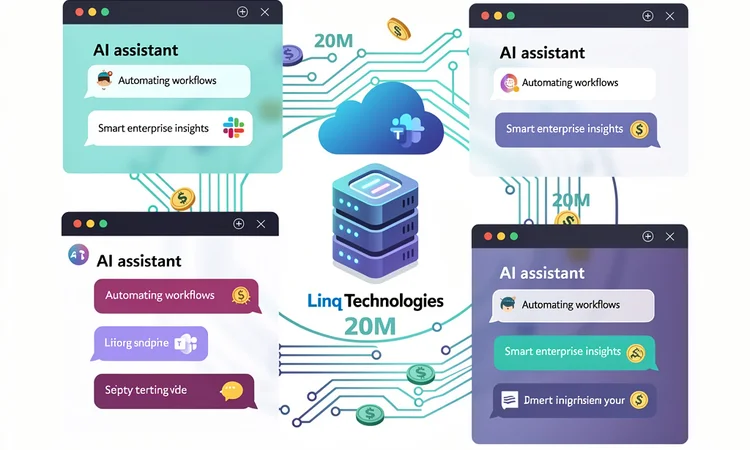
The race to embed artificial intelligence into everyday communication tools has entered a new phase, with Linq Technologies securing $20 million in Series A funding to build AI assistants that operate directly within messaging platforms. The investment, led by Greylock Partners with participation from Accel and Index Ventures, signals a strategic shift in how enterprise software companies are thinking about AI deployment—moving away from standalone applications toward integration with the communication tools workers already use daily.
According to TechCrunch , Linq’s approach addresses a fundamental friction point in enterprise AI adoption: the need for employees to switch between multiple applications to access AI capabilities. The company’s platform enables businesses to deploy custom AI assistants that function natively within Slack, Microsoft Teams, and other messaging environments, eliminating the context-switching that has plagued previous generations of enterprise software.
“We’re not trying to build another chatbot that sits in a separate window,” explained Linq CEO Sarah Chen in the TechCrunch interview. “We’re building infrastructure that lets AI assistants become native participants in the conversations where work actually happens.” This distinction matters in an enterprise market increasingly saturated with AI tools that promise productivity gains but often create additional workflow complexity.
The Technical Architecture Behind Embedded AI
Linq’s technology stack represents a departure from traditional chatbot architectures. Rather than routing messages through external APIs that introduce latency and security concerns, the company has developed what it calls “conversation-native” AI that processes requests within the messaging platform’s existing infrastructure. This approach requires deep integration with each platform’s API and security protocols, but delivers response times comparable to human participants in threaded conversations.
The technical challenge involves more than simple message parsing. Linq’s system must understand conversation context across multiple threads, maintain awareness of shared documents and links, and respect the complex permission structures that govern enterprise messaging platforms. The company has built proprietary natural language processing models specifically trained on workplace communication patterns, which differ significantly from consumer chat data that powers most general-purpose AI assistants.
Market Timing and the Messaging Platform Wars
The funding arrives as messaging platforms themselves are racing to integrate AI capabilities. Microsoft has embedded Copilot throughout its Office 365 suite, including Teams, while Slack’s parent company Salesforce has introduced Einstein AI features across its product line. Yet Linq’s investors see opportunity in the gap between platform-native AI and the specific needs of individual enterprises.
“Every company wants customized AI that understands their specific workflows, terminology, and business logic,” noted Greylock partner David Sze in a statement about the investment. “The platform providers are building horizontal solutions, but there’s enormous demand for vertical and company-specific AI assistants that can be deployed quickly without requiring a complete overhaul of existing systems.”
The market dynamics favor specialized providers like Linq because enterprise customers increasingly demand AI solutions that integrate with their proprietary data and processes. A recent Gartner survey found that 73% of enterprise IT leaders consider “customizability” the most important factor when evaluating AI tools, ahead of both cost and raw performance metrics.
Security and Compliance Challenges
Operating AI assistants within messaging platforms introduces complex security considerations that Linq must address to win enterprise customers. Corporate messaging systems contain sensitive strategic discussions, customer data, and confidential business information—all of which must be protected while still enabling AI assistants to provide useful functionality.
Linq has built its platform with what the company describes as “zero-knowledge architecture,” meaning the AI assistants process information without transmitting message content to external servers. All computation happens within the customer’s existing cloud infrastructure or on-premises systems, depending on their security requirements. This approach aligns with growing enterprise demand for AI solutions that don’t require sending proprietary data to third-party providers.
The company has also invested heavily in compliance certifications, achieving SOC 2 Type II, GDPR, and HIPAA compliance before launching commercially. These credentials are essential for selling into regulated industries like healthcare and financial services, where messaging platforms often contain protected health information or material non-public information about securities.
Use Cases Driving Enterprise Adoption
Early Linq customers are deploying AI assistants for a range of specialized functions that extend beyond simple question-answering. One financial services client uses a Linq-powered assistant that monitors deal team conversations and automatically generates summaries for senior management, flagging potential compliance issues in real-time. Another customer in healthcare has built an assistant that helps clinical teams access patient information and research literature without leaving their HIPAA-compliant messaging environment.
The most compelling use cases involve AI assistants that can take actions, not just provide information. Linq’s platform enables assistants to create tasks in project management systems, update CRM records, schedule meetings, and trigger workflows in other enterprise applications—all through natural language commands within messaging threads. This “conversational workflow automation” represents a significant evolution from earlier chatbot implementations that primarily served as search interfaces.
The Competitive Environment
Linq enters a crowded market of companies attempting to bridge AI capabilities and workplace communication tools. Competitors include both well-funded startups like Moveworks and established enterprise software vendors expanding their AI offerings. The company’s differentiation rests on its focus on customization and its willingness to work within customers’ existing platform choices rather than requiring adoption of proprietary tools.
The funding will support Linq’s expansion beyond its current integrations with Slack and Microsoft Teams to include platforms like Discord, Telegram, and WhatsApp Business, which are gaining traction in certain industries and international markets. The company is also investing in its developer platform, which enables customers and third-party developers to build specialized AI assistants for niche use cases.
Industry analysts note that Linq’s approach of embedding AI within existing communication tools aligns with broader trends in enterprise software toward “composable” architectures, where businesses assemble custom solutions from interoperable components rather than adopting monolithic platforms. This architectural philosophy has driven the success of companies like Twilio and Stripe in their respective categories.
Financial Metrics and Growth Trajectory
While Linq has not disclosed detailed financial metrics, the company indicated in the TechCrunch report that it has grown from five enterprise customers at the beginning of 2025 to more than 50 currently, with annual recurring revenue growing at triple-digit rates quarter-over-quarter. The average contract value exceeds $100,000 annually, with larger deployments reaching seven figures as customers expand AI assistant usage across multiple departments.
The Series A funding brings Linq’s total capital raised to $27 million, including a $7 million seed round led by Accel in early 2025. The company plans to use the new capital primarily for engineering headcount, adding specialists in machine learning, platform integration, and security. Sales and marketing will also see significant investment as Linq attempts to scale beyond its initial customer base in technology and financial services.
The Broader Implications for Enterprise AI
Linq’s approach represents a bet on a particular vision of how AI will integrate into workplace environments: not as separate applications that workers must learn and access independently, but as capabilities woven into the communication tools that already structure their workday. This vision challenges the assumption that AI assistants require dedicated interfaces or that enterprises will adopt entirely new platforms to access AI functionality.
The success or failure of this approach will have implications beyond Linq’s own trajectory. If embedded AI assistants prove more effective than standalone tools at driving adoption and delivering productivity gains, it could accelerate the shift toward AI-as-infrastructure rather than AI-as-application. This would favor companies like Linq that provide integration layers over those building comprehensive AI platforms.
For messaging platform providers, Linq’s growth presents both opportunity and threat. On one hand, companies like Linq expand the functionality and value of messaging platforms, potentially increasing their stickiness with enterprise customers. On the other, successful third-party AI assistants could reduce the strategic value of platform providers’ own AI initiatives, turning messaging platforms into commoditized infrastructure.
Looking Forward: The Integration Challenge
The path ahead for Linq involves navigating the complex dynamics of platform partnerships while maintaining the flexibility that enterprise customers value. As messaging platforms continue developing their own AI capabilities, Linq must demonstrate sufficient differentiation to justify its position in the technology stack. The company’s focus on customization and vertical-specific solutions provides some insulation from platform competition, but sustained success will require continuous innovation.
The broader question facing the enterprise AI market is whether specialized integration providers like Linq can maintain independent positions as platform vendors expand their own AI offerings. History suggests that successful infrastructure companies often get acquired by platforms seeking to accelerate their capabilities, making Linq an potential acquisition target for messaging platform providers or larger enterprise software companies.
For now, the $20 million in fresh capital gives Linq runway to prove its thesis: that the future of enterprise AI lies not in standalone applications, but in intelligent assistants that disappear into the communication tools workers already use. Whether this vision succeeds will depend on Linq’s ability to deliver AI capabilities that are genuinely more useful when embedded in messaging platforms than when accessed through separate interfaces—a technical and product challenge that will test the limits of current AI technology and enterprise software design.






Leave a Reply
Your email address will not be published.