





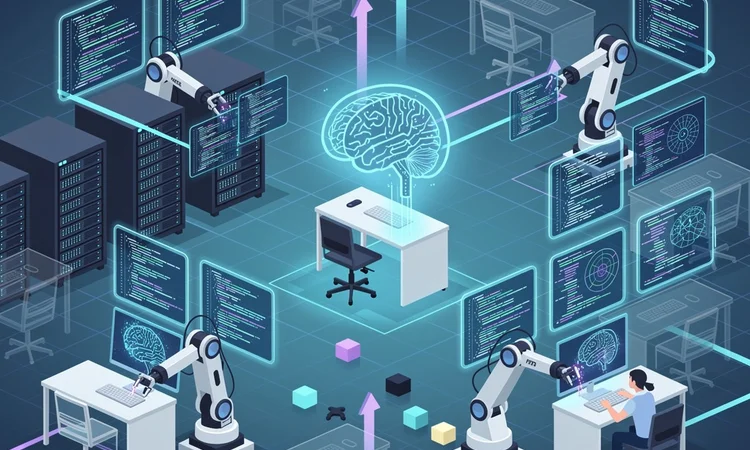
Meta Platforms is witnessing a fundamental transformation in how software gets built, with artificial intelligence tools enabling individual engineers to accomplish what previously required entire teams of developers. The social media giant’s embrace of AI-powered coding assistants represents more than incremental productivity gains—it signals a potential restructuring of how technology companies organize their workforce and approach product development in an era where machine intelligence augments human capability at unprecedented scale.
According to Business Insider , Meta executives have observed that AI coding tools are allowing single employees to perform tasks that traditionally required coordination across multiple team members. This shift comes as the company has invested billions in developing its own large language models and integrating AI capabilities throughout its engineering infrastructure. The implications extend far beyond Meta’s Menlo Park headquarters, offering a preview of how artificial intelligence may reshape software development across the technology sector.
The productivity multiplier effect Meta is experiencing aligns with broader industry trends. GitHub reported that developers using its AI-powered Copilot tool complete tasks up to 55% faster than those working without AI assistance. Meta’s internal tools appear to be delivering similar or even more dramatic results, particularly for routine coding tasks, debugging, and code review processes that consume significant engineering time.
The Architecture of AI-Enhanced Engineering
Meta’s approach to AI-augmented development relies on sophisticated language models trained on vast repositories of code, including the company’s own proprietary codebases. These systems can generate functional code from natural language descriptions, identify bugs, suggest optimizations, and even refactor legacy code to improve performance or maintainability. Engineers at Meta now routinely interact with AI assistants that understand context across multiple files and can propose solutions that account for the company’s specific architectural patterns and coding standards.
The technology builds upon Meta’s substantial investments in AI research and infrastructure. The company has developed its Llama family of large language models, which serve as the foundation for various internal tools. Unlike general-purpose coding assistants, Meta’s internal AI systems have been fine-tuned on the company’s specific technology stack, making them particularly effective at generating code that integrates seamlessly with existing systems and adheres to Meta’s engineering practices.
Redefining Team Structures and Workflows
The shift toward AI-augmented individual productivity is forcing Meta to reconsider traditional team structures. Historically, complex features required product managers, multiple engineers with different specializations, designers, and quality assurance specialists working in concert. With AI tools handling more of the routine implementation work, the company is experimenting with smaller, more autonomous teams where individual engineers can take projects from concept to deployment with minimal handoffs.
This reorganization carries significant implications for hiring and workforce planning. If one engineer equipped with AI tools can accomplish what previously required three to five team members, technology companies may need fewer total employees to maintain the same development velocity. However, the nature of work shifts toward higher-level problem-solving, architectural decisions, and creative feature design—tasks that still require human judgment and domain expertise.
The Economics of AI-Powered Development
From a financial perspective, the productivity gains Meta is experiencing could translate into substantial cost savings or accelerated product development timelines. The company has faced pressure from investors to improve efficiency following several years of aggressive spending on metaverse initiatives and infrastructure. AI-powered development tools offer a path to maintain or increase output while potentially reducing headcount or redeploying engineers to higher-priority projects.
The economic calculus extends beyond direct labor costs. Faster development cycles mean features reach users more quickly, potentially accelerating revenue generation and competitive positioning. Additionally, AI-assisted code review and bug detection can improve software quality, reducing the costs associated with production incidents and technical debt. These compounding benefits make AI coding tools attractive even accounting for the substantial computational resources required to run them.
Quality Control and Technical Debt Concerns
Despite the productivity benefits, Meta and other companies adopting AI-powered development tools face legitimate concerns about code quality and long-term maintainability. AI-generated code, while often functional, may not always follow best practices or consider edge cases that experienced engineers would anticipate. There’s a risk that over-reliance on AI assistants could lead to accumulation of technical debt if generated code isn’t carefully reviewed and refined.
Meta has implemented guardrails to address these concerns, including mandatory human review of AI-generated code before it enters production systems. The company’s engineering culture emphasizes that AI tools should augment rather than replace human judgment. Senior engineers are expected to understand the code they ship, even when AI tools generate substantial portions of it. This approach aims to capture productivity benefits while maintaining the code quality standards necessary for systems serving billions of users.
The Human Element in an AI-Augmented Future
The transformation Meta is undergoing raises important questions about the future role of software engineers. As AI tools handle more routine coding tasks, the profession is evolving toward higher-level responsibilities. Engineers increasingly focus on system design, architectural decisions, and solving novel problems that AI tools aren’t yet capable of addressing independently. This shift demands different skills—less emphasis on memorizing syntax or implementing standard algorithms, more focus on creative problem-solving and understanding complex system interactions.
For individual engineers, the change presents both opportunities and challenges. Those who effectively leverage AI tools can dramatically increase their impact and potentially command higher compensation for their amplified productivity. However, engineers who resist adopting these tools or fail to develop the higher-level skills they enable may find themselves at a competitive disadvantage. The industry is witnessing a bifurcation between engineers who embrace AI augmentation and those who view it skeptically.
Competitive Implications Across the Technology Sector
Meta’s success with AI-powered development tools is being closely watched by competitors and could trigger a broader transformation across the technology industry. Companies that effectively deploy these tools gain advantages in development speed and cost efficiency, potentially forcing others to adopt similar approaches to remain competitive. This dynamic may accelerate consolidation of AI capabilities among large technology companies with resources to develop sophisticated internal tools.
Smaller companies and startups face different dynamics. While they may lack resources to build custom AI coding assistants, they can leverage commercially available tools like GitHub Copilot or emerging alternatives. This democratization of AI-powered development could level the playing field in some respects, allowing small teams to compete with larger organizations. However, the most sophisticated applications of AI in software development—those fine-tuned on proprietary codebases and integrated deeply into engineering workflows—may remain advantages of well-resourced technology giants.
Regulatory and Ethical Dimensions
The productivity transformations enabled by AI coding tools also raise policy questions about workforce displacement and the concentration of technological capabilities. If major technology companies can accomplish more with fewer engineers, what happens to the engineers whose roles become redundant? While some may transition to higher-level positions, others may face displacement, contributing to broader concerns about AI’s impact on employment.
Additionally, there are intellectual property considerations when AI models are trained on code from various sources. Questions about code ownership, licensing compliance, and the potential for AI tools to inadvertently reproduce copyrighted code remain areas of active legal and ethical debate. Meta and other companies must navigate these issues carefully to avoid legal challenges while capturing the benefits of AI-assisted development.
Looking Ahead: The Next Phase of Development
Meta’s experience with AI-powered development tools represents an early chapter in what will likely be a multi-decade transformation of how software gets built. Current tools primarily assist with code generation and routine tasks, but future iterations may handle increasingly complex responsibilities. Researchers are exploring AI systems that can design entire system architectures, automatically optimize performance, or even identify and implement new product features based on user behavior analysis.
The ultimate vision extends beyond individual productivity gains to fundamental changes in how humans and AI systems collaborate on complex technical projects. Rather than AI simply making engineers faster at existing tasks, the technology may enable entirely new approaches to software development that weren’t previously feasible. Meta’s investments position the company to shape and benefit from this evolution, potentially creating competitive advantages that extend well beyond near-term productivity improvements.
As Meta continues refining its AI-powered development practices, the company serves as a laboratory for the broader technology industry. The lessons learned—both successes and failures—will inform how other organizations approach AI augmentation. For engineers, technology leaders, and investors, understanding these dynamics is essential for navigating an industry in the midst of its most significant transformation since the advent of high-level programming languages. The question is no longer whether AI will reshape software development, but how quickly and completely the transformation will occur.






Leave a Reply
Your email address will not be published.