



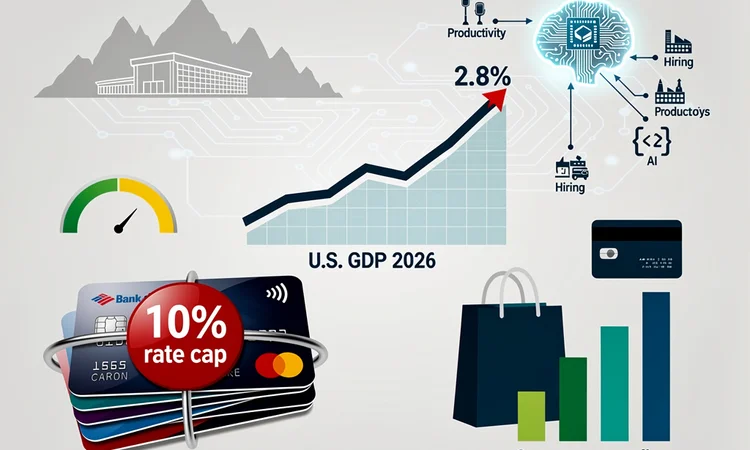
Bank of America Corp. Chief Executive Brian Moynihan struck a cautiously optimistic tone on the U.S. economy from the World Economic Forum in Davos, Switzerland, boosting his firm’s 2026 GDP forecast to 2.8% while cautioning that President Donald Trump’s proposed 10% cap on credit card interest rates risks triggering an unintended contraction in credit availability. Speaking on Bloomberg Surveillance, Mr. Moynihan highlighted robust consumer spending and business momentum but warned of an “equal but opposite reaction” to rate caps that could dampen the very affordability they aim to foster.
The bank’s research team, led by Candice Browning, raised its 2026 GDP projection from 2.1% ahead of Davos, reflecting confidence in the settling effects of Trump administration policies on trade, tariffs, taxes, immigration, and deregulation. Mr. Moynihan noted the forecast had fluctuated—from 2.5% pre-Davos last year, down to 1.5% amid policy uncertainty, and now up again. Consumer spending, which injects about $4.5 trillion annually into the economy from 70 million households Bank of America serves, grew 5% in the fourth quarter of 2025 over the prior year and accelerated slightly in early January.
Consumer Resilience Amid Affordability Pressures
Despite surveys showing consumer unease over lingering inflation memories, actual spending patterns tell a different story, Mr. Moynihan said. Bank of America Institute analysis divides customers into thirds by income, revealing growth across all segments, with the middle third pacing the expansion. Spending on dining out, vacations, and essentials remains strong, even as households recall pre-Covid price levels. “Watch what they do,” Mr. Moynihan urged, pointing to activity across seven million consumers as of late January.
This resilience positions Bank of America favorably for 2026 growth. Markets, led by co-President Jim DeMars, posted 15 straight quarters of double-digit year-over-year gains, up 10% in Q4 2025. Investment banking fees hit $4.6 billion in December alone, making 2025 the second-best year in company history after the pandemic-fueled 2021 peak. Pipelines for IPOs, deals, and broader revenue streams are filling up, aided by easing regulatory hurdles that previously stalled multibillion-dollar transactions.
Rate Cap Risks Reshuffling Credit Access
Mr. Moynihan’s sharpest critique targeted the 10% credit card APR cap, proposed by Mr. Trump effective January 20, 2026, via Truth Social. While endorsing affordability—citing Bank of America’s 90% overdraft fee reductions over 15 years, $500 no-interest emergency loans used by eight million customers, and low-rate no-frills cards—he warned of economic blowback. “Every action has an equal and opposite reaction,” he said, echoing a Hamilton lyric. A hard cap could “reallocate credit,” slowing spending and availability, potentially excluding riskier borrowers and raising charge-off rates.
The CEO revealed ongoing White House discussions to devise alternatives avoiding such pitfalls. Ideas include accelerating wealth transfers, like penalty-free 401(k) withdrawals for down payments on homes, alongside boosting housing supply in high-demand cities such as Charlotte (30,000-unit shortage) and New York (100,000 units). Mr. Moynihan stressed maintaining credit access to sustain spending confidence, noting paycheck growth at 3%-4% across Bank of America’s client base.
Hiring Slowdown Tied to Immigration Fears
Hiring has softened over the past year, with small-business surveys flagging labor availability as a renewed constraint. Mr. Moynihan attributed this partly to immigration policy uncertainty, advising the administration to refine messaging to avoid spooking naturalized citizens or legal workers. Population growth relies on immigration to offset modest natural increase, he noted, warning against constraints on business expansion.
At Davos, the fourth industrial revolution theme underscores AI’s role. Bank of America hired 65,000 post-pandemic but entered 2026 with flat headcount despite adding 2,000 annual college graduates. January saw 1,300 hires offset by attrition, enabling productivity gains. From 100,000 consumer-bank staff in 2010 to 50,000 today, transaction volume tripled via AI-driven tools like Erica, which sent a billion proactive alerts last year.
AI Productivity Fuels Long-Term Optimism
Mr. Moynihan recounted 1969-2019 U.S. employment doubling to 160 million amid technological leaps, from no workplace computers to ubiquitous devices. He anticipates similar absorption of AI efficiencies through growth, managing headcount via attrition. From 212,000 employees now—up from 175,000 in 2010 under his tenure—the bank eyes controlled expansion. Investor Day previews showed consumer operations handling triple the activity with half the staff, blending AI, alerts, and human oversight.
Business lines reflect this edge. Recent $1 billion stock awards to non-executive employees via the Sharing Success Program underscore shared prosperity ( Fox Business ). Mr. Moynihan’s Davos bullishness contrasts Wall Street’s caution, with Bank of America eyeing stronger growth from credit availability and low delinquencies ( Fox Business ).
Policy Dialogues Shape 2026 Trajectory
Relations with the White House remain constructive, with Mr. Moynihan briefing international clients on distinguishing security from trade policies. JPMorgan Chase CEO Jamie Dimon echoed rate-cap concerns at Davos, calling it an “economic disaster” that could harm 80% of Americans by curbing credit ( Reuters ; Yahoo Finance ). Bank of America continues proposing solutions, from overdraft innovations to housing reforms, to align policy with economic vitality.
Mr. Moynihan’s outlook defies consensus, projecting GDP above peers amid policy stabilization ( Market Realist ). AI’s benefits are “kicking in more,” per prior remarks ( Bloomberg ). As Davos conversations intensify, his blend of data-driven forecasts and policy nuance positions Bank of America at the intersection of consumer strength and regulatory flux.






Leave a Reply
Your email address will not be published.