








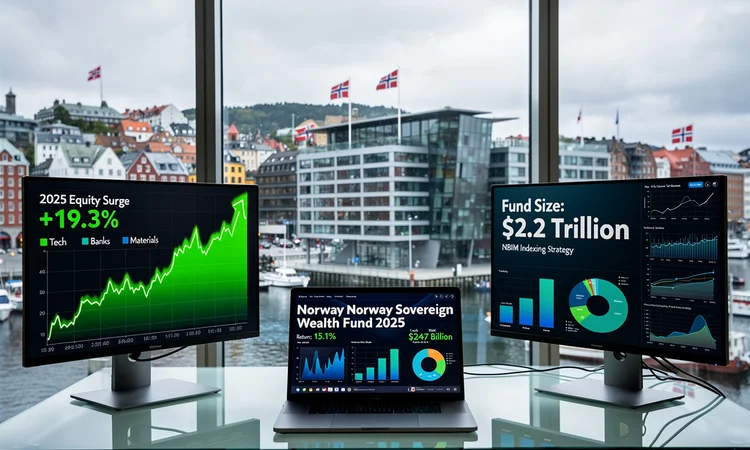
Norway’s Government Pension Fund Global, the world’s largest sovereign wealth fund, delivered a staggering 15.1% return on investment in 2025, generating 2.36 trillion Norwegian kroner—or about $247 billion—in profits, according to Norges Bank Investment Management (NBIM). The fund’s value swelled to 21.27 trillion kroner ($2.2 trillion) by year-end, up 1.53 trillion kroner from the prior year. This marked the highest annual gain since the fund’s inception in the 1990s, though it trailed its benchmark index by 0.28 percentage points.
Equities, comprising 71% of the portfolio, powered the performance with a 19.3% return. Fixed income added 5.4%, unlisted real estate 4.4%, and renewable energy infrastructure a robust 18.1%. NBIM CEO Nicolai Tangen highlighted the drivers in a statement: “Stocks in technology, financials and basic materials stood out, making a significant contribution to the overall return.” CNBC detailed how these sectors propelled the record results amid a global rally in AI-driven tech and resilient banking stocks.
Tech Titans Anchor Equity Surge
The fund holds significant stakes in U.S. tech giants, including 1.3% of Nvidia, 1.2% of Apple, and 1.3% of Microsoft, positions that benefited from continued AI enthusiasm. Europe’s banking sector also shone, with holdings in Bank of America, JPMorgan Chase, Goldman Sachs, Santander, UBS, HSBC, and UniCredit delivering outsized gains. A standout was Fresnillo, which rocketed 452.5% on a silver price boom and its acquisition of Probe Gold, underscoring basic materials’ role. The same CNBC report noted these specific contributors.
From a turbulent start—marked by a $40 billion first-quarter loss amid tech volatility, as reported by IDNFinancials citing NBIM CEO Tangen—the fund rebounded strongly. Q3 saw a 5.8% return, or $103 billion profit, driven by basic materials, telecoms, and financials, per CNBC . Deputy CEO Trond Grande emphasized equity strength at 7.7% for the quarter.
Strategic Allocations Amid Volatility
NBIM’s passive, index-tracking approach—investing in over 8,700 companies across 44 countries via the FTSE Global All Cap index—minimized risk while capturing market upside. U.S. equities, nearly 40% of holdings, remained pivotal, as NBIM data shows annualized returns of 6.59% since 1998, outpacing the benchmark by 0.24 points through Q3 2025. The fund’s 700 staff manage $2.5 billion per employee, per Reddit discussions on r/stocks citing Q3 figures.
Renewables proved resilient, contrasting 2024’s -10% dip noted in prior reports. Unlisted real estate steadied after earlier losses. Transaction costs totaled $2 billion in 2024, with equities at 71.4% of assets returning 18.2%, according to Global Trading . Active management added value, with NBIM reporting outperformance over five years in a letter to Norway’s Ministry of Finance, as covered by IPE .
Ethical Guardrails and Global Scrutiny
Ethical mandates shaped decisions, including divestments from Israeli firms in August 2025 over military ties, per Wikipedia and NBIM updates. The fund targets net-zero by 2050, expanding climate engagements in its 2030 plan, as ESG Today reported. U.S. holdings in US Treasuries rose to $199 billion (9.4% of assets), defying geopolitical tensions.
Norway’s fund, born from oil surpluses in 1990, now generates more income than petroleum production for its 5.6 million citizens—$244,000 per capita at earlier valuations, per Robert Eccles . A 3% annual withdrawal cap preserves intergenerational wealth. In December 2025, NBIM overtook Japan’s GPIF as the largest asset owner at 20.44 trillion kroner, Top1000Funds noted.
Benchmark Discipline in Boom Times
Slightly underperforming the benchmark reflects disciplined indexing, with relative returns averaging positive long-term. 2025’s 15.1% topped 2024’s 13% ($222 billion), continuing a record streak after 2023’s gains. X posts from @CNBC and @business amplified the news, confirming equity dominance at 19.3%.
Challenges persist: Q1 2025 losses from tech downturns, per Tangen, and debates over 71% equity exposure’s volatility. Yet, diversification across 63 countries and sectors buffered risks. Bloomberg highlighted the fund’s index fidelity versus peers’ strategic bets in its analysis .
Implications for Global Capital Flows
As 1.5% owner of global listed equities, NBIM influences governance, voting at 6,078 meetings in past years. Its 2025 success validates heavy tech-financial weighting amid AI and rate stabilization. Fortune noted average 7.45% over 2019-2023 versus peers, underscoring steady compounding in its profile . X reactions, like from @CGTNEurope , echoed the 15.1% figure.
The fund’s trajectory signals investor confidence in U.S.-centric growth, renewables rebound, and banking resilience. With assets surpassing $2 trillion, Norway exemplifies prudent oil-to-asset transformation, setting benchmarks for sovereign investors worldwide.






Leave a Reply
Your email address will not be published.