






Nvidia’s Ambitious Push Into Factory Floors Hits Speed Bumps Amid AI Dominance
In the high-stakes world of technology, few companies have ridden the artificial intelligence wave as triumphantly as Nvidia Corp. Over the past two years, its revenue has surged to staggering heights, fueled by insatiable demand for AI chips. Yet, behind this success story, CEO Jensen Huang harbors grander visions: transforming the manufacturing sector through advanced simulation tools. According to a recent report from The Information , these ambitions are yielding disappointingly slow returns, raising questions about whether Nvidia can replicate its AI magic in the gritty realm of industrial production.
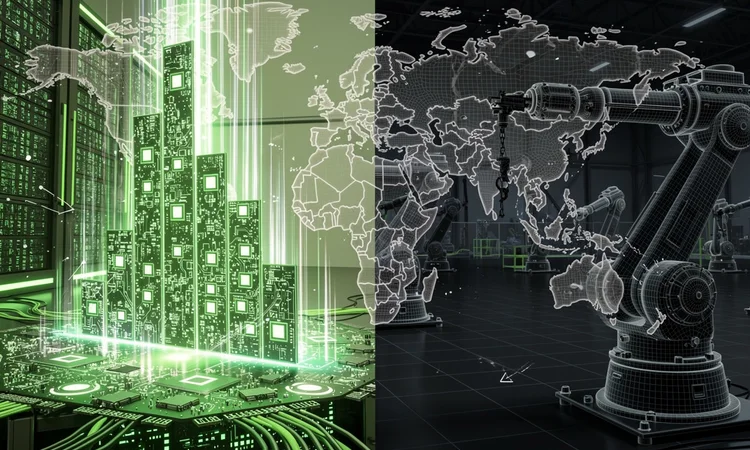
Huang has long championed Nvidia’s Omniverse platform, a suite of software that enables the creation of “digital twins”—virtual replicas of physical factories, robots, and processes. The idea is seductive: manufacturers could simulate operations in a risk-free digital environment, optimizing everything from assembly lines to supply chains before committing real-world resources. This push aligns with broader industry trends toward automation and efficiency, especially as labor shortages and geopolitical tensions strain global production networks. However, adoption has been tepid, with few major customers fully embracing the technology despite Huang’s persistent evangelism.
The contrast is stark when set against Nvidia’s core business. In the nine months through October 2025, the company reported nearly $148 billion in revenue, a meteoric rise from $27.5 billion in the same period of 2023, largely driven by data center chips for AI training. But Omniverse, positioned as a cornerstone of Nvidia’s future growth, remains a niche player. Insiders suggest that while the platform dazzles in demonstrations—showcasing hyper-realistic simulations powered by Nvidia’s GPUs—translating that into tangible productivity gains for factories has proven elusive.
Challenges in Digital Twin Adoption
One key hurdle is the complexity of integration. Manufacturers, particularly in sectors like automotive and electronics, operate with legacy systems that don’t easily mesh with Omniverse’s cutting-edge requirements. As noted in a post on X from industry analyst Ben Pouladian, Nvidia’s dominance in AI hardware stems from years of building supply chain relationships, but replicating that in software for manufacturing demands a different playbook. Pouladian highlighted how rivals struggle to scale due to bottlenecks in advanced packaging, a reminder that hardware-software ecosystems don’t emerge overnight.
Moreover, the return on investment for digital twins often materializes slowly, if at all. A report from Sherwood News underscores this, pointing out that while Huang remains bullish on simulating robots for manufacturing, the business unit’s returns have been underwhelming. Companies experimenting with Omniverse report high upfront costs for hardware and training, with benefits accruing over years rather than quarters. This timeline clashes with the fast-paced expectations of investors accustomed to Nvidia’s rapid AI-fueled growth.
Geopolitical factors add another layer of complication. U.S. export restrictions on advanced chips to China have disrupted Nvidia’s market share there, dropping from 95% to around 50% as local players like Huawei ramp up production using domestic foundries such as SMIC. An X post by analyst tphuang detailed how improved yields at SMIC’s 7nm process are enabling Chinese firms to shift away from Nvidia, potentially limiting the global reach of Omniverse in key manufacturing hubs.
Supply Chain Strains and Market Pressures
Nvidia’s manufacturing ambitions are further tested by broader semiconductor industry challenges. Recent news from OC3D reveals plans for heavy cuts to GeForce RTX 50 series GPU production in early 2026, attributed to rising memory costs. Such constraints could indirectly affect Omniverse, which relies on powerful GPUs for rendering complex simulations. If Nvidia prioritizes AI chip production amid shortages, its manufacturing software might suffer from resource allocation trade-offs.
Financially, Nvidia continues to impress. Its third-quarter fiscal 2026 results, announced via NVIDIA Newsroom , showed record revenue of $57 billion, up 62% year-over-year, with data center sales leading the charge. Yet, this dominance masks vulnerabilities in diversified bets like Omniverse. Analysts at Nasdaq argue that Nvidia’s ability to outperform the market in 2026 hinges on expanding beyond AI training into inference and other applications, but slow progress in manufacturing could dilute that narrative.
Posts on X from users like Shanu Mathew highlight mounting constraints in the semiconductor supply chain, with projections of Nvidia reaching $383 billion in revenue for 2026 amid shortages of high-bandwidth memory. These insights reflect a sentiment that while Nvidia’s core business thrives, ambitious forays into manufacturing face headwinds from capacity limits and competition. Taiwan Semiconductor Manufacturing Co. (TSMC), a key partner, is ramping up production, but as an X post by Thomas Gatliff noted, yield issues in advanced nodes like N2 persist, potentially hampering the volume needed for widespread Omniverse deployment.
Strategic Shifts and Future Prospects
To counter these setbacks, Nvidia is doubling down on partnerships. Collaborations with companies like Siemens and Foxconn aim to embed Omniverse into real-world applications, such as designing smarter factories. However, as detailed in The Information report, few customers have moved beyond pilots. One executive quoted anonymously described the platform as “impressive but impractical” for day-to-day operations, citing interoperability issues with existing CAD software.
Investor optimism remains high, fueled by predictions from experts like Gene Munster of Deepwater Asset Management. In a piece from Business Insider , Munster forecasts the AI boom extending another two to three years, with Nvidia benefiting from wider adoption. Yet, for manufacturing specifically, the path is murkier. A Motley Fool analysis at The Motley Fool lists reasons Nvidia could beat the market again, including its ecosystem strength, but acknowledges that segments like Omniverse need faster monetization to contribute meaningfully.
Competition is intensifying too. Rivals like AMD and Intel are pushing their own simulation tools, while cloud giants such as Amazon and Microsoft develop in-house alternatives. An X post by Kaushik referenced DA Davidson’s warning of a potential cyclical downturn by 2026, as major clients shift investments toward proprietary hardware. This could erode Nvidia’s edge in manufacturing software, where differentiation relies on seamless integration with its GPUs.
Innovation Amid Uncertainty
Despite the slow returns, Huang’s vision isn’t without merit. Digital twins have proven valuable in niche areas, like aerospace and automotive prototyping, where firms like BMW use Omniverse to simulate vehicle assembly. Expanding this to broader manufacturing could unlock efficiencies, especially as industries grapple with sustainability mandates and supply chain disruptions. Recent web searches reveal growing interest in AI-driven factories, with TSMC’s role in AI growth highlighted in a 24/7 Wall St. article at 24/7 Wall St. , emphasizing how foundry capacity underpins tools like Omniverse.
Nvidia’s response includes heavy investments in R&D, with plans to enhance Omniverse’s accessibility through cloud-based versions. This could lower barriers for smaller manufacturers, potentially accelerating adoption. However, as Sherwood News reported, the business’s underwhelming performance suggests a need for more compelling case studies to convince skeptics.
Looking ahead, the interplay between Nvidia’s AI stronghold and its manufacturing push will define its trajectory. Posts on X from users like Dan Nystedt discuss production issues with Nvidia’s Blackwell chips, impacting shipments into 2025 and possibly delaying Omniverse advancements. Yet, optimism persists; a Nasdaq piece posits that strategic moves in 2026 could solidify Nvidia’s position.
Balancing Ambition with Execution
The semiconductor sector’s broader dynamics add context. China’s push for self-sufficiency, as seen in X discussions about gallium monopolies and 5G standards, poses long-term risks to Nvidia’s global ambitions. U.S. sanctions, while aimed at curbing rivals, have inadvertently boosted local innovation, per an X post by Barrett from 2024, which warned of backlash against overly harsh restrictions.
Internally, Nvidia must navigate resource allocation. With AI demand projected to drive $65 billion in quarterly revenue, as per a Motley Fool forecast at another Motley Fool article , diverting focus to Omniverse risks short-term investor discontent. Analysts suggest that success in manufacturing will require not just technological prowess but also ecosystem building—forging alliances that make digital twins indispensable.
Ultimately, Nvidia’s journey into manufacturing reflects the perils of diversification in a boom-and-bust industry. While AI chips propel record profits, the slow burn of Omniverse underscores the patience needed for paradigm shifts. As 2026 unfolds, whether Huang’s perpetual dissatisfaction translates into breakthroughs or more tempered expectations will be closely watched by insiders. The company’s ability to adapt, innovate, and integrate could yet turn ambitious visions into industrial reality, bridging the gap between digital promise and factory-floor impact.






Leave a Reply
Your email address will not be published.