




Global enterprises are confronting a payroll reckoning. Once a back-office chore, payroll now anchors employee trust, regulatory adherence, and business resilience amid borderless workforces and relentless rule changes. Legacy systems, strained by international growth and hybrid models, breed errors, delays, and fines that ripple through finance, legal, and leadership ranks. Modern platforms promise integration and intelligence, turning payroll into a competitive edge.
“Payroll is one of the few systems where mistakes are immediately felt by every employee,” says Suresh Kurapati , a senior HR technology architect experienced in Workday global solutions. Inaccuracies trigger underpayments or overpayments, inviting audits, penalties, and reputational hits. As firms expand, varying tax regimes, deductions, and reporting demands expose disconnected tools and manual fixes to failure.
Organizations accelerating digital shifts in analytics and finance often sideline payroll, yet its breakdowns cascade widely. “What organizations often underestimate is how payroll problems cascade across systems,” Kurapati explains. A single data mismatch between HR and payroll can spark compliance breaches or reporting flaws, burdening teams with reconciliation.
Legacy Traps Exposed
Global expansion redefines payroll demands. Country-specific statutes create mazes of compliance, where outsourcing or vendor patchwork fragments data and oversight. HR and finance drown in exceptions, losing sight of costs and risks. Hybrid work amplifies this, with legacy setups faltering on real-time accuracy for distributed teams.
Deloitte’s 2025 Global Payroll Benchmarking report spotlights mega-enterprises—firms with 25,000 to 240,000 employees across tech, finance, and healthcare—revealing detailed staffing and cost benchmarks. It underscores structural strains, with 88% developing global strategies, up 40% since 2018, amid regulatory flux and headcount surges.
Payroll pros report 64% of systems lacking agility, per Workday insights cited by Payslip . Fragmentation persists: firms juggle nearly four providers globally, worse in LATAM and APAC due to rules complexity.
AI Agents Reshape Operations
Enter agentic AI, automating payroll end-to-end—from data ingestion to validation and runs. By 2028, Gartner forecasts 33% of enterprise apps embedding it, up from under 1% in 2024. ADP deploys it for onboarding and validations, aligning with talent attraction and cost control. “Agentic AI unlocks new frontiers of automation,” says ADP’s Amin Venjara.
“IT is definitely a bigger part of the decision making,” notes Tonya James , ADP’s VP of global payroll product management. Priorities now include data security, integrations, and user management as agents span systems.
Multiplier’s 2026 trends outlook predicts AI as autonomous agents interpreting regs, adjusting formulas real-time. It automates 40-60% of tasks, birthing roles like Payroll AI Product Leader for governance. Yet 70% of pros lack AI savvy, signaling upskilling urgency.
Real-Time Demands Accelerate
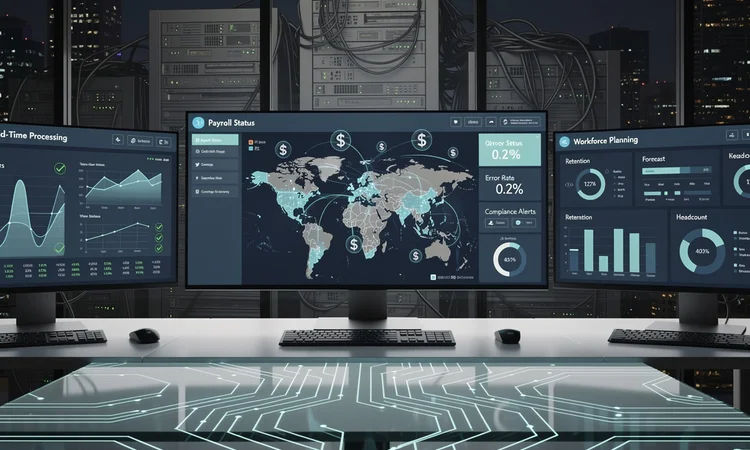
Real-time payroll processing (RTPP) syncs live with attendance and benefits, enabling continuous calculations. Finance gains instant labor cost views; workers access earned wages. Paychex’s 12 trends for 2026 highlight this, with 74% of firms eyeing growth via payroll data. EWA advanced $22 billion to 7 million workers in 2022, boosting retention.
Cloud platforms deliver auto tax updates, scalability, and security—77% of mid-sized firms prioritize cyber defenses amid AI threats. Pay transparency mandates in 15 U.S. states and EU’s 2026 directive demand unified views, fostering equity.
“The biggest transformation…will be payroll acting as a compliance co-pilot,” per Multiplier’s Michael Nierstedt. It flags risks pre-issue, vital as 37% see real-time planning as payroll’s top strategic use.
Unified Platforms Cut Fragmentation
Modern HR suites knit payroll with recruiting, benefits, and finance into one truth source. Workday and ADP exemplify, reducing manual tweaks. Kurapati affirms: “Modern payroll platforms reduce reliance on manual intervention by ensuring…data are aligned.” This boosts audit trails, adaptability.
Deel’s Mariah Hantis, in Thomson Reuters , pushes localized teams plus consolidation: average six tools yield 10 logins. AI slashes processing, freeing strategists. EU pay gap disclosures loom, testing multi-jurisdiction ops.
Payroll data fuels workforce economics: forecast costs, model headcount, spot retention risks. “Payroll data is one of the most dependable sources,” Kurapati states, empowering decisions in uncertainty.
Compliance Storms on Horizon
2026 brings U.S. overtime tweaks, state wage hikes, IRS 1099-NEC for contractors over $2,000. Globally, hybrid workers risk misclassification penalties. EORs and integrated stacks shield via local expertise, per Gloroots.
UKG’s trends warn AI sans trust flops; talent ecosystems flex. Deloitte notes outsourcing, tech as disruptors. INFiniti HR flags budgeting for modernization amid wage pressures.
Firms delaying face exposure: errors cost 2% of salary bills, per older Alight data, with GDPR fines at 4% revenue.
Strategic Shifts in Workforce Planning
Payroll evolves to intelligence hub. Multiplier’s Vamsi Krishna: AI scans for errors continuously. Teams pivot to oversight, analytics. Ian Giles: “Near real-time payroll data is one of the most powerful insights.”
Paychex notes payroll as “strategic business tool.” Leapsome eyes data-driven HR; Journey stresses integration. Blockchain pilots like Zebec target $11T U.S. market with stablecoins, but fiat rails dominate.
For enterprises, modernization protects growth: unified architectures meet local regs consistently, per Pete Schlampp.
Path Forward for Executives
Boardrooms must prioritize: assess legacy risks, benchmark via Deloitte, invest cloud/AI. Localized partners aid expansion; governance tames agentic AI. “Payroll modernization is not just a technology upgrade…It’s a business decision,” Kurapati concludes, safeguarding staff and scalability.






Leave a Reply
Your email address will not be published.