





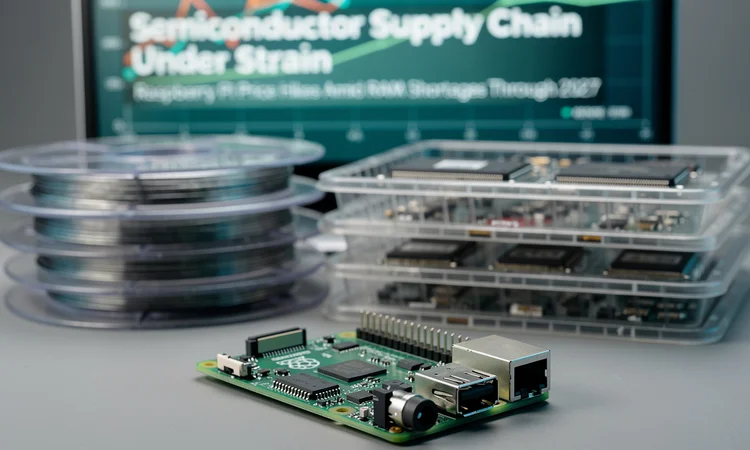
The global semiconductor industry faces a new crisis as Raspberry Pi, the British computing company beloved by hobbyists and industrial users alike, announced its second price increase in just two months—an unprecedented move that signals deepening troubles in memory chip markets. According to Ars Technica , the company cited ongoing RAM shortages as the primary driver behind the decision, marking a dramatic shift for an organization that has maintained remarkably stable pricing throughout most of its twelve-year history.
The Cambridge-based manufacturer, which has sold more than 60 million single-board computers since its 2012 launch, now finds itself caught in a perfect storm of supply chain disruptions, geopolitical tensions, and manufacturing constraints that industry analysts warn could persist well into 2027. The price adjustments affect multiple product lines, with the flagship Raspberry Pi 5 seeing increases of up to 15% depending on configuration and memory capacity. For a company that built its reputation on democratizing computing through affordability, these hikes represent not just a business decision but a fundamental challenge to its mission.
The RAM crisis driving these price increases stems from a confluence of factors that have been building since late 2025. Major memory manufacturers in South Korea and Taiwan have reported significant production challenges, with some facilities operating at reduced capacity due to equipment failures and delayed maintenance schedules. Industry sources indicate that DRAM spot prices have surged by more than 40% since December 2025, with LPDDR4X modules—the type commonly used in Raspberry Pi devices—experiencing even steeper increases due to competing demand from smartphone and automotive sectors.
Manufacturing Bottlenecks Compound Supply Pressures
The memory shortage extends beyond simple supply-demand imbalances. Semiconductor manufacturing requires extraordinarily complex supply chains, with individual chips requiring hundreds of processing steps and materials sourced from dozens of countries. Recent disruptions at key chemical suppliers in Japan and Germany have created cascading delays throughout the production pipeline. These challenges have been particularly acute for older-generation memory technologies, which paradoxically face tighter supply constraints than cutting-edge chips as manufacturers prioritize newer, higher-margin products.
Raspberry Pi’s reliance on LPDDR4X memory, rather than the latest LPDDR5 or DDR5 standards, initially seemed like a strategic advantage. These mature technologies typically offer better pricing and more stable supply chains. However, as major manufacturers shift production capacity toward newer memory types to serve premium smartphone and laptop markets, the available supply of older-generation chips has contracted sharply. This dynamic has forced smaller buyers like Raspberry Pi to compete more aggressively for limited inventory, driving up procurement costs.
The situation has been exacerbated by inventory dynamics within the broader electronics industry. After experiencing significant oversupply conditions in 2023 and early 2024, memory manufacturers implemented aggressive production cuts to stabilize pricing. These reductions, combined with unexpectedly strong demand recovery in multiple sectors, have created the current shortage environment. Industry data suggests that memory manufacturers are now operating at approximately 85% of capacity, with lead times for new orders extending to 16-20 weeks compared to the historical norm of 8-12 weeks.
Geopolitical Tensions Reshape Semiconductor Markets
Beyond pure supply-demand economics, geopolitical factors have introduced new uncertainties into semiconductor markets. Ongoing trade tensions between major economies have prompted companies to diversify their supply chains and build strategic inventory buffers, further tightening available supply. Export controls on advanced semiconductor manufacturing equipment have complicated expansion plans for some facilities, while tariffs and trade restrictions have increased costs and complexity throughout the supply chain.
The memory crisis also reflects broader structural challenges in semiconductor manufacturing. Building new fabrication facilities requires investments of $10-20 billion and construction timelines of 3-5 years, making it difficult for the industry to respond quickly to demand shifts. While several major memory manufacturers announced capacity expansion plans in 2024 and 2025, these facilities won’t reach full production until 2027 or later. This inherent lag between investment decisions and production output creates cyclical boom-bust patterns that have characterized the memory industry for decades.
For Raspberry Pi, the price increases represent a painful but necessary response to input cost pressures. The company operates on relatively thin margins compared to consumer electronics giants, with limited ability to absorb significant cost increases without passing them along to customers. Internal documents suggest that memory costs now represent approximately 30-35% of total bill-of-materials expenses for Raspberry Pi devices, up from roughly 20-25% in 2024. This shift has fundamentally altered the company’s cost structure and forced difficult pricing decisions.
Industrial Customers Face Strategic Challenges
The price increases carry particularly significant implications for industrial and commercial users who have integrated Raspberry Pi devices into their products and infrastructure. Companies in sectors ranging from digital signage to industrial automation have built business models around the predictable, low-cost availability of these single-board computers. Sudden price volatility introduces budget uncertainties and may force some organizations to reconsider their technology choices or absorb higher costs that compress profit margins.
Educational institutions, another key constituency for Raspberry Pi, face similar pressures. Schools and universities worldwide have incorporated these devices into computer science curricula and maker programs, often operating under tight budget constraints. Price increases of 10-15% may seem modest in percentage terms, but they can significantly impact programs planning to purchase dozens or hundreds of units. Some educational technology coordinators report already scaling back planned purchases or seeking alternative funding sources to maintain program scope.
The hobbyist community, which formed Raspberry Pi’s original core audience, has responded with a mixture of understanding and frustration. Online forums and social media discussions reveal that many enthusiasts recognize the external market forces driving the increases while expressing disappointment that the era of ultra-affordable computing may be ending. Some users are exploring alternative single-board computers from competitors, though many of these alternatives face similar cost pressures or lack the extensive software ecosystem and community support that has made Raspberry Pi the category leader.
Industry-Wide Implications and Future Outlook
The Raspberry Pi situation serves as a canary in the coal mine for broader electronics markets. If a well-managed company with strong supplier relationships and significant purchasing volume faces such acute pricing pressures, smaller manufacturers and startups likely face even more severe challenges. Industry analysts suggest that the current memory shortage could trigger a wave of price increases across consumer electronics categories, from budget laptops to IoT devices, as manufacturers adjust to the new cost environment.
Looking ahead, the memory market outlook remains uncertain. Some analysts project that supply-demand balance could improve by late 2026 as new production capacity comes online and demand moderates in certain sectors. However, others warn that structural factors—including the industry’s oligopolistic structure, high barriers to entry, and cyclical investment patterns—may perpetuate volatility. The concentration of memory manufacturing among a handful of companies in a few geographic regions creates inherent fragility in global supply chains.
Raspberry Pi’s response to the crisis extends beyond price adjustments. The company has reportedly intensified efforts to secure long-term supply agreements with memory manufacturers, accepting higher costs in exchange for greater supply certainty. These contracts may provide more stable pricing for customers over the medium term, though they also reduce the company’s flexibility to capitalize on potential future price declines. Additionally, Raspberry Pi is exploring technical modifications to future product designs that could reduce memory costs or enable use of more readily available chip variants.
Navigating Uncertainty in Component Markets
The current crisis highlights fundamental questions about supply chain resilience and the trade-offs between efficiency and redundancy. For decades, electronics manufacturers have optimized supply chains for cost minimization and just-in-time inventory management. These strategies delivered impressive cost reductions and enabled products like Raspberry Pi to reach remarkably low price points. However, they also created systems with limited buffers to absorb shocks, whether from natural disasters, geopolitical events, or demand fluctuations.
Some industry observers argue that the recurring semiconductor shortages of recent years—from the automotive chip crisis of 2021-2022 to the current memory shortage—demonstrate the need for more resilient supply chain architectures. This might include greater inventory buffers, diversified supplier bases, and potentially even regionalized production to reduce dependence on concentrated manufacturing hubs. However, these resilience measures carry costs that would likely translate to higher product prices, creating tension between affordability and security of supply.
For now, Raspberry Pi customers across all segments must adapt to a new reality of higher prices and potential supply constraints. The company has committed to maintaining production volumes and meeting delivery commitments, though lead times have extended for some configurations. As the memory market situation evolves through 2026, further price adjustments—in either direction—remain possible. The broader lesson extends well beyond single-board computers: in an increasingly complex and interconnected global economy, even the most stable and predictable markets can experience sudden disruptions that ripple through entire industries and affect millions of users worldwide.






Leave a Reply
Your email address will not be published.