





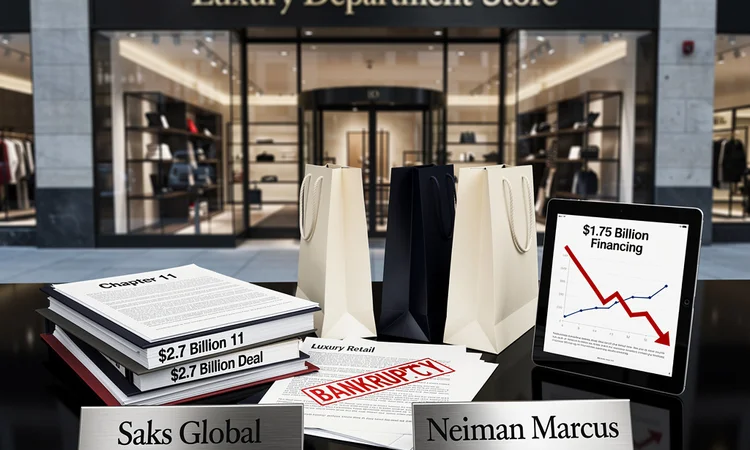
Saks Global, the parent company of Saks Fifth Avenue, Neiman Marcus and Bergdorf Goodman, filed for Chapter 11 bankruptcy protection late Tuesday in Houston federal court, marking one of the most dramatic retail failures since the pandemic. The filing comes barely a year after a $2.7 billion acquisition of Neiman Marcus that was billed as a transformative merger to create a luxury retail powerhouse. Instead, it accelerated a downward spiral fueled by mounting debt, supplier revolts and a broader pullback in high-end spending.
The company listed assets and liabilities each between $1 billion and $10 billion in its court documents. Saks has secured $1.75 billion in debtor-in-possession financing, including $1 billion from a bondholder group led by Pentwater Capital and Bracebridge Capital, $250 million from asset-based lenders headed by Bank of America, and $500 million in potential equity upon emergence. Stores will remain open during the process, the company said in a statement.
Geoffroy van Raemdonck, former Neiman Marcus CEO, was named Saks Global’s new chief executive effective immediately, replacing Marc Metrick who resigned days after the company missed a $100 million debt payment in December. Richard Baker, executive chairman and architect of the Neiman Marcus deal, stepped down from the interim CEO role he assumed earlier this year.
The Merger That Backfired
The $2.7 billion Neiman Marcus takeover, funded largely through new debt raised in late 2024, was intended to consolidate market share and generate cost synergies. But sales plunged 13% to $1.6 billion in the period ended Aug. 2, with net losses widening to $288 million, according to The Wall Street Journal . A luxury spending slowdown that gripped the sector since 2023 exacerbated the strain, as affluent consumers traded down or deferred big-ticket purchases.
Even before the merger, Saks faced cash crunches. In February 2025, it extended supplier payment terms to 90 days from 60 and spread back payments over 12 months, prompting some vendors to halt shipments. This inventory shortage created a vicious cycle, further eroding sales. In June, Saks restructured $600 million in debt, but it wasn’t enough to stave off default.
“The debt-fueled acquisition of Neiman Marcus always made bankruptcy a likely destination for Saks Global. The only real surprise has been the speed of the collapse,” retail analyst Neil Saunders of GlobalData told Daily Mail .
Financing Lifeline and Restructuring Path
The DIP financing package provides runway for operations while Saks evaluates its footprint. With 33 Saks Fifth Avenue stores, 36 Neiman Marcus locations (some overlapping in markets), two Bergdorf Goodman flagships and about 70 Saks Off 5th outlets, the company plans to shed underperforming sites. It already announced nine Off 5th closures for January 2026, but insiders expect broader cuts, potentially halving Off 5th and trimming flagship stores, per Reuters .
Saks recently sold land under Neiman Marcus stores in Beverly Hills and San Francisco for $100 million and explored selling 49% of Bergdorf Goodman for $1 billion. “Bankruptcy will give Saks Global some breathing space and a chance to restructure,” Saunders added. “However, it is vital that debt levels are brought down and that the company has room to make the investments needed.”
Posts on X highlight the rapid timeline: Saks raised billions for the acquisition in 2024, debt turned distressed mid-year, it skipped a $100 million interest payment late 2025, and filed in early 2026—14 months from deal to Chapter 11.
Roots of a Retail Icon
Saks traces to 1867 in Washington, D.C., when Andrew and Isadore Saks opened a men’s store. It expanded to New York’s Herald Square in 1902 and its iconic Fifth Avenue flagship in 1924, a limestone behemoth spanning a city block near Vanderbilt mansions. Mergers with Gimbel Brothers in the 1930s and later owners like British American Tobacco and Investcorp followed, before HBC—led by Baker—acquired it in 2013 for $2.9 billion, drawn partly by the Fifth Avenue site’s $3.7 billion valuation.
HBC invested heavily, including a $300 million flagship renovation around 2019 with a Rem Koolhaas escalator, relocating cosmetics upstairs to prioritize handbags on prime ground floor. Saks split its e-commerce into a separate unit in 2021 for a potential IPO that fizzled amid Farfetch’s collapse. Holiday spectacles, like the 2023 Dior carousel transforming the facade into a light show, burnished its image, though 2024’s was canceled before reinstatement in 2025.
Yet department stores have lost leverage to powerhouse brands like LVMH’s Louis Vuitton and Kering’s Gucci, which now dominate via direct boutiques. Neiman Marcus itself emerged from a 2020 bankruptcy, as did peers like Barneys, Lord & Taylor (also Baker-owned) and Hudson’s Bay, which shuttered all stores in 2025.
Supplier Squeeze and Shopper Impact
Saks blamed its woes on “inventory availability and vendor confidence, not underlying demand for luxury goods,” per court filings cited by CNBC . Vendors, burned by delayed payments, curtailed goods, starving shelves amid a sector slump. The bankruptcy prioritizes recent supplier claims, but longer-term relations must be rebuilt.
Shoppers may see deep discounts soon, as Chapter 11 often triggers going-out-of-business sales. Saks’s winter sale already offers up to 85% off, with a $4,900 Brunello Cucinelli bag at $2,900 and Givenchy pumps from $1,100 to under $700, drawing bargain hunters amid closure fears, according to Daily Mail .
For suppliers, uncertainty looms: Will they recover full payments? The fashion industry reels, echoing recent casualties. As Saks navigates restructuring, its fate underscores the high stakes of debt-laden bets in a shifting luxury arena dominated by direct-to-consumer brands and online giants.
Creditor Dynamics and Emergence Outlook
Bondholders like Pentwater now hold sway, providing the bulk of DIP funds and equity backstop. Asset-based lenders, secured against inventory and receivables, released $250 million liquidity. This structure aims for a quicker exit than typical bankruptcies, potentially within months if a reorganization plan wins approval.
Saks closed a San Francisco store and Neiman a Dallas flagship post-merger, signaling early pruning. Further rationalization targets overlapping locations and low-traffic Off 5th sites. Success hinges on restoring vendor trust, investing in digital and flagships, and capitalizing on any luxury rebound, though analysts caution years of effort lie ahead.
The saga spotlights broader pressures: a $400 billion luxury sector bloated by cheap debt, now cracking under higher rates and consumer caution. For industry insiders, Saks Global’s path charts the risks of consolidation without adaptation in an era where brands, not department stores, command loyalty.






Leave a Reply
Your email address will not be published.