





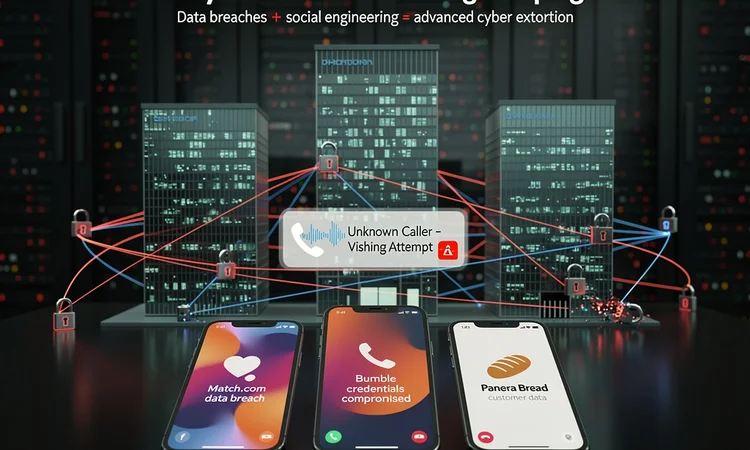
The notorious cybercrime syndicate ShinyHunters has launched an aggressive new campaign that marks a significant evolution in their tactics, combining traditional data breaches with sophisticated voice phishing operations to extort hundreds of major corporations. The group, which has been responsible for some of the most significant data breaches in recent years, is now leveraging stolen credentials and personal information in what security researchers are calling a SLSH (Social Engineering and Lateral System Hacking) campaign that threatens to redefine corporate cybersecurity vulnerabilities.
According to CSO Online , ShinyHunters has recently released stolen data from high-profile companies including Match.com, Bumble, and Panera Bread as part of this escalating campaign. The group’s new approach represents a dangerous fusion of technical sophistication and social engineering that exploits the human element of cybersecurity—often considered the weakest link in any organization’s defense infrastructure. Security experts warn that this campaign could affect hundreds of companies across multiple sectors, with the potential for widespread financial and reputational damage.
The timing of this campaign is particularly concerning as it comes during a period when many organizations are still recovering from previous breaches and struggling to implement comprehensive security measures. The vishing component—voice phishing conducted through phone calls—adds a layer of authenticity that makes these attacks significantly more dangerous than traditional email-based phishing attempts. Attackers can use stolen personal information to build credibility with their targets, making it increasingly difficult for employees to distinguish legitimate communications from fraudulent ones.
The Evolution of ShinyHunters’ Criminal Enterprise
ShinyHunters first emerged on the cybercrime scene in 2020, quickly establishing themselves as one of the most prolific data theft groups in the underground economy. The collective gained notoriety for breaching numerous high-profile companies and either selling the stolen data on dark web marketplaces or releasing it publicly to gain notoriety within the hacking community. Their targets have ranged from technology companies to retailers, financial services providers, and now, dating platforms and restaurant chains.
What distinguishes ShinyHunters from other cybercriminal organizations is their willingness to publicly disclose their activities and the scale of their operations. The group has demonstrated a pattern of targeting companies with large user bases, where the stolen data can be monetized through various channels including identity theft, credential stuffing attacks, and now, targeted vishing campaigns. Their latest operation suggests a maturation of their business model, moving beyond simple data theft to more sophisticated extortion schemes that maximize the value extracted from each breach.
Inside the SLSH Campaign Methodology
The SLSH campaign represents a multi-stage attack methodology that begins with initial network compromise and data exfiltration, followed by social engineering attacks that leverage the stolen information. In the vishing phase, attackers contact employees using information gleaned from breached databases, often impersonating IT support staff, executives, or other trusted figures within the organization. The goal is to trick employees into divulging additional credentials, approving fraudulent transactions, or providing access to more sensitive systems.
Security researchers have observed that these vishing calls are highly sophisticated, with attackers demonstrating detailed knowledge of internal company structures, employee relationships, and ongoing projects. This level of detail can only be obtained through prior data breaches, suggesting that ShinyHunters may be sitting on vast repositories of corporate information collected over years of operations. The psychological manipulation involved in these calls is considerable, with attackers creating artificial urgency, exploiting authority relationships, and using technical jargon to overwhelm their targets.
The Dating App Data Breach Dimension
The inclusion of Match.com and Bumble in the latest data releases is particularly troubling given the sensitive nature of information stored on dating platforms. These applications collect extensive personal data including photographs, location information, personal preferences, and private messages—all of which can be weaponized in social engineering attacks. Users of these platforms often share information they would never disclose in professional contexts, making the data especially valuable for building convincing pretexts in vishing operations.
The breach of dating platform data also raises serious concerns about personal safety and privacy beyond the corporate context. Criminals can use this information for various nefarious purposes including blackmail, stalking, and identity theft. The combination of professional information from corporate breaches and personal information from dating apps creates a comprehensive profile that attackers can exploit across multiple domains of a victim’s life. This holistic approach to data exploitation represents a troubling trend in cybercrime, where the boundaries between personal and professional vulnerabilities are increasingly blurred.
Corporate Response and Security Implications
Organizations targeted by ShinyHunters face a complex challenge in responding to these attacks. Traditional cybersecurity measures focused on network defense and endpoint protection are insufficient when attackers are exploiting human psychology and social engineering. Companies must now implement comprehensive security awareness training that specifically addresses vishing threats, teaching employees to recognize and respond appropriately to suspicious phone calls even when the caller appears to have legitimate information.
The financial implications of these attacks extend far beyond the immediate costs of breach response and remediation. Companies face potential regulatory penalties under data protection laws such as GDPR and CCPA, litigation from affected customers and employees, and long-term reputational damage that can impact customer trust and shareholder value. The Panera Bread inclusion in the recent data releases demonstrates that even companies outside the traditional technology sector are vulnerable, suggesting that no industry can consider itself immune from these threats.
The Dark Web Economy and Data Monetization
ShinyHunters operates within a sophisticated underground economy where stolen data is bought, sold, and traded among criminals. The group’s decision to release data publicly rather than selling it exclusively on dark web marketplaces may serve multiple purposes: establishing credibility within the hacking community, pressuring victims to pay ransoms, and demonstrating capabilities to potential clients for hire. This public approach also serves as marketing for their vishing campaigns, as the released data provides proof of their access and capabilities.
The monetization strategies employed by groups like ShinyHunters have become increasingly sophisticated, with multiple revenue streams including initial access brokering, ransomware partnerships, and now, targeted extortion through vishing. Each stolen record can be monetized multiple times through different channels, creating significant financial incentives for continued operations. The economic model supporting these activities is remarkably resilient, with distributed infrastructure and cryptocurrency payments making law enforcement intervention challenging.
Law Enforcement Challenges and International Dimensions
Prosecuting cybercriminals like ShinyHunters presents significant challenges for law enforcement agencies. The group likely operates across multiple jurisdictions, using anonymization technologies and cryptocurrency to obscure their identities and locations. International cooperation is essential but often hampered by differing legal frameworks, resource constraints, and geopolitical considerations. While several members of prominent hacking groups have been arrested in recent years, the decentralized nature of these organizations means that operations often continue even after key figures are apprehended.
The scale of the current vishing campaign—with hundreds of companies potentially in the crosshairs—suggests that ShinyHunters has significant resources and organizational capacity. This level of sophistication indicates that the group may have evolved from a loose collective of hackers into a more structured criminal enterprise with defined roles, processes, and objectives. The implications for corporate security are profound, as organizations must now defend against adversaries with nation-state-level capabilities operating for purely financial motives.
Building Resilience Against Next-Generation Threats
Defending against SLSH campaigns requires a multi-layered approach that addresses both technical and human vulnerabilities. Organizations must implement robust authentication mechanisms that cannot be easily bypassed through social engineering, such as hardware security keys and biometric verification. However, technology alone is insufficient—companies must foster a security-conscious culture where employees feel empowered to question suspicious requests and report potential security incidents without fear of repercussion.
The vishing component of ShinyHunters’ campaign highlights the critical importance of voice authentication and verification procedures. Organizations should establish clear protocols for handling sensitive requests received by phone, including callback procedures to verified numbers and multi-person authorization for high-risk transactions. Regular security awareness training must evolve beyond generic phishing education to address the specific tactics employed in sophisticated vishing attacks, including scenarios where attackers possess legitimate internal information.
The Broader Implications for Digital Trust
The escalation of ShinyHunters’ activities reflects a broader crisis in digital trust that extends beyond individual companies or sectors. As cybercriminals demonstrate increasingly sophisticated capabilities to breach even well-defended organizations and exploit the stolen data in creative ways, consumers and businesses alike face growing uncertainty about the security of their digital interactions. This erosion of trust has real economic consequences, potentially slowing digital transformation initiatives and forcing companies to invest heavily in security measures that may never be fully effective against determined adversaries.
The coming months will likely reveal the full extent of ShinyHunters’ current campaign as more victims come forward and security researchers continue to analyze the released data. Organizations across all sectors must treat this as a wake-up call, recognizing that the threat environment has evolved significantly and that yesterday’s security measures are insufficient for today’s challenges. The integration of data breaches with sophisticated social engineering represents a new paradigm in cybercrime—one that demands equally sophisticated and comprehensive responses from the corporate world. The question is no longer whether organizations will be targeted, but whether they will be prepared when the vishing calls begin.






Leave a Reply
Your email address will not be published.