







The aviation industry stands at an inflection point as Skyryse, a Los Angeles-based startup, secured an additional $300 million in funding to advance its mission of making helicopter flight as simple as driving a car. The substantial Series C round, which brings the company’s total funding to over $500 million, signals growing investor confidence in aviation automation technology at a time when the sector grapples with persistent safety challenges and a critical pilot shortage.
According to TechCrunch , the funding round was led by Eclipse Ventures, with participation from existing investors including Fidelity Management & Research Company and Venrock. The capital injection comes as Skyryse prepares to scale production of its FlightOS operating system, which the company claims can reduce pilot workload by up to 90% while simultaneously enhancing safety margins across various aircraft platforms.
Founded in 2016 by Mark Groden, a former SpaceX engineer, Skyryse has spent nearly a decade developing technology that fundamentally reimagines aircraft control systems. The company’s approach centers on abstracting the complexity of flight operations through sophisticated software and hardware integration, similar to how modern smartphones simplified computing for mainstream consumers. This philosophy has attracted attention from both commercial operators and government agencies seeking solutions to longstanding aviation challenges.
The Technology Behind the Transformation
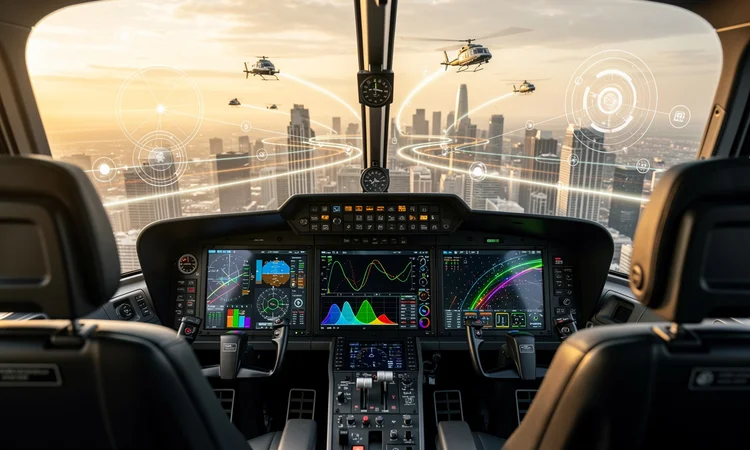
Skyryse’s FlightOS represents a comprehensive reimagining of aircraft control architecture. Unlike traditional fly-by-wire systems that merely replace mechanical linkages with electronic signals, FlightOS integrates multiple redundant systems, artificial intelligence, and advanced automation to create what the company describes as a “universal operating system” for aircraft. The system features a simplified cockpit interface with a single control stick and touchscreen displays, replacing the bewildering array of switches, pedals, and levers that have intimidated aspiring pilots for generations.
The company’s technology stack includes proprietary flight control computers, redundant sensor arrays, and machine learning algorithms that continuously monitor aircraft performance and environmental conditions. When potentially dangerous situations arise—such as spatial disorientation, a leading cause of helicopter accidents—the system can automatically intervene to maintain stable flight. This capability addresses a critical vulnerability in rotorcraft operations, where loss of visual references has historically resulted in fatal accidents even among experienced pilots.
Market Timing and Industry Pressures
The substantial investment in Skyryse arrives as the aviation industry confronts multiple concurrent crises. The United States faces an acute shortage of qualified helicopter pilots, with many operators struggling to maintain adequate staffing levels for emergency medical services, law enforcement, and commercial operations. Traditional pilot training requires hundreds of hours and costs exceeding $100,000, creating significant barriers to entry that Skyryse’s technology could potentially lower.
Safety statistics underscore the urgency of innovation in rotorcraft operations. Helicopter accidents continue to claim lives at rates significantly higher than fixed-wing aviation, with human error cited as a contributing factor in the majority of incidents. The National Transportation Safety Board has repeatedly highlighted the need for technological solutions to address controllability issues and reduce pilot workload, particularly in demanding operational environments such as emergency medical services and offshore energy support.
Regulatory Pathways and Certification Challenges
Skyryse’s path to commercial deployment hinges on navigating the Federal Aviation Administration’s rigorous certification process. The company has already achieved significant regulatory milestones, including FAA approval for its retrofit system on the Robinson R44 helicopter, one of the world’s most popular light rotorcraft platforms. This certification represents a crucial validation of Skyryse’s approach and provides a template for expanding to additional aircraft types.
The regulatory framework for highly automated aircraft systems remains in development, with the FAA working to establish standards that balance innovation with safety imperatives. Skyryse has engaged extensively with regulators throughout its development process, conducting thousands of test flights and generating comprehensive safety data to support its certification applications. The company’s strategy of retrofitting existing aircraft types, rather than developing entirely new aircraft, may accelerate regulatory approval by leveraging established airframe certifications.
Commercial Applications and Early Adopters
Skyryse has strategically focused its initial commercialization efforts on specific market segments where its technology delivers immediate value. The company has partnered with helicopter operators in the emergency medical services sector, where the combination of time-critical missions and challenging operating conditions creates strong demand for safety enhancements. These early deployments serve dual purposes: generating revenue and operational data while demonstrating the technology’s real-world capabilities to potential customers and regulators.
Beyond emergency services, Skyryse envisions applications across diverse aviation sectors including tourism, corporate transportation, and urban air mobility. The company’s technology could prove particularly valuable in enabling new operational paradigms such as single-pilot operations for aircraft currently requiring two crew members, or facilitating the transition to autonomous flight as regulatory frameworks evolve. The $300 million funding round positions Skyryse to expand its manufacturing capacity and support infrastructure to serve these growing markets.
Competitive Dynamics and Industry Skepticism
While Skyryse has captured significant attention and capital, the company operates in an increasingly crowded field of aviation technology startups pursuing various approaches to aircraft automation. Competitors range from established aerospace manufacturers developing evolutionary improvements to existing systems, to well-funded startups developing entirely new electric vertical takeoff and landing aircraft with integrated automation. This competitive environment demands that Skyryse execute flawlessly on both technology development and commercial deployment to justify its substantial valuation.
The aviation industry’s inherent conservatism presents both challenges and opportunities for Skyryse. Pilots, operators, and regulators rightfully scrutinize new technologies that claim to enhance safety, particularly when those technologies fundamentally alter established operational procedures. Skyryse must demonstrate not only that its system works as advertised, but that it can be reliably maintained, that pilots can be effectively trained on it, and that it delivers measurable safety improvements across diverse operating conditions. The company’s extensive testing program and methodical approach to certification suggest awareness of these imperatives.
Financial Sustainability and Path to Profitability
The $300 million funding round provides Skyryse with substantial runway to scale operations, but questions about the company’s path to profitability remain central to its long-term viability. The aviation industry’s economics are notoriously challenging, with high development costs, lengthy certification timelines, and price-sensitive customers creating difficult margin dynamics. Skyryse’s business model combines one-time retrofit installation fees with recurring software licensing and support services, potentially creating more favorable unit economics than traditional aerospace manufacturing.
The company’s ability to achieve profitability will depend on several factors: the pace of regulatory approvals for additional aircraft types, customer adoption rates, manufacturing scale efficiencies, and the competitive pricing environment. Skyryse’s investors are betting that the combination of large addressable markets, compelling value propositions, and defensible technology will ultimately generate returns commensurate with the substantial capital deployed. The company’s progress over the next 24 to 36 months will be critical in validating or challenging this investment thesis.
Broader Implications for Aviation’s Future
Skyryse’s vision extends beyond incremental improvements to existing aircraft operations. The company sees its technology as foundational infrastructure for the future of aviation, enabling operational concepts that remain impractical or impossible with conventional systems. As urban air mobility concepts advance from science fiction toward commercial reality, the ability to operate aircraft safely with reduced pilot workload becomes increasingly essential. Skyryse’s FlightOS could serve as the operating system layer that makes these future transportation networks viable.
The company’s success or failure will have ramifications extending far beyond its own commercial fortunes. A successful demonstration that sophisticated automation can meaningfully enhance aviation safety while reducing operational complexity could accelerate regulatory acceptance of increasingly autonomous aircraft systems. Conversely, any high-profile failures or safety incidents could generate regulatory and public skepticism that sets back the entire advanced air mobility sector. Skyryse operates under intense scrutiny from stakeholders across the aviation ecosystem, all watching to see whether Silicon Valley’s approach to aviation innovation can deliver on its ambitious promises.
The $300 million investment in Skyryse represents more than confidence in a single company—it reflects a broader belief that aviation stands ready for fundamental transformation through software and automation. As the company moves from development into scaled deployment, the aviation industry watches closely to see whether this substantial bet on technology-driven change will reshape how humans take to the skies, or whether the complexities of flight will prove more resistant to disruption than optimistic investors anticipate. The answer will emerge not in boardrooms or laboratories, but in the demanding operational environments where Skyryse’s technology must prove its worth.






Leave a Reply
Your email address will not be published.