


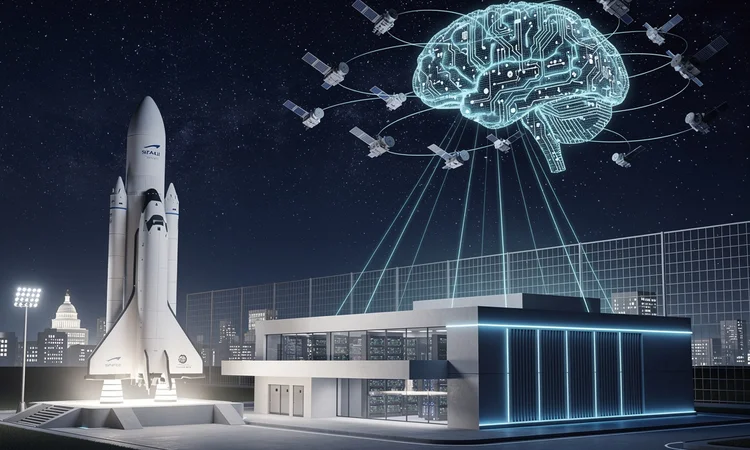
Elon Musk’s sprawling business empire may be on the verge of its most significant restructuring to date, as his aerospace manufacturer SpaceX and artificial intelligence startup xAI have reportedly entered preliminary merger discussions. The potential combination would create an unprecedented entity bridging space exploration, satellite communications, and cutting-edge AI development, according to Engadget .
The talks, which sources familiar with the matter describe as exploratory, come at a pivotal moment for both companies. SpaceX, valued at approximately $350 billion following its latest funding round, has established itself as the dominant force in commercial spaceflight and satellite deployment. Meanwhile, xAI, founded by Musk in July 2023, has rapidly positioned itself as a competitor to OpenAI and Anthropic, despite being barely two years old. The potential merger raises fundamental questions about corporate structure, regulatory oversight, and the concentration of technological power under a single umbrella.
The Strategic Rationale Behind Consolidation
Industry analysts suggest the merger discussions reflect more than simple corporate efficiency. SpaceX’s Starlink satellite network, which now serves millions of customers globally, generates vast quantities of data that could prove invaluable for training AI models. The synergies between SpaceX’s infrastructure and xAI’s computational ambitions present compelling strategic advantages that neither company could easily replicate independently.
According to sources close to the negotiations, the merger would allow xAI to leverage SpaceX’s existing infrastructure, including its data centers and satellite network, while providing SpaceX with advanced AI capabilities to enhance autonomous flight systems, satellite operations, and mission planning. This vertical integration mirrors strategies employed by other tech giants, though the scale and scope of Musk’s proposed consolidation would be unprecedented in the private space sector.
Financial Implications and Valuation Challenges
The financial structure of any potential merger remains unclear, particularly given the vast disparity in valuations between the two entities. SpaceX’s $350 billion valuation dwarfs xAI’s most recent assessment, though the AI company has attracted significant investor interest. In May 2024, xAI raised $6 billion in Series B funding at a post-money valuation of $24 billion, according to regulatory filings.
Investment banking sources suggest that structuring a merger between companies at such different stages of development presents unique challenges. SpaceX operates with substantial revenue from launch services and Starlink subscriptions, while xAI remains in earlier commercial stages, primarily focused on developing its Grok AI assistant and competing for enterprise contracts. The valuation methodology for combining these entities would need to account for SpaceX’s proven business model alongside xAI’s speculative but potentially transformative technology.
Regulatory Scrutiny and Antitrust Concerns
Any merger of this magnitude would inevitably attract intense regulatory scrutiny from multiple government agencies. SpaceX already operates under extensive oversight from the Federal Aviation Administration, the Federal Communications Commission, and NASA, given its role in national security launches and the Artemis moon program. Adding AI capabilities to this portfolio could trigger additional review from the Department of Justice and Federal Trade Commission.
Legal experts note that the merger could face particular scrutiny regarding data privacy and national security. SpaceX’s contracts with the Department of Defense and intelligence agencies involve highly classified information and critical infrastructure. Integrating AI systems developed by xAI into these operations would require extensive security reviews and potentially new regulatory frameworks. The Committee on Foreign Investment in the United States (CFIUS) might also examine the merger, particularly given concerns about AI technology and satellite networks.
Competitive Dynamics in the AI Race
The potential merger comes as competition intensifies in the artificial intelligence sector. OpenAI, backed by Microsoft, recently achieved a valuation exceeding $150 billion, while Google’s DeepMind and Anthropic continue advancing large language models and AI safety research. Musk’s decision to potentially merge xAI with SpaceX suggests a recognition that competing in AI requires not just algorithmic innovation but also massive computational infrastructure and unique data sources.
xAI’s Grok chatbot, currently available to X Premium subscribers, has distinguished itself through real-time access to data from X (formerly Twitter), which Musk also owns. Integrating SpaceX’s satellite data, telemetry information, and operational insights could provide xAI with training data unavailable to competitors, potentially creating a significant competitive moat. This data advantage could prove particularly valuable in developing AI systems for autonomous vehicles, robotics, and aerospace applications.
The Broader Musk Corporate Ecosystem
The SpaceX-xAI merger discussions occur within the context of Musk’s broader business empire, which includes Tesla, X, Neuralink, and The Boring Company. Critics have long questioned whether Musk’s attention can adequately span such diverse ventures, while supporters argue his companies benefit from shared vision and technological cross-pollination. A SpaceX-xAI merger would formalize relationships that already exist informally through Musk’s leadership.
Tesla’s autonomous driving ambitions, for instance, could benefit from AI advances at xAI, while Neuralink’s brain-computer interfaces might leverage similar machine learning architectures. However, this interconnectedness also raises corporate governance concerns. Shareholders in each entity may have conflicting interests, and Musk’s ability to allocate resources, talent, and opportunities across his portfolio creates potential conflicts of interest that any merger structure would need to address.
Technical Integration Challenges
Beyond financial and regulatory considerations, actually merging SpaceX and xAI operations would present formidable technical and organizational challenges. SpaceX employs approximately 13,000 people focused primarily on aerospace engineering, manufacturing, and launch operations. xAI’s team, while smaller, consists primarily of AI researchers, machine learning engineers, and software developers. Integrating these distinct corporate cultures and technical disciplines would require careful planning.
The companies’ different operational rhythms also present integration challenges. SpaceX operates on hardware development cycles measured in months or years, with extensive testing and validation requirements driven by safety concerns. AI development, by contrast, often follows more rapid iteration cycles, with software updates deployed continuously. Reconciling these different approaches to development, risk management, and innovation would be essential for any successful merger.
Market Reactions and Investor Considerations
While neither SpaceX nor xAI are publicly traded, their private investors would play crucial roles in any merger decision. SpaceX’s investor base includes Fidelity, Sequoia Capital, and Google, among others, while xAI counts Andreessen Horowitz, Sequoia Capital, and Saudi Prince Alwaleed bin Talal among its backers. These investors would need to approve any merger terms, and their diverse interests could complicate negotiations.
Some investors might welcome the combination as creating a more diversified entity with multiple revenue streams and growth opportunities. Others might prefer to maintain separate investments, allowing them to adjust their exposure to aerospace versus AI sectors independently. The merger structure would need to accommodate these varying preferences, potentially through complex share classes or exchange ratios that preserve investor optionality.
Implications for Space Industry Competition
A combined SpaceX-xAI entity would possess capabilities that no competitor could easily match. Blue Origin, founded by Jeff Bezos, focuses primarily on launch services and lunar landers without a comparable AI initiative. United Launch Alliance, a joint venture between Boeing and Lockheed Martin, similarly lacks an integrated AI component. The merger could accelerate SpaceX’s already substantial lead in commercial spaceflight while creating new barriers to entry for potential competitors.
International competitors, including China’s state-backed space program and the European Space Agency, might view a SpaceX-xAI merger as further evidence of American dominance in space technology. This could intensify global competition and potentially accelerate international efforts to develop indigenous capabilities in both space access and artificial intelligence. The geopolitical implications of concentrating such capabilities in a single private entity controlled by one individual would likely feature prominently in policy debates.
The Path Forward
As merger discussions continue, numerous questions remain unanswered. The timeline for any potential transaction remains unclear, as does the specific structure such a merger might take. Musk could pursue a full merger, create a holding company structure, or establish more limited operational partnerships that preserve separate corporate entities while enabling collaboration.
What seems certain is that any combination of SpaceX and xAI would represent a watershed moment in the evolution of Musk’s business empire and the broader technology sector. The merger would test regulatory frameworks designed for an earlier era, challenge conventional thinking about corporate structure and competition, and potentially reshape both the space industry and artificial intelligence development for decades to come. As these discussions progress, stakeholders across government, industry, and civil society will be watching closely to understand the implications of this unprecedented consolidation.






Leave a Reply
Your email address will not be published.