








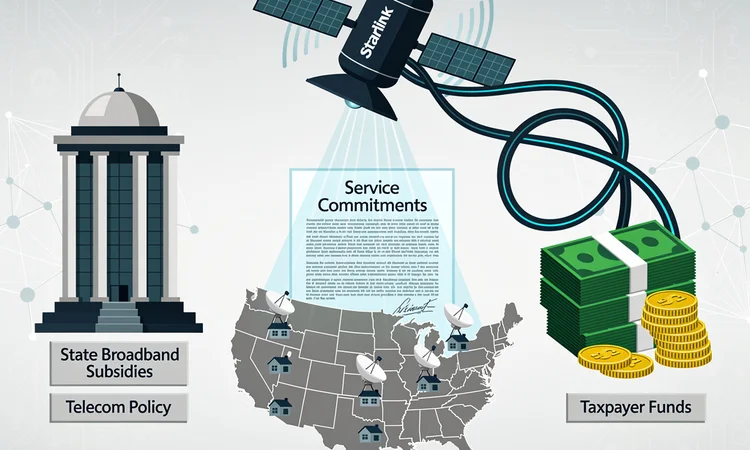
SpaceX’s Starlink satellite internet service has positioned itself as a revolutionary solution to America’s rural broadband crisis, promising high-speed connectivity to the most remote corners of the country. Yet a troubling pattern has emerged across multiple states: the company is demanding millions in public subsidies even in areas where residents show little interest in subscribing to its service, raising fundamental questions about how taxpayer dollars should fund telecommunications infrastructure.
According to Ars Technica , Starlink has been aggressively pursuing state broadband grants while simultaneously demonstrating an unwillingness to meet basic service adoption requirements that ensure public money actually benefits communities. In Maine, the company walked away from a $16.5 million grant after refusing to commit to achieving a 40% subscription rate among eligible households—a threshold designed to verify that residents actually want and will use the service being subsidized with their tax dollars.
The Maine situation represents just one flashpoint in a broader conflict between Starlink’s business model and traditional public interest requirements for telecommunications subsidies. State officials have long attached strings to broadband grants, requiring providers to demonstrate genuine community need and actual service adoption. These requirements exist for sound policy reasons: without them, companies could collect public funds for deploying infrastructure that sits largely unused, wasting taxpayer money while failing to solve connectivity problems.
The Federal Funding Controversy That Started It All
Starlink’s contentious relationship with broadband subsidies began at the federal level. The Federal Communications Commission initially awarded SpaceX $885.5 million through the Rural Digital Opportunity Fund (RDOF) in 2020, one of the largest allocations in the program. However, the FCC reversed that decision in 2022, rejecting Starlink’s application on the grounds that the company had failed to demonstrate it could deliver the promised service at the required speeds and that satellite technology was not the most cost-effective solution for many of the designated areas.
The FCC’s decision sparked intense debate within the telecommunications industry. Starlink supporters argued that the rejection represented regulatory bias against innovative satellite technology in favor of traditional fiber optic networks. Critics countered that the FCC was simply enforcing its own standards and protecting taxpayers from funding an unproven technology that might not deliver promised results. The controversy took on political dimensions, with some Republican lawmakers accusing the Biden administration of unfairly targeting Elon Musk’s company.
Following the federal setback, Starlink pivoted to pursuing state-level broadband grants, which often come with different requirements and less stringent oversight than federal programs. This strategy has met with mixed results. Some states, eager to address rural connectivity gaps and attracted by Starlink’s promise of rapid deployment without trenching fiber cables, have welcomed the company’s applications. Others have insisted on traditional accountability measures, leading to standoffs like the one in Maine.
The Subscription Rate Debate and Public Accountability
At the heart of the conflict lies a fundamental question: should companies receiving public subsidies be required to prove that people actually want their service? State broadband officials argue emphatically yes. The 40% subscription threshold that Maine attempted to impose on Starlink reflects a common-sense principle—if fewer than half of eligible households choose to subscribe even when service is available, it suggests either the service doesn’t meet community needs or the pricing remains prohibitively expensive despite public subsidization.
Starlink’s resistance to such requirements reveals tensions in its business model. The company argues that it should be paid simply for making service available, regardless of whether residents choose to subscribe. This “build it and they will come” approach shifts risk entirely onto taxpayers. If residents don’t subscribe, the public has funded infrastructure deployment that fails to achieve its core purpose of connecting unserved communities, while Starlink keeps the grant money.
Traditional telecommunications providers have long operated under different expectations. When phone companies and cable providers received universal service subsidies, they typically faced requirements to actually connect customers and maintain service, not merely make it theoretically available. The difference matters enormously for public accountability. A fiber network built with public funds that sits largely unused represents a waste of resources, but at least the infrastructure exists for potential future use. Starlink’s satellite capacity, by contrast, exists regardless of whether any particular community receives subsidies—the satellites serve global customers, making the case for location-specific subsidies more difficult to justify.
Economic Realities Behind Starlink’s Pricing Structure
The subscription rate issue connects directly to Starlink’s pricing, which remains substantially higher than many terrestrial broadband options. The service currently costs $120 per month for residential users, with an additional hardware fee of $599 for the satellite dish and equipment. For rural households, many of which have lower median incomes than urban areas, these costs represent a significant burden even when the service itself has been subsidized through public grants.
This pricing structure creates a paradox in Starlink’s subsidy strategy. The company seeks public money ostensibly to make broadband accessible to underserved rural communities, yet maintains premium pricing that many rural residents cannot afford. If subsidies are meant to bridge the digital divide, critics argue they should result in either lower consumer prices or guaranteed service adoption—otherwise, the public investment fails to achieve its social purpose.
Starlink defenders counter that the company’s costs remain high due to the enormous capital expenditure required to build and maintain a satellite constellation. SpaceX has launched thousands of satellites and continues deploying new ones regularly. The company argues its pricing reflects these real costs and that subsidies should help offset deployment expenses rather than force below-market consumer pricing. Yet this argument essentially asks taxpayers to subsidize a premium service that many cannot afford to use.
State-by-State Patchwork Creates Regulatory Confusion
The absence of consistent federal policy has created a confusing patchwork of state approaches to Starlink subsidies. Some states have embraced the company enthusiastically, viewing satellite technology as a quick fix for rural connectivity gaps. Others have maintained stringent requirements similar to Maine’s, insisting on accountability measures before releasing public funds. This inconsistency creates perverse incentives, encouraging Starlink to focus on states with lax oversight while avoiding those with stronger consumer protection requirements.
The situation also raises questions about interstate equity. Rural residents in states with weaker subsidy requirements might see Starlink receive public funding with minimal strings attached, while residents in states with stronger oversight might miss out on service entirely if Starlink refuses to participate. This patchwork approach undermines the goal of universal broadband access, turning it into a matter of geographic luck rather than systematic policy.
Federal regulators have largely stepped back from this arena following the RDOF controversy, leaving states to navigate these issues independently. The FCC’s current approach focuses on funding fiber deployment through newer programs like the Broadband Equity, Access, and Deployment (BEAD) Program, which generally prioritizes terrestrial networks over satellite solutions. This leaves satellite subsidies primarily to state discretion, with predictably inconsistent results.
The Broader Implications for Telecommunications Policy
Starlink’s subsidy disputes illuminate larger tensions in American telecommunications policy. For decades, the country has struggled to balance private sector innovation with public interest requirements in communications infrastructure. The traditional model involved regulated monopolies or near-monopolies accepting oversight and service obligations in exchange for exclusive service territories and guaranteed returns. That model has largely collapsed, replaced by a more competitive but less regulated environment.
Satellite broadband represents a particularly challenging case because it doesn’t fit neatly into existing regulatory frameworks. Unlike terrestrial networks that serve specific geographic areas, Starlink’s satellites serve global customers. This makes traditional concepts like service territories and local obligations difficult to apply. Yet without such obligations, the rationale for public subsidies becomes murky—why should taxpayers fund a global commercial network that would exist regardless of whether any particular community receives grants?
The answer likely requires new thinking about telecommunications subsidies in the satellite era. Rather than simply adapting frameworks designed for telephone networks and cable systems, policymakers may need entirely new approaches that account for satellite technology’s unique characteristics. This might include outcome-based funding tied to actual adoption rates, sliding-scale subsidies based on demonstrated community need, or hybrid models that combine public infrastructure investment with regulated pricing requirements.
What Rural Communities Actually Need
Lost in the policy debates and corporate positioning is a simple question: what do rural communities actually need and want? The answer varies considerably by location, income level, and existing infrastructure. Some truly remote areas with no realistic prospect of fiber deployment might benefit enormously from satellite service, even at premium prices. Other communities might be better served by investments in terrestrial networks that offer lower long-term costs and higher speeds.
The subscription rate requirements that Starlink resists actually serve as a useful proxy for community preference. If residents don’t subscribe when service becomes available, it signals either that the service doesn’t meet their needs or that pricing remains too high. Both scenarios suggest that public subsidies have failed their purpose. Conversely, high subscription rates indicate genuine community need and appropriate use of public funds. Starlink’s unwillingness to accept such accountability measures raises legitimate questions about whether its subsidy pursuit serves public interests or simply corporate revenue goals.
Moving forward, state and federal policymakers face difficult choices about how to allocate limited broadband funding. The digital divide remains real and urgent, with millions of Americans still lacking adequate internet access. Satellite technology like Starlink offers genuine advantages in some scenarios, particularly for extremely remote locations. However, blanket subsidies without accountability requirements risk wasting public resources while failing to ensure that rural residents actually gain affordable, usable connectivity. The Maine example suggests that at least some states are willing to insist on accountability, even if it means confronting one of the most high-profile companies in the technology sector. Whether this approach spreads or remains an exception will help determine whether America’s broadband subsidies ultimately serve public needs or private profits.






Leave a Reply
Your email address will not be published.