









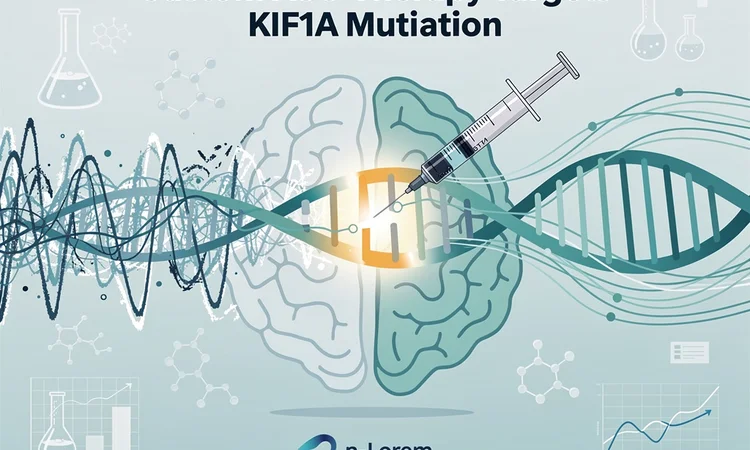
In the quiet intensity of a New York City apartment, an 11-year-old girl named Susannah Rosen has become a pioneer in the fight against one of medicine’s most elusive foes: KIF1A-Associated Neurological Disorder (KAND). Diagnosed at age 2½ in 2016 with a mutation in the KIF1A gene, Susannah faced a progressive neurodegenerative condition that robs patients of motor function, vision, cognition, and often life itself in early childhood for severe cases. A custom antisense oligonucleotide (ASO) therapy, delivered free of charge by the nonprofit n-Lorem Foundation, has delivered tangible relief after years of relentless decline, marking a milestone in personalized medicine for nano-rare diseases.
The KIF1A gene encodes a molecular motor protein essential for transporting cargo within neurons, crucial for brain function. Susannah’s “toxic gain of function” mutation produces a harmful protein that kills nerve cells throughout the brain and body, leading to symptoms including developmental delays affecting over 90% of patients, vision impairment in more than 80%, seizures in over 40%, unsteady gait, tremors, and gastrointestinal issues. Her parents, actor-writer Luke Rosen and Sally Jackson, noticed early red flags like Susannah’s inability to kick her legs in the bath and her army crawling while peers ran. Initially misdiagnosed as cerebral palsy—a fate for about one in four KIF1A cases—the family persisted until genetic confirmation.
A Desperate Quest for Families
Dr. Wendy Chung, Susannah’s physician and a CNBC Advisory Board member, urged the family to connect 100 patients to spur research, as none existed in 2016. Luke and Sally founded KIF1A.org , now linking over 700 families worldwide and revealing KAND’s underreported prevalence—potentially 1 to 30 patients per mutation, far from the ultra-rare label once assumed. “One of the things we realized about KIF1A is that it’s not nearly as rare as we might think it is,” Dr. Chung said in a taped interview with KIF1A.org. “We can see just over the past three years that we’ve been watching the numbers grow.” ( CNBC )
This network paved the way to n-Lorem, founded in 2020 by Dr. Stanley Crooke, founder of Ionis Pharmaceuticals and a pioneer in ASO technology. The nonprofit targets “nano-rare” diseases with fewer than 30 patients globally, designing bespoke ASOs—short synthetic strands of 18-20 genetic letters with a “ZIP code” to bind faulty RNA. In Susannah’s case, the drug skips the toxic mutation, enabling production of normal protein. Delivered via spinal tap, replacing cerebrospinal fluid, it bypasses the blood-brain barrier. Susannah, n-Lorem’s first treated patient, received doses for three years, with Dr. Crooke personally investing $10 million since launch.
Precision Medicine’s Spinal Delivery
“It’s genetic medicine,” Dr. Crooke explained. “So we take the genetic code directly and design a relatively small molecule… that will direct it to the RNA in the cell that we want it to bind to.” The foundation has accepted 200 of over 400 applicants, treating its 40th patient as of early 2026, at an average development cost of $1.2 million per therapy—provided free for life. Susannah’s mutation numbers in her spinal fluid grew over three years under monitoring by Dr. Chung, signaling the drug’s reach into her central nervous system. ( CNBC )
The breakthrough shone after her second dose. “One morning after she had received treatment, we were sitting at breakfast, and I was like, ‘Something is wrong,'” Luke recalled. “But it wasn’t. It was the fact that it was quiet and we were able to look at each other. Her tremor was gone. That’s not an FDA-approved outcome measure… but it is something that just means the world to us.” Behavioral shifts emerged, offering stolen moments of normalcy amid progression. Yet challenges persist: regressions signal the disease catching up, with parents lamenting a five-year delay. “We’re afraid the disease is catching up to the treatment… Our gal is a pioneer,” Luke said.
Tremors Vanish, But Battle Rages
n-Lorem’s model addresses a core pharma blind spot: diseases too small for profit-driven trials. “The FDA defines rare disease as a patient population of 200,000,” Dr. Crooke noted. “But we now know that there are many, many pathogenic mutations that produce disease in far fewer patients… And our focus is on these patients, because they have no hope.” With over 7,000 rare diseases—many neurological—affecting millions collectively, ASOs represent scalable hope, echoing successes like Spinraza for spinal muscular atrophy. ( Scientific American )
Recent advances amplify this momentum. In November 2025, Novartis secured FDA approval for Itvisma, a gene replacement therapy for spinal muscular atrophy patients over two years old with SMN1 mutations, expanding access for older children and adults previously limited to infant treatments like Zolgensma. “This is another welcome advancement… addressing the unmet needs that remain,” said a patient advocate. ( Novartis ) Similarly, Mass General Brigham reported six-year data showing 94% stabilization in cerebral adrenoleukodystrophy patients via gene therapy, with over 80% disability-free. ( Mass General Brigham )
Wider Ripples in Gene Therapy
Personalized ASOs build on precedents like milasen, a 2019 N-of-1 therapy for a unique CLN7 mutation, which stabilized seizures in a single patient. ( PMC ) n-Lorem’s pipeline, now at dozens of patients, proves feasibility for nano-rare cases, where isolation once reigned. KIF1A.org’s role underscores patient-led acceleration: from zero trials to bespoke drugs in a decade.
Susannah’s story highlights timing’s cruelty—earlier intervention could saturate more brain cells in younger patients. Future kids will benefit from her trailblazing, as n-Lorem refines protocols. For industry insiders, this signals a paradigm shift: nonprofits filling gaps, ASOs as off-the-shelf platforms for mutations, and family networks as research catalysts. The road remains arduous, but Susannah’s quiet breakfasts prove precision medicine’s power to reclaim fragments of life from genetic chaos.



Leave a Reply
Your email address will not be published.