






Small and medium-sized businesses confront heightened workplace injury risks, prompting the National Safety Council to release a targeted guide equipping owners with practical tech adoption strategies. Titled “A Small Business Guide to Safety Technology: Practical Strategies for Beginners, Growing Teams and First-Time Adopters,” the resource from NSC’s Work to Zero initiative outlines scalable frameworks amid rising incident rates.
“Small and medium-sized businesses are at an elevated risk for workplace injuries,” states Safety+Health Magazine . Authored by Kenna Stanley, senior research associate at NSC, the guide addresses barriers like limited budgets and expertise. “We know that small employers need support,” Stanley said. “We really wanted to get in there and arm them with the knowledge and the framework so that they can apply technologies in a really scalable, easy-to-understand way.”
The document structures adoption around a five-step innovation journey: assess risks, identify solutions like wearables and AI, gauge readiness, build business cases, and pilot implementations. Appendices offer worker survey questions, vendor evaluation checklists, and post-pilot feedback tools, emphasizing non-punitive tech use and worker engagement.
Risk Realities Hit Small Firms Hard
Recent data underscores urgency for SMBs. Pie Insurance’s 2025 State of Workplace Safety Report reveals 75% of small businesses—those with 500 or fewer employees—experienced injuries last year, with half deemed preventable, averaging four lost workdays per incident and potential savings up to $10,000 annually if mitigated, per Pie Insurance . “Many accidents are preventable, but only if employees understand that safety isn’t about checking boxes—it’s about protecting themselves and their coworkers,” said Carla Woodard, SVP of Claims at Pie Insurance.
Workplace injuries cost U.S. businesses $176.5 billion yearly, fueling AI’s preventive role where predictive analytics flags 75% of high-risk incidents, according to StartUs Insights . SMBs, often improvising due to equipment shortages, face amplified vulnerabilities in construction, manufacturing, and warehousing.
OSHA and NIOSH bolstered support with an updated Small Business Safety and Health Handbook, adding checklists for ergonomics, violence prevention, and heat illness alongside electrical and fall protections, available at Safety+Health Magazine .
Wearables Lead Charge in Real-Time Protection
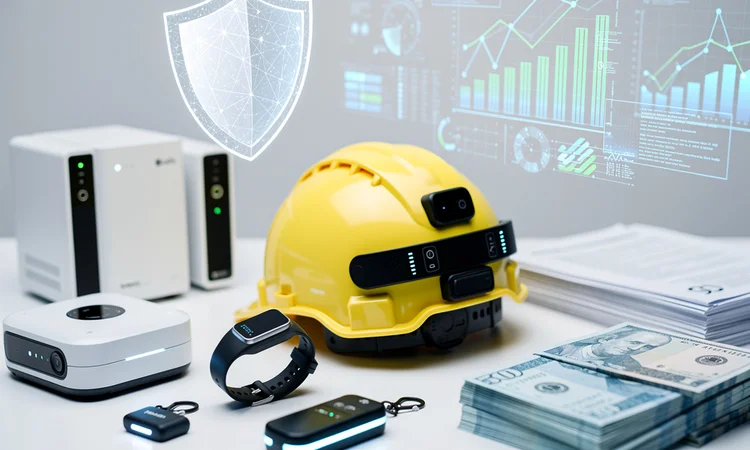
Wearables dominate emerging tools, monitoring vitals, fatigue, and environments to preempt hazards. Chubb highlights physiological trackers for stress, proximity detectors in hardhats to avert collisions, and exosuits reducing lift strains, enabling quicker injury returns, as detailed in Chubb .
“I think small businesses have an advantage in a couple ways,” Stanley noted. “First, with fewer decision-makers and bureaucracy, they can pivot and innovate more quickly and with less resistance. Leadership is naturally more visible in small companies, which makes it easier to form relationships, build trust and engage their workers in new initiatives.” Casual toolbox talks and surveys foster buy-in without formal overheads.
Smart PPE market growth to $8.23 billion by 2030 at 13.11% CAGR reflects adoption, with only 17-18% current use despite new hire risks—36% of injuries strike first-year employees, per StartUs Insights.
AI Predictive Power Targets Preventable Losses
AI integration flags violations via video analysis—used by 50% in EHS benchmarks—and powers 60% predictive analytics uptake. The AI safety market eyes $6.8 billion by 2030, per StartUs Insights. Computer vision pairs cameras with machine learning for incident root causes, as in EHSLeaders .
For SMBs, collaborative purchasing, tax credits, insurance rebates, and vendor financing slash costs, per the NSC guide. “Employee engagement doesn’t have to mean formal meetings or structured safety huddles – it can also happen during everyday conversations,” the guide advises, promoting ongoing feedback via quick check-ins.
Proximity systems like Litum’s real-time crane zones achieved 100% safety for a Fortune 500 steel firm, demonstrating scalability to smaller operations via X posts from industry watchers.
Overcoming Barriers with Pilots and Culture
Small firms leverage agility: visible leaders build trust faster. Designate a “digital champion” and ensure data privacy in vendor queries. Post-pilot worker questions gauge effectiveness: “Do you experience any discomfort, pain or strain during or after work?”
VR training cuts incidents 74% via simulations, while drones inspect hazards sans human exposure, per Chubb. Safety apps offer free noise and lifting guides, easing entry for resource-strapped SMBs.
“A lot of these frameworks and recommendations are really applicable to all organizations, so it’s a great resource,” Stanley added. “I think it’s great for any organization that’s interested in trying a new technology but maybe doesn’t know where to start or how to actually implement it.”
Financial Incentives Drive Adoption Surge
Grants and networks enable pilots without strain. Pie data shows commercial vehicle crashes cost $5,725 each, with 42% of fleets hit yearly—tech averts such hits. Mental health links amplify risks, with stress tied to accidents, urging holistic approaches.
Exoskeletons combat musculoskeletal disorders, 543,000 UK cases in 2023/24 costing 7.8 million days, mirroring U.S. trends. AI fatigue detection in wearables like Modjoul SmartBelt prevents overexertion.
2026 trends emphasize EHS platforms with IoT for compliance, projecting 10% market cap gains for top performers, per StartUs Insights.
Forward Path: Pilots to Proactive Defense
NSC’s guide, downloadable via Work to Zero, empowers SMBs to assess: “Are there any areas in the workplace where you feel unsafe or uneasy?” Transparency avoids punitive perceptions, building innovation cultures.
As 75% of SMBs report incidents, tech shifts reactive to predictive paradigms. “Workplace safety isn’t just about preventing physical injuries—it’s essential to both employee well-being and a business’s long-term success,” Woodard emphasized. Early adopters secure edges in retention, costs, and compliance.






Leave a Reply
Your email address will not be published.