







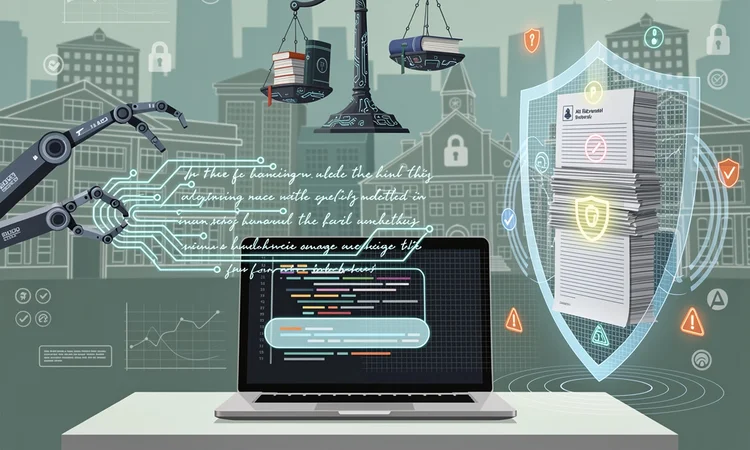
A technological cat-and-mouse game is unfolding across American college campuses, where students are deploying increasingly sophisticated artificial intelligence tools not just to write their assignments, but to disguise that AI assistance from detection software. The emergence of so-called “humanizer” programs—applications designed to rewrite AI-generated text to appear human-authored—represents a new frontier in academic integrity challenges that is leaving educators scrambling for solutions.
According to NBC News , students are now routinely using a two-step process: first generating essays and assignments with ChatGPT or similar large language models, then running that content through humanizer tools like Undetectable AI, StealthWriter, or HIX Bypass to evade detection software such as Turnitin and GPTZero. This systematic approach to academic dishonesty has become so prevalent that some students openly discuss strategies on social media platforms and online forums, treating it as a standard part of their academic toolkit rather than an ethical violation.
The phenomenon reveals a fundamental shift in how students perceive artificial intelligence in education. Rather than viewing AI assistance as cheating, many students consider it a legitimate resource—comparable to using a calculator in mathematics or a spell-checker in writing. This generational divide in attitudes toward AI is creating unprecedented challenges for institutions that must balance technological innovation with academic integrity standards developed in a pre-AI era.
The Technology Behind the Deception
Humanizer tools operate on a deceptively simple principle: they analyze AI-generated text and rewrite it to incorporate characteristics typical of human writing, such as varied sentence structure, occasional grammatical imperfections, and less predictable word choices. These applications use their own AI models trained specifically to identify and modify the telltale patterns that AI detection software looks for, including uniform sentence length, repetitive phrasing, and statistically predictable word sequences.
The effectiveness of these tools has improved dramatically in recent months. Early versions produced awkward, obviously manipulated text, but current iterations can generate prose that not only passes detection software but often reads more naturally than the original AI output. Some premium humanizer services even offer multiple “humanization” levels, allowing users to balance between readability and undetectability based on their specific needs.
Detection Software Struggles to Keep Pace
The companies behind AI detection tools acknowledge they are fighting an uphill battle. Turnitin, which serves more than 16,000 educational institutions globally, has invested heavily in developing AI detection capabilities, but the company admits that humanizer tools present a significant challenge to their technology. The fundamental problem is that detection software relies on identifying statistical patterns, while humanizers are specifically designed to disrupt those same patterns.
GPTZero, another popular detection tool, has reported that its accuracy rates drop significantly when analyzing text that has been processed through humanizer applications. The company’s founder has stated publicly that the detection arms race may be unwinnable using current technological approaches, suggesting that educational institutions need to rethink their entire approach to assignments and assessment rather than relying solely on detection software.
This technological limitation has profound implications for academic integrity enforcement. When detection tools cannot reliably distinguish between human and AI-generated work, institutions lose their primary mechanism for identifying violations. Some universities have responded by abandoning detection software entirely, acknowledging that false positives and false negatives have made these tools more problematic than helpful.
The Economics of Academic Dishonesty
The humanizer tool market has become a lucrative industry, with some services charging monthly subscription fees ranging from $10 to $50 for unlimited use. Free versions with limited capabilities are also widely available, lowering the barrier to entry for students who might not otherwise invest in such tools. This accessibility has democratized what was once a more exclusive form of academic dishonesty, making it available to students regardless of financial resources.
Marketing for these services often employs euphemistic language, positioning the tools as aids for “improving writing” or “avoiding false AI detection” rather than explicitly promoting academic dishonesty. Some companies claim their products serve legitimate purposes, such as helping non-native English speakers refine AI-assisted translations or allowing professionals to use AI tools without triggering corporate content filters. However, student testimonials and usage patterns suggest that academic applications dominate their customer base.
Institutional Responses and Policy Challenges
Universities are responding to this challenge with widely varying strategies, reflecting uncertainty about the most effective approach. Some institutions have implemented strict AI bans, threatening severe penalties for any detected use of artificial intelligence in coursework. Others have taken the opposite approach, explicitly permitting AI use while requiring students to document and cite their AI assistance, treating it similarly to other research tools.
A growing number of educators are redesigning assessments to minimize opportunities for AI misuse. This includes shifting toward in-class writing assignments, oral examinations, and project-based assessments that require demonstrated understanding rather than polished written products. Some professors now require students to submit their work in stages, including outlines, drafts, and revision histories, making it more difficult to simply generate and submit AI-created content.
However, these adaptations come with significant costs. In-class assessments require more faculty time and classroom resources, while process-based assignments demand substantially more grading effort. For large lecture courses or institutions with limited resources, such approaches may not be practically feasible, leaving these schools particularly vulnerable to AI-assisted academic dishonesty.
The Student Perspective and Rationalization
Student attitudes toward AI use reveal a complex mixture of pragmatism, ethical reasoning, and rationalization. Many students argue that AI tools are inevitable features of their future professional environments, making learning to use them effectively more valuable than traditional writing skills. Others point to the enormous workload demands of modern college curricula, suggesting that AI assistance is necessary to manage competing obligations from multiple courses, part-time employment, and extracurricular activities.
Some students draw distinctions between different types of AI use, viewing it as acceptable for brainstorming, outlining, or editing but inappropriate for generating entire assignments. However, these personal ethical boundaries vary widely and often conflict with institutional policies. The lack of consistent standards across courses and institutions further contributes to student confusion about what constitutes acceptable AI use.
The Broader Implications for Higher Education
The humanizer tool phenomenon forces fundamental questions about the purpose and methods of higher education. If AI can generate competent written work and other tools can make that work undetectable, what value do traditional writing assignments retain? Some educators argue this moment requires reimagining assessment entirely, focusing on skills that AI cannot easily replicate, such as critical thinking, creative problem-solving, and interpersonal communication.
The challenge extends beyond individual courses to institutional accreditation and degree value. If employers and graduate schools cannot trust that degree holders actually possess the skills their transcripts suggest, the credential value of higher education erodes. This concern is particularly acute in fields like writing, research, and analysis, where AI capabilities most directly overlap with learning objectives.
Legal and regulatory frameworks are struggling to keep pace with these technological developments. Current academic integrity policies at most institutions were written before generative AI existed and often fail to address the specific scenarios that humanizer tools create. Updating these policies requires careful consideration of enforceability, fairness, and alignment with educational goals—a process that many institutions are still navigating.
Looking Ahead: Adaptation or Obsolescence
The trajectory of this technological arms race remains uncertain. Some experts predict that detection technology will eventually catch up, developing new methods that can identify humanized AI text. Others believe that the cat-and-mouse game will continue indefinitely, with each advance in detection met by corresponding improvements in evasion. A third possibility is that the distinction between human and AI writing will become so blurred that detection becomes meaningless.
What seems clear is that higher education cannot simply wait for technological solutions to resolve these challenges. The widespread availability and use of humanizer tools represents a fundamental shift in the academic integrity environment, requiring institutions to rethink not just their detection methods but their entire approach to teaching, learning, and assessment. Those that adapt successfully may emerge stronger, with more meaningful and effective educational practices. Those that cling to outdated assessment methods risk becoming increasingly irrelevant in an AI-saturated world.
The humanizer tool phenomenon ultimately reflects broader societal questions about artificial intelligence, authenticity, and the value of human effort in an age of increasingly capable machines. How higher education navigates these challenges will likely influence not just academic integrity but the role and relevance of universities in the twenty-first century.






Leave a Reply
Your email address will not be published.