




In the austere corridors of Silicon Valley’s post-pandemic reality, a new calculus is being written, one where the traditional metrics of corporate health—revenue growth and user engagement—are no longer sufficient to protect rank-and-file employees. Pinterest, the visual discovery engine that once positioned itself as the “nicest” corner of the internet, has become the latest bellwether for a harsh industry transition. The company recently executed a targeted reduction of its workforce, a move that insiders suggest is not merely a reaction to economic headwinds, but a proactive restructuring designed to replace human operational roles with automated systems. According to a report by Mashable , these cuts are explicitly tied to the integration of artificial intelligence, signaling a departure from the high-touch, human-centric growth models that defined the social media era of the 2010s.
This development marks a significant inflection point for the San Francisco-based firm, which has historically relied on a robust headcount to manage its complex relationships with advertisers and creators. The layoffs, which affected approximately 150 employees, or less than 5% of the total workforce, might appear statistically minor compared to the massive reductions seen at Meta or Google. However, the qualitative nature of these cuts tells a far more significant story for industry observers. Rather than trimming fat from bloated experimental divisions, Pinterest is streamlining core business functions that can now be managed by algorithmic logic. As noted in coverage by Bloomberg , the reduction aligns with a broader push for efficiency that has seen technology executives rewarded by Wall Street for decoupling revenue growth from headcount expansion.
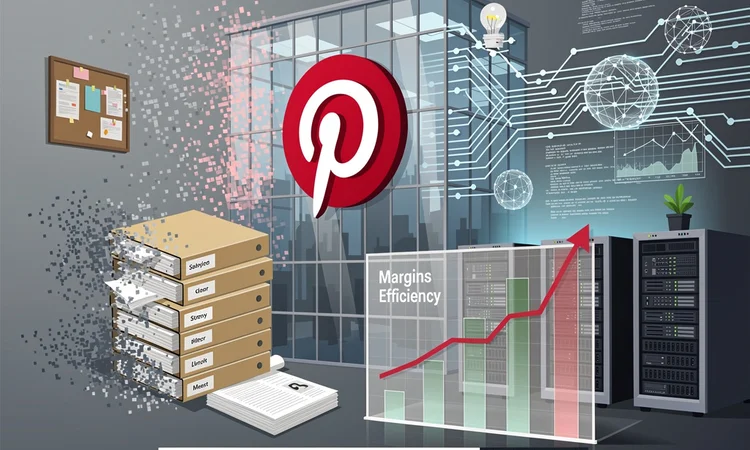
The Strategic Realignment at Pinterest Reflects a Broader Industry Consensus That the Next Phase of Margin Expansion Will Be Driven by Replacing Human Capital with Generative Technologies Rather Than Simply Scaling Output.
The mechanics of this shift are rooted in the evolving nature of digital advertising. For years, platforms like Pinterest required substantial sales and creative teams to help brands navigate their ecosystems. However, the introduction of sophisticated AI tools has automated much of this friction. Pinterest’s CEO, Bill Ready, who took the helm in 2022 with a mandate to monetize the platform’s massive intent data, has aggressively pushed for “shoppable” content. This strategy relies heavily on machine learning to match user intent with products, bypassing the need for manual curation or bespoke ad sales support. As detailed by CNBC , while the company’s revenue has continued to grow, the pressure to improve operating margins has forced leadership to scrutinize every role that does not directly contribute to engineering the underlying AI architecture.
This transition is not unique to Pinterest, but the company’s specific demographic and utility make it a fascinating case study. Unlike TikTok, which relies on algorithmic entertainment, or Meta, which relies on social graphs, Pinterest is an engine of future intent—users go there to plan weddings, renovations, and meals. Historically, interpreting this intent required a nuanced human touch. The recent cuts suggest that leadership believes their proprietary AI models have matured to a point where they can understand the semantic and visual context of a “bohemian living room” better, and more cheaply, than human teams. A report from TechCrunch highlights that this restructuring is aimed at removing layers of management and reorganizing teams to speed up the delivery of these new automated products to market.
While Wall Street Has Reacted Favorably to the Promise of Lower Overheads and Higher Margins, the Internal Cultural Cost of Transitioning to an AI-First Organization Creating a Rift Between Leadership and the Workforce.
The morale implications of these “AI-driven” layoffs are profound. For years, tech workers operated under the assumption that if their product was successful and profitable, their jobs were secure. Pinterest’s move shatters that social contract. It introduces a paradigm where an employee’s primary competitor is not a rival firm, but the very software they helped train. Industry analysts point out that this creates a precarious environment for the remaining staff. The drive for efficiency is relentless; as AI agents become capable of handling more complex tasks—from coding assistance to customer support and ad creative generation—the threshold for human necessity rises. The Verge notes that this wave of cuts specifically impacted the lower rungs of the corporate ladder, but the precedent it sets threatens middle management and creative roles that were previously considered safe from automation.
Furthermore, the timing of these cuts coincides with a record-breaking period for the tech sector’s financial performance, creating a dissonance that is difficult to reconcile for labor advocates. Pinterest is not a company in distress; it is a company optimizing for a future where headcount is a liability rather than an asset. This philosophy is trickling down from the hyperscalers. When Mark Zuckerberg declared the “Year of Efficiency,” he signaled to the market that the era of excess was over. Pinterest, often seen as a follower in terms of aggressive corporate tactics, is now lock-step with this philosophy. Observations from Business Insider suggest that investors are explicitly asking management teams during earnings calls how they plan to leverage AI to reduce operating expenses, effectively mandating these types of workforce reductions.
The Evolution of Pinterest’s Advertising Technology Stack Demonstrates How Machine Learning Has Moved From a Feature for User Retention to the Central Engine of Corporate Profitability and Labor Reduction.
Deep within Pinterest’s engineering blogs and quarterly reports lies the technical justification for these moves. The company has invested heavily in computer vision and generative AI to power features like “Shop the Look” and “Collages.” These tools automatically identify products within user-generated images and link them to retailers. Previously, partnerships teams would work manually to onboard merchants and tag catalogs. Now, ingestion and classification are largely automated. The efficiency gains are undeniable: the software works 24/7, scales infinitely, and doesn’t require health insurance. However, the “human in the loop” was often the quality control mechanism that prevented the platform from becoming a spam-filled wasteland. By removing these human guardrails in favor of AI, Pinterest is betting that its algorithms are sophisticated enough to maintain trust. Reuters indicates that while ad revenue is up, the risk of degrading the user experience remains a critical concern for long-term retention.
The shift also impacts the creative side of the advertising equation. Pinterest has launched tools that allow advertisers to use AI to generate background images and variations of ad copy. This democratization of creative assets reduces the need for advertisers to hire agencies, but it also reduces Pinterest’s need for internal creative strategists who used to guide big brands on best practices. The platform is becoming a self-serve utility powered by black-box algorithms. This transition mirrors the broader programmatic advertising world, but applying it to a platform rooted in inspiration and aesthetics is a gamble. If the AI generates uncanny or irrelevant content, the “magic” of Pinterest—the very thing that differentiates it from Google Images—could erode.
As the Dust Settles on This Latest Round of Cuts, the Tech Industry Is Watching Closely to See If Pinterest Can Maintain Its soulful Brand Identity While Ruthlessly Automating Its Operations.
The ultimate test for Pinterest will be whether it can retain its unique culture—both for users and the remaining employees—while operating with the cold efficiency of a purely data-driven entity. The “Pinners” who use the app do so for a sense of curated discovery, a feeling that has always felt distinctively human. If the operational cuts lead to a degradation in the quality of support, community management, or content moderation, the short-term margin gains could result in long-term user churn. Moreover, the remaining workforce is now tasked with doing more with less, utilizing the very tools that displaced their colleagues. This dynamic creates a workforce that is arguably more productive but significantly less loyal. The Wall Street Journal has previously reported on the delicate balance Pinterest must strike between satisfying aggressive investor demands for profitability and maintaining the growth trajectory that justifies its valuation.
In the final analysis, Pinterest’s restructuring is a microcosm of the Silicon Valley condition in 2024. The promise of AI is no longer abstract; it is a line item on a balance sheet that is actively deleting salaries to improve earnings per share. For the industry insiders watching this unfold, the lesson is stark: competence is no longer the primary currency of employment. In an environment where an algorithm can predict, create, and sell with increasing accuracy, the human role is being rewritten in real-time. Pinterest has made its choice, betting the company’s future on the belief that code is more valuable than the people who once wrote it.






Leave a Reply
Your email address will not be published.