









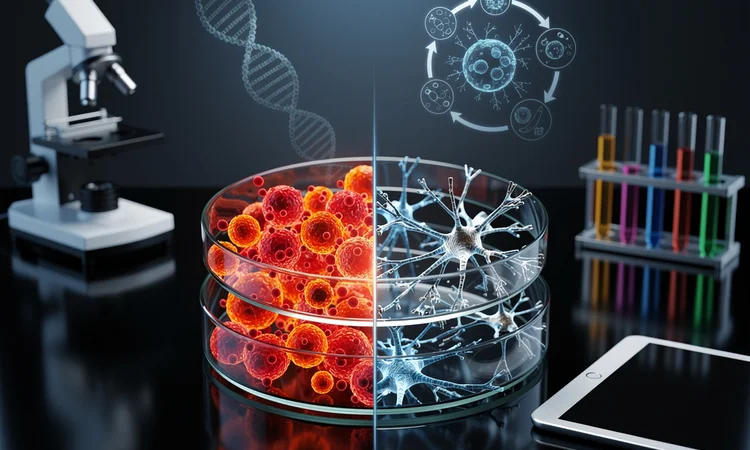
A startling inverse relationship between cancer and Alzheimer’s disease has emerged from decades of epidemiological research, suggesting that the biological mechanisms protecting against one condition may increase susceptibility to the other. This paradox, long observed but poorly understood, is now driving a new wave of scientific investigation that could fundamentally reshape our understanding of aging, cellular regulation, and neurodegenerative disease.
According to Slashdot , recent research has reignited interest in this phenomenon, with scientists examining the cellular and molecular pathways that appear to create this protective effect. The relationship is not merely correlational but suggests fundamental biological trade-offs in how our bodies manage cell growth, death, and protein regulation as we age.
The observation that cancer patients show reduced rates of Alzheimer’s disease, and vice versa, has been documented across multiple large-scale population studies spanning continents and decades. This inverse correlation persists even after accounting for competing mortality risks, suggesting a genuine biological relationship rather than statistical artifact. Researchers estimate that cancer survivors may have up to 35% lower risk of developing Alzheimer’s compared to the general population, while Alzheimer’s patients show similarly reduced cancer incidence.
Cellular Mechanisms at the Heart of the Paradox
The biological explanation for this inverse relationship centers on fundamental differences in cellular behavior. Cancer represents uncontrolled cell proliferation, where cells divide rapidly and refuse to die through normal apoptotic processes. Alzheimer’s disease, conversely, involves excessive cell death and the failure of neurons to maintain themselves, accompanied by the accumulation of toxic protein aggregates including beta-amyloid plaques and tau tangles.
The protein p53, often called the “guardian of the genome,” plays a central role in this biological seesaw. This tumor suppressor protein triggers cell death when DNA damage is detected, preventing potentially cancerous cells from proliferating. However, increased p53 activity, while protective against cancer, may contribute to excessive neuronal death and reduced cellular resilience in the aging brain. Conversely, reduced p53 function increases cancer risk but may allow neurons to survive longer despite accumulating damage.
PIN1, a protein involved in regulating cell division and protein folding, represents another key player in this paradox. Overexpression of PIN1 is associated with certain cancers, as it promotes cell cycle progression. However, PIN1 also helps prevent the formation of tau tangles in the brain. Loss of PIN1 function increases Alzheimer’s risk while potentially reducing cancer susceptibility, creating another axis of biological trade-off.
The Wnt Signaling Pathway and Dual Disease Protection
The Wnt signaling pathway, crucial for cell proliferation and stem cell maintenance, exemplifies the complexity of this relationship. Overactive Wnt signaling can promote tumor growth in various cancers, particularly colorectal cancer. However, this same pathway is essential for neuronal survival, synaptic plasticity, and clearing beta-amyloid from the brain. Reduced Wnt signaling in the aging brain contributes to neurodegeneration, while its activation might simultaneously increase cancer risk elsewhere in the body.
Research into shared genetic factors has revealed specific gene variants that influence risk for both conditions in opposite directions. Variations in genes controlling inflammation, cellular stress responses, and protein degradation pathways show this bidirectional effect. The apolipoprotein E (APOE) gene, particularly the APOE4 variant, increases Alzheimer’s risk substantially but shows complex relationships with various cancer types, with some studies suggesting reduced cancer mortality among APOE4 carriers.
Inflammation presents another dimension of this paradox. Chronic inflammation is recognized as a promoter of both cancer development and neurodegeneration. However, the type, location, and timing of inflammatory responses appear to create different outcomes. The inflammatory environment that might suppress tumor growth in peripheral tissues could prove neurotoxic in the brain, while anti-inflammatory approaches that protect neurons might inadvertently reduce immune surveillance against cancer.
Metabolic Reprogramming and Disease Susceptibility
Metabolic differences between cancer cells and neurons provide additional insight into this inverse relationship. Cancer cells typically rely on aerobic glycolysis, the Warburg effect, metabolizing glucose inefficiently but rapidly to fuel growth. Neurons, among the most metabolically active cells in the body, depend on efficient oxidative phosphorylation and are exquisitely sensitive to metabolic dysfunction. Metabolic shifts that favor one cellular strategy may disadvantage the other.
The role of cellular senescence—the state where cells stop dividing but don’t die—adds another layer of complexity. Senescent cells accumulate with aging and secrete inflammatory factors that contribute to tissue dysfunction. While senescence serves as a crucial tumor suppression mechanism, preventing damaged cells from becoming cancerous, the accumulation of senescent cells in the brain may contribute to neuroinflammation and Alzheimer’s pathology. Clearing senescent cells through senolytic drugs shows promise in animal models of neurodegeneration but raises concerns about cancer risk.
Autophagy, the cellular recycling process that degrades and recycles damaged proteins and organelles, represents yet another shared pathway with opposing effects. Efficient autophagy helps prevent cancer by eliminating damaged cellular components that could lead to malignant transformation. However, established tumors often hijack autophagy to survive under stress. In the brain, impaired autophagy contributes to the accumulation of toxic proteins characteristic of Alzheimer’s disease, suggesting that enhancing this process could be neuroprotective.
Implications for Drug Development and Treatment Strategies
This biological paradox presents profound challenges for drug development. Medications that activate pathways protective against one disease may inadvertently increase risk for the other. Several cancer drugs, particularly those targeting cell cycle regulation and apoptosis, have shown unexpected effects on neurodegeneration in preclinical studies. Some chemotherapy agents that force cancer cells into apoptosis might theoretically reduce Alzheimer’s risk, though their neurotoxic effects complicate this picture.
Conversely, drugs developed to treat Alzheimer’s by promoting neuronal survival and reducing cell death could theoretically increase cancer risk by allowing damaged cells to persist. This concern has shadowed development of anti-apoptotic therapies and drugs targeting p53 pathways. The challenge for pharmaceutical companies lies in identifying therapeutic windows where benefits for one condition don’t create unacceptable risks for the other.
Epidemiological studies of cancer survivors taking specific medications have provided natural experiments in this regard. Some research suggests that certain cancer treatments, particularly those affecting inflammatory pathways, may influence subsequent Alzheimer’s risk. However, the complexity of cancer treatment regimens, survival bias, and competing health risks make these relationships difficult to isolate and interpret definitively.
Age-Specific Considerations and Personalized Medicine
The inverse cancer-Alzheimer’s relationship varies with age, suggesting that the optimal balance between proliferation and cell death shifts across the lifespan. In younger individuals, robust tumor suppression mechanisms are crucial for preventing cancer during decades of potential exposure to carcinogens and accumulated mutations. In older age, when cancer risk remains high but neurodegeneration emerges as a major threat, the optimal balance may shift toward preserving neuronal function even at some theoretical cost to cancer surveillance.
This age-dependent dynamic suggests that personalized medicine approaches should account for individual risk profiles. Someone with strong family history of early-onset Alzheimer’s might benefit from interventions that prioritize neuroprotection, accepting potentially increased cancer screening needs. Conversely, individuals with high genetic cancer risk might prioritize tumor suppression, with careful monitoring for cognitive changes.
Biomarkers that predict individual positioning along the cancer-neurodegeneration spectrum could enable more precise interventions. Measuring levels of key proteins like p53, PIN1, and markers of Wnt pathway activity might help stratify patients and guide treatment decisions. Genetic profiling for variants affecting both conditions could further refine risk assessment and therapeutic targeting.
Environmental and Lifestyle Factors Influencing Both Conditions
Environmental and lifestyle factors that influence both cancer and Alzheimer’s risk add further complexity to this relationship. Exercise, widely recognized as protective against both conditions, may work through shared mechanisms including improved insulin sensitivity, reduced inflammation, and enhanced cellular stress resistance. However, the specific types and intensities of exercise that optimize protection against each condition may differ.
Dietary factors show similarly complex relationships. Caloric restriction and intermittent fasting, which activate cellular stress resistance pathways and autophagy, show promise against both cancer and neurodegeneration in animal models. However, the optimal dietary approaches may differ, with some evidence suggesting that ketogenic diets particularly benefit brain health while their effects on cancer risk remain debated. Specific nutrients and bioactive compounds may show divergent effects on the two conditions.
The future of research in this area lies in understanding these biological trade-offs well enough to identify interventions that provide protection against both conditions simultaneously, or at least minimize increased risk for one while treating the other. Some promising candidates include compounds that modulate inflammation in tissue-specific ways, drugs that enhance protein quality control without broadly suppressing apoptosis, and interventions that optimize metabolic flexibility across different tissue types. As our understanding of the molecular mechanisms underlying this paradox deepens, the goal is not to choose between cancer prevention and Alzheimer’s protection, but to find ways to achieve both.






Leave a Reply
Your email address will not be published.