









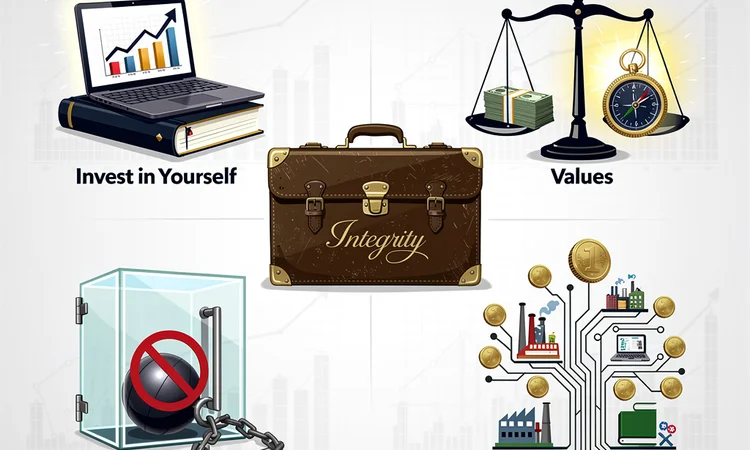
OMAHA, Neb. — For decades, investors and executives have made the pilgrimage to this Midwestern city, seeking an audience with Warren Buffett to unravel the intricate financial models and prescient market calls that built the colossus of Berkshire Hathaway. They come for the secret to picking stocks, yet often leave with something far more fundamental: a blueprint for life. While Wall Street obsesses over his portfolio, the enduring and arguably more valuable Buffett legacy may be his rigorously consistent and deceptively simple operating system for personal conduct, a philosophy that treats character, discipline, and relationships as assets with the highest compound interest of all.
This personal doctrine, articulated over countless interviews, shareholder meetings, and letters, stands in stark contrast to the debt-fueled, short-term-oriented mindset prevalent in many corners of the financial world. It is a system built not on complex algorithms but on timeless principles of prudence and integrity. While his financial acumen is legendary, it is this underlying framework that has guided his decisions, insulated him from catastrophic errors, and ultimately defined his unique version of success, a metric that has little to do with the fluctuating value of his stock holdings.
The principles are not secrets shrouded in corporate mystique but are openly shared, often with a grandfatherly candor. They cover the avoidance of personal debt, the critical importance of self-investment, the non-negotiable value of integrity, and a radical approach to inheritance. For industry insiders accustomed to high-stakes leverage and complex financial instruments, Buffett’s life advice serves as a powerful reminder that the most significant risks and rewards are often found far from the trading floor, within the daily decisions that shape one’s character and destiny.
The Cardinal Sin of Personal Leverage
At the very foundation of the Buffett protocol is a profound aversion to debt. He has repeatedly warned that it is one of the easiest ways for smart people to go broke. In a resurfaced interview that continues to capture attention, he was unequivocal about the dangers of credit cards, calling them a trap that encourages people to pay exorbitant interest rates. As detailed by Business Insider , Buffett recounted a friend whose daughter was struggling with credit card debt, a situation he found baffling when government bonds were yielding a fraction of the interest she was paying. His advice was simple and direct: pay it off immediately.
This isn’t merely folksy wisdom; it is the micro-level application of the same principle that has guided Berkshire Hathaway’s corporate strategy for half a century. Buffett has always prioritized maintaining a fortress-like balance sheet, flush with cash and free from the constraints of significant leverage. This financial discipline allows him to act decisively during market panics, acquiring assets at distressed prices while competitors are forced into retreat. By treating personal debt with the same seriousness as corporate leverage, he argues individuals can achieve a similar form of financial sovereignty.
His warning extends beyond financial ruin to the psychological burden debt creates. “If you’re smart, you’re going to make a lot of money without borrowing,” he has often said. For him, leverage is a gamble on the future that is simply unnecessary, an attempt to get rich faster that dramatically increases the odds of ending up with nothing. It’s a lesson in patience and risk management that is as applicable to a household budget as it is to a multi-billion-dollar acquisition.
Investing in the Asset That Can’t Be Taxed or Stolen
If avoiding debt is Buffett’s primary defensive strategy, his core offensive move is relentless self-investment. He believes the single most valuable asset any individual possesses is their own earning power, and the best way to enhance it is by improving one’s skills. Specifically, he has championed the power of communication, both written and oral. He frequently tells the story of his own terror of public speaking as a young man, a fear so paralyzing he would actively avoid courses that required presentations.
Recognizing this as a critical deficiency, he enrolled in a Dale Carnegie public speaking course, a $100 investment he considers the most important of his life. As Fortune magazine has highlighted, the diploma from that course is the only one he displays in his office, valuing it more than his degrees from the University of Nebraska or Columbia Business School. He estimates that honing this one skill immediately raised his intrinsic value by 50%, an astonishing return on investment that continues to compound.
This focus on communication is evident in the clarity and wit of his annual shareholder letters, which have become must-read texts on business and investing. They are masterclasses in taking complex subjects and making them understandable, building trust and loyalty among his shareholders. His advice to students is therefore not to master arcane financial modeling, but to learn to write and speak with clarity and conviction. It is a skill, he insists, that cannot be inflated away, taxed, or stolen, and will pay dividends for a lifetime.
The Three-Legged Stool of Human Capital
When it comes to evaluating people—whether as potential hires, business partners, or managers of Berkshire’s subsidiaries—Buffett employs a simple but unforgiving filter. He looks for three qualities: integrity, intelligence, and energy. He is quick to add a crucial caveat: if they don’t have the first, the other two will kill you. A smart and energetic person without integrity will simply use their talents to cheat and exploit you more effectively.
This principle explains the remarkable autonomy granted to the CEOs of Berkshire’s vast and diverse collection of companies. Buffett and his late partner Charlie Munger built their empire by acquiring well-run businesses and then trusting the existing management to continue their work without interference from Omaha. This hands-off approach is only possible because they first conduct a rigorous assessment of character. They are not buying a company; they are partnering with the people who run it.
This “integrity-first” approach is a direct challenge to the “move fast and break things” ethos that has defined other corners of the business world. For Buffett, reputation is a priceless asset, one that takes a lifetime to build and can be destroyed in minutes. By making integrity the non-negotiable entry ticket to the Berkshire ecosystem, he has built a culture of trust that serves as a powerful competitive advantage, fostering long-term thinking and ethical behavior in an era often defined by its absence.
Crafting an Inheritance of Purpose, Not Idleness
Perhaps nowhere is Buffett’s philosophy more counter-cultural than in his approach to wealth and family. He has famously stated his intention to leave his children “enough money so that they would feel they could do anything, but not so much that they could do nothing.” This statement encapsulates his belief that dynastic wealth is often a corrosive force, robbing future generations of ambition and purpose. He has called the idea of passing on a “food stamp for life” to one’s children a mistake that is both anti-social and anti-meritocratic.
Instead of creating a dynasty, Buffett has pledged to give away more than 99% of his fortune to philanthropy. He was a co-founder of The Giving Pledge , a campaign to encourage the world’s wealthiest individuals to dedicate the majority of their wealth to charitable causes. His own pledge directs the bulk of his Berkshire Hathaway stock to the Bill & Melinda Gates Foundation, among other family foundations. This decision is not an afterthought but a core part of his life’s plan, re-framing immense wealth as a tool for societal benefit rather than a means of familial privilege.
His children, now adults with their own successful careers and philanthropic endeavors, have embraced this philosophy. They have been given the resources to pursue their passions but were never handed the keys to the Berkshire kingdom. Buffett’s approach is a masterclass in separating financial success from personal identity, teaching his children that their value is defined by their own contributions to the world, not by the size of their trust fund.
The Competitive Advantage of Intellectual Honesty
In a corporate culture that often rewards unwavering confidence and penalizes admissions of error, Buffett has made a habit of publicly dissecting his own mistakes. He famously called his 1993 purchase of Dexter Shoe Company his worst deal ever, a mistake made even more painful because he used Berkshire stock for the acquisition. As CNBC has noted, he calculated that the blunder ultimately cost his shareholders billions of dollars. He has been similarly candid about his initial failure to appreciate the business models of companies like Google and his premature selling of other stocks.
This radical transparency is not an act of self-flagellation but a strategic tool for learning. By openly admitting his errors, he creates a culture where intellectual honesty is prized over ego. It allows him and his team to learn from the past and avoid repeating the same mistakes. This practice is a cornerstone of the rational, evidence-based approach that is the hallmark of his investment style. It inoculates him against the confirmation bias and hubris that have brought down so many other celebrated investors.
This willingness to own his blunders also builds immense credibility with his shareholders. They know he will be as forthright about the company’s failures as he is about its successes. In his most recent shareholder meeting, he continued this tradition, discussing the evolving economic environment and the challenges facing Berkshire, a testament to his consistent philosophy as reported by Yahoo Finance . For Buffett, acknowledging a mistake is not a sign of weakness; it is a prerequisite for growth and the ultimate proof of a rational mind at work.
The Final Tally: A Balance Sheet of Love
After a lifetime spent analyzing balance sheets and calculating intrinsic value, Warren Buffett’s ultimate measure of a successful life has nothing to do with numbers. When asked how he defines success, his answer is both simple and profound. As quoted in Forbes , he has said that when you get to his age, “you will measure your success in life by how many of the people you want to have love you actually do love you.”
This is the final, and most important, piece of the Buffett protocol. The discipline, the integrity, the learning—they are not just means to financial ends. They are the building blocks of a life rich in the things that money cannot buy: authentic relationships, respect, and love. His own life is a testament to this belief. Despite his extraordinary wealth, he lives a famously modest life in the same Omaha home he bought in 1958, deriving his greatest pleasure not from his possessions but from his work, his family, and his friendships.
Ultimately, the complete picture of Warren Buffett reveals that his investment genius is inseparable from his personal philosophy. The patience to wait for the right investment is the same patience that avoids credit card debt. The integrity he demands in his managers is the same integrity he strives for in himself. And the long-term, compounding approach he takes to capital is the same one he applies to relationships and self-improvement. The greatest lesson from the Oracle of Omaha may be that the wisest investment one can ever make is in a well-lived life.






Leave a Reply
Your email address will not be published.